
How Long Does SEO Take to Work? A Realistic Small Business Timeline
Owners ask the same question after the first blog post or title rewrite: how long does SEO take to work? The honest answer is a range, not a calendar promise. SEO takes time, and the clock depends on the query type, competition, site age, and page quality more than on a fixed “30-day rank” slogan.
This article sets practical SEO expectations: what often moves in weeks, what usually needs months, what speeds results up, what slows them down, and what to measure while you wait. If you need a step-by-step plan for the next month, use that as the work calendar—this guide is about timelines, not weekly checklists.
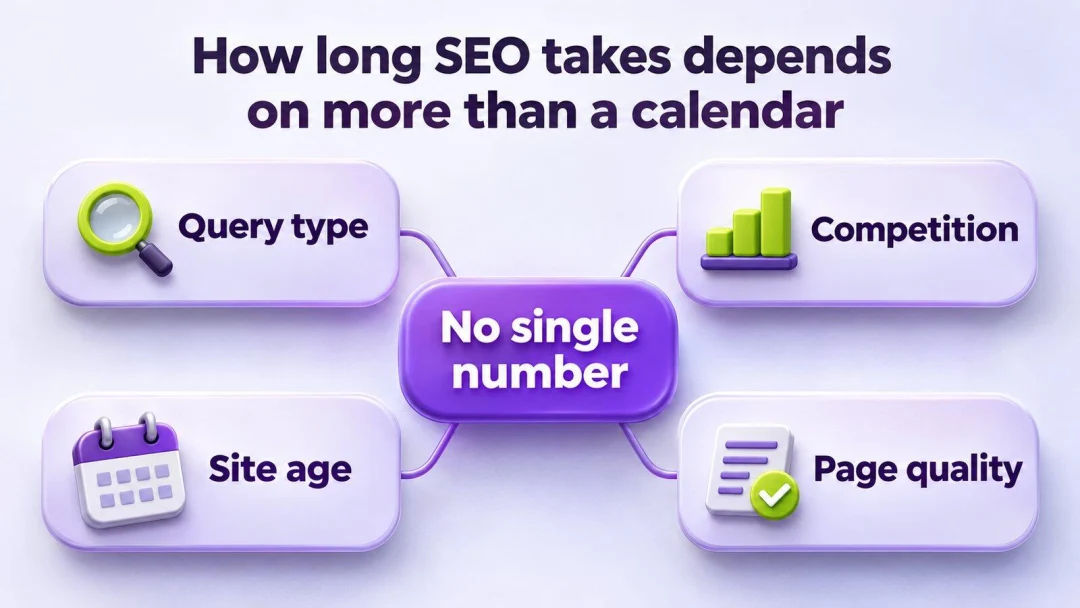
The honest answer: timelines vary by query (no single calendar)
There is no single number for how long does SEO take. A branded search for your business name can respond quickly once the site is indexed and consistent. A competitive commercial head term can sit for many months even with solid pages. Treating every query as if it should hit page one on the same schedule is how small teams burn out.
Think in layers:
- Query type (branded, local, informational, competitive commercial)
- Competition already ranking
- Site age, trust signals, and crawl health
- How clearly one page matches one primary intent
A two-year-old site with clear service pages and steady edits usually “feels faster” than a brand-new domain with thin stubs—even when both teams work the same number of hours. Age is not magic, but crawl history and consistent relevance help.
Studies show search systems reward useful, stable pages over one-off bursts. That is why “publish once and wait” feels slower than a steady cadence of clear pages and fixes. Your job is not to stare at a single national head term; it is to stack earlier wins while harder phrases mature.
Typical timelines by query type
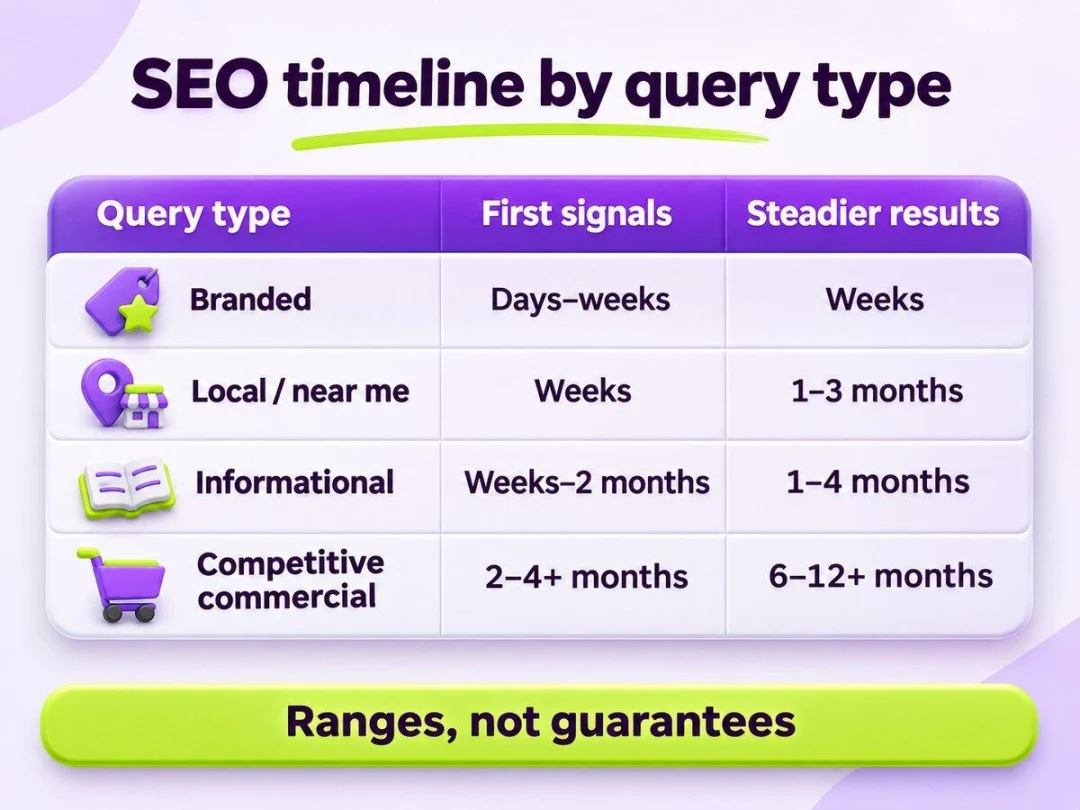
When people ask how long does it take to rank on Google, the useful reply is “for which kind of search?” Use the ranges below as orientation—not guarantees.
Branded searches (usually fastest)
If someone already searches your business name, product name, or unique service label, timelines are often measured in days to a few weeks after clean indexing: accurate titles, a clear homepage or about path, and consistent NAP-style facts on the site. Brand demand is yours; SEO mostly needs to stop getting in the way.
Local / “near me” style queries
Local-intent phrases for a real service area often show first useful signals in weeks to a few months when the site page matches the job and the business is findable nearby. For free local search steps, keep that work as its own layer—this article only flags that local queries usually move faster than national commercial heads, not how to manage every local channel.
Informational / blog topics
Guides and FAQs can earn impressions relatively early if the topic is specific and under-served. Steady clicks and “best URL for this query” status more often land in the 1–4 month window for realistic small-site topics—faster for narrow problems, slower for crowded how-tos.
Write for the question behind the query. A plumber’s “how to stop a running toilet” page that includes tools, safety notes, and when to call a pro usually outruns a vague “plumbing tips” post. Depth on one intent beats a thin series that repeats the same advice under five titles.
Competitive commercial terms (slowest for small sites)
Phrases like generic “best [service] [big city]” or broad category heads frequently need 6–12+ months of focused pages, internal support, and patience—sometimes longer when directories and national brands dominate. That is normal, not a sign you “failed SEO” in month two.
If how long to rank on Google for a head term is your only success metric, you will undervalue the local and problem pages that already pay the bills. Keep competitive heads on a longer track; fund them with supporting content and internal links only after the map says they deserve a dedicated URL.
| Query type | First signals (often) | Steadier results (often) |
|---|---|---|
| Branded | Days–weeks | Weeks |
| Local / near me | Weeks | 1–3 months |
| Informational | Weeks–2 months | 1–4 months |
| Competitive commercial | 2–4+ months | 6–12+ months |
Again: ranges, not contracts. A strong niche page can beat the slow end; a weak page on a hard term can sit past the long end.
What speeds SEO results up
You cannot buy a guarantee, but you can remove friction. These habits usually shorten how long for SEO to work on the queries you actually care about.
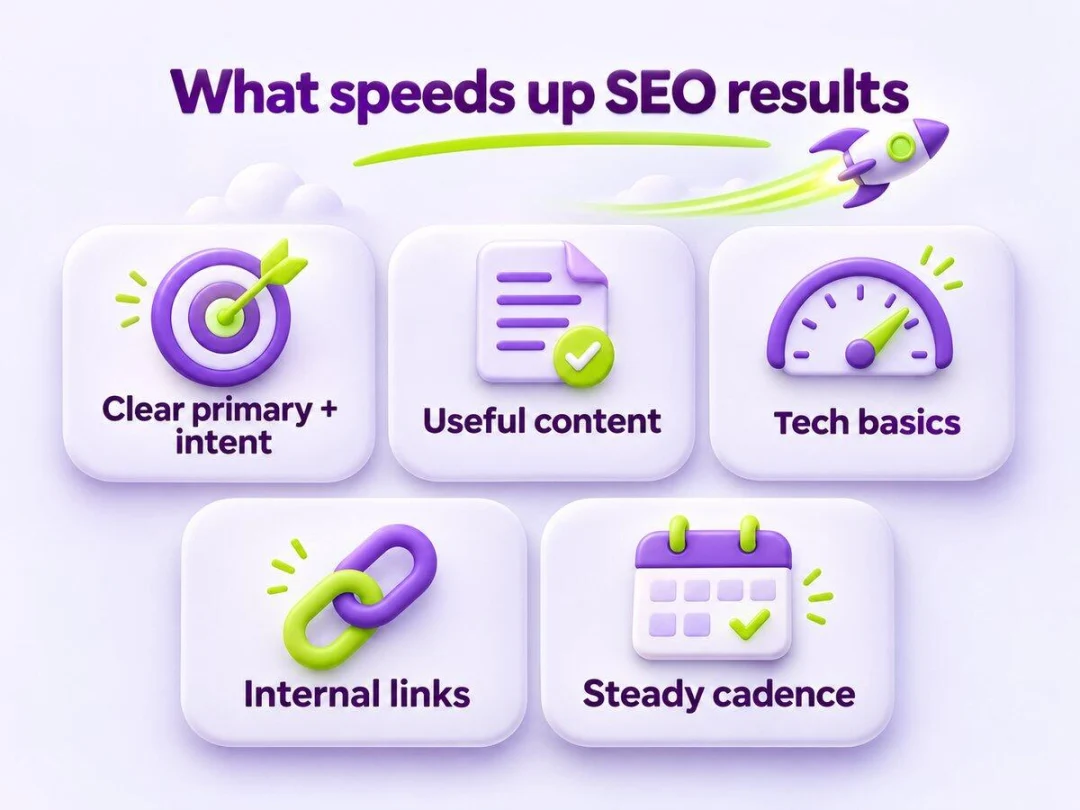
- Clear primary + intent on each URL. One main phrase, one job for the page. If you still need how to build a one-page keyword map, do that before writing five overlapping drafts.
- Useful content on money pages and guides. Answer the sub-questions a careful buyer asks; update thin pages instead of spawning duplicates.
- Technical basics. Pages index, load reasonably, and do not hide behind broken redirects. You do not need an enterprise audit to fix obvious crawl blockers.
- Internal links to important URLs. Point related guides and services at the pages that should win; orphan pages move slower.
- Consistency over spikes. A calm weekly cadence beats a one-weekend flood and three silent months.
For which SEO work to prioritize first, pick the accelerators that match your site’s weakest layer—map, money page, or crawl—not every tip at once.
What slows SEO down
The same clock runs the other way when the site fights itself.
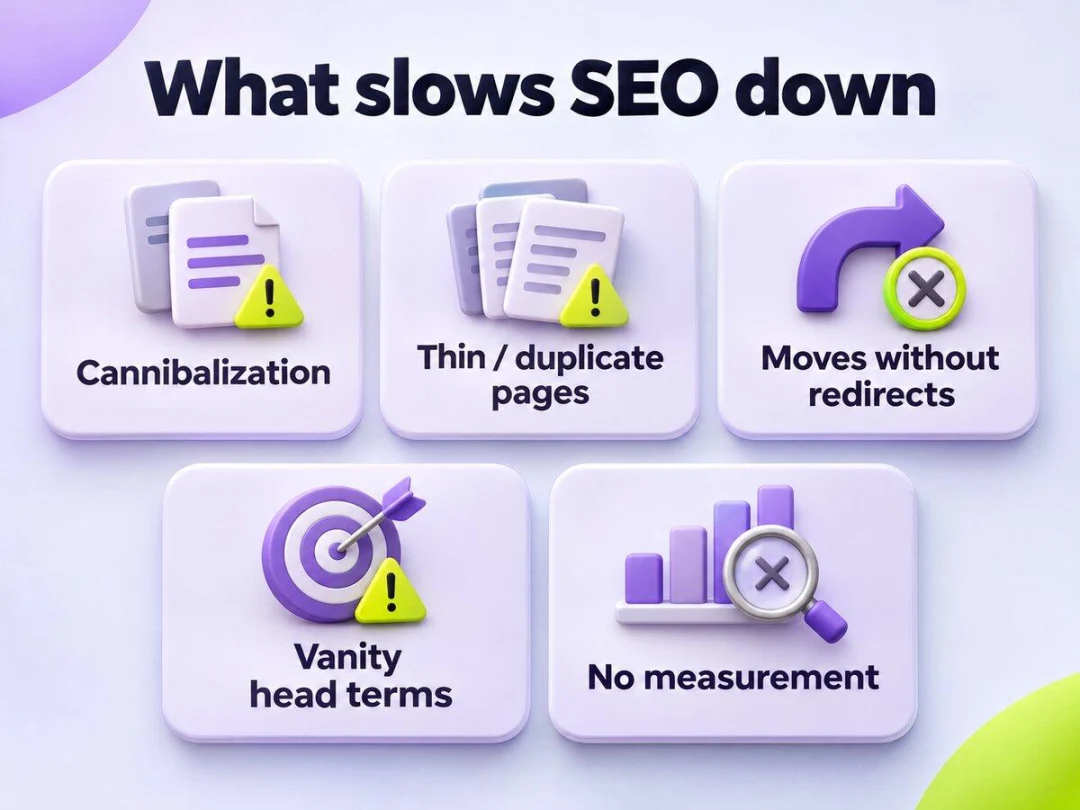
- Keyword cannibalization — two URLs chasing the same primary
- Thin or duplicate pages — near-copies that dilute trust and crawl attention
- Migrations without redirects — CMS moves, domain changes, or URL renames that drop equity overnight
- Vanity head terms — huge volume, wrong intent, or impossible competition for a small site
- Waiting without measurement — no Search Console review, so you cannot tell “slow but healthy” from “stuck”
- Rewriting the strategy every fortnight — constant URL and title churn prevents learning
Specific, buyer-language phrases often show movement earlier than ultra-broad heads. Treat that as a prioritization hint while you wait on harder terms—not as a separate deep-dive in this article. Patience only works when the page still matches the intent you chose in month one.
What to measure while you wait
Rank screenshots alone are a noisy scoreboard. Separate leading indicators from lagging ones so you know whether the system is learning your pages.
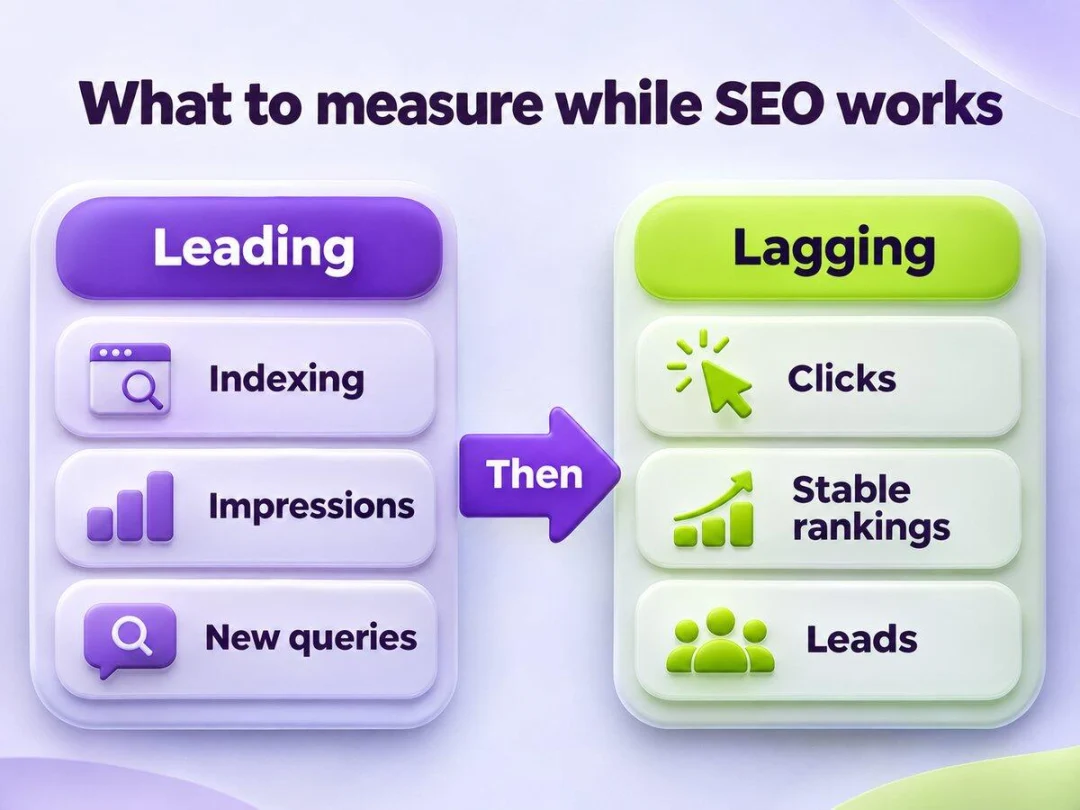
Leading indicators (impressions, queries, indexing)
In Google Search Console, watch whether target URLs are indexed, whether impressions rise for the phrases on your map, and whether new queries appear that match the page’s job. Early motion often shows up here before clicks feel “real.”
Also note coverage issues: excluded pages, soft 404 patterns, or a money URL that never appears in the index will make every timeline look worse than it is. Fix discovery first; then judge speed.
Lagging indicators (clicks, rankings for target URLs, leads)
Clicks, stable positions for the primary phrase on the chosen URL, and business outcomes (calls, forms, bookings) lag behind impressions. Judge them on a longer window—especially for competitive terms.
A practical rhythm for a busy owner: a 15-minute Search Console skim every week, and a deeper look at the keyword map every month. That is enough to see whether how long does SEO take to work on your list is trending healthier—without living inside reports.
If jargon like impressions, cannibalization, or intent still feels fuzzy, keep plain-English definitions of advanced SEO terms nearby while you read reports.
A realistic 90-day expectation check (not a 30-day rank guarantee)
Use ninety days as an expectation checkpoint, not a promise of page one. Do not confuse this with the week-by-week task list in the 30-day plan article—different job.
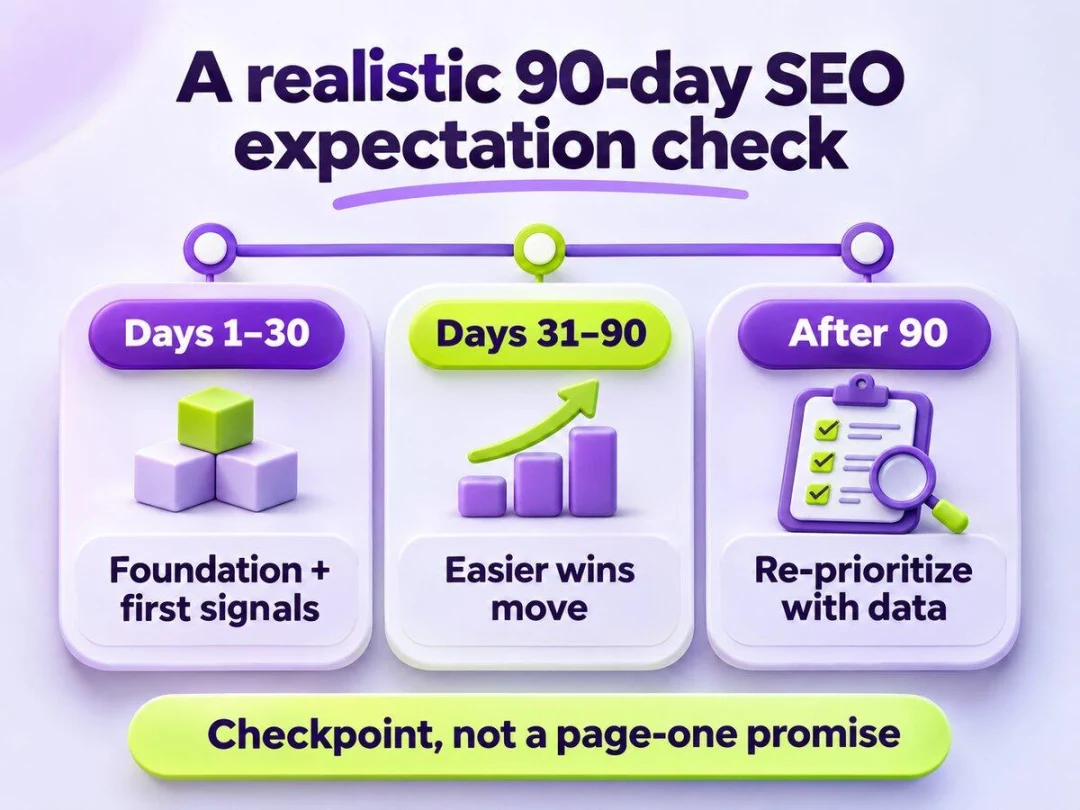
Days 1–30 — Foundation and first signals
Ship the map, fix the priority money page, clear obvious index issues, and publish only what the map supports. Success looks like indexing, early impressions, and a cleaner structure—not “we own the category.”
Days 31–90 — Movement on easier wins
Branded, local, and specific informational phrases are the ones most likely to show clearer movement. Competitive heads may still be warming up. Refresh titles and sections where Search Console shows impressions without clicks.
After day 90 — Re-prioritize with data
Keep what is rising, merge or redirect what cannibalizes, and decide which hard terms still deserve investment. Changing strategy every two weeks resets the clock; changing strategy after a measured 90 days is normal.
FAQ
How long does SEO take to work for a brand-new website?
New sites often need extra weeks just for discovery and trust. Expect branded and very specific phrases to move first; treat competitive commercial terms as a longer program. Foundation quality still matters more than posting volume.
How fast do local searches show movement?
Many local-intent queries show useful signals within weeks to a few months when the service page is clear and the business is relevant nearby. Competitive metro terms take longer. Ranges vary by city and niche.
Can SEO work in 30 days?
Owners often compress “how long does SEO take” into a single month because ads feel instant. You can complete meaningful work in 30 days—map, fixes, stronger pages. That is not the same as guaranteed rankings. First signals may appear inside a month; steadier results usually need a longer window, especially off branded queries.
Why do some keywords move faster than others?
Intent fit, competition, and how unique your page is all matter. Branded and specific problem phrases usually outpace broad commercial heads. Site-wide issues (duplicates, weak internals) slow everything.
What if I see impressions but no clicks yet?
That often means Google is testing your URL for the query but the title/snippet or page promise is not winning the click yet. Improve clarity before you abandon the phrase. Clicks lag impressions; panic is optional.
When should I change strategy instead of waiting longer?
Change when measurement shows a structural problem: wrong intent, cannibalization, no indexing, or a term you cannot win. Do not change only because a competitive head is still slow at day 45.
Set expectations, then do the next right task
How long does SEO take to work? Long enough that patience needs a plan—and short enough that weekly neglect shows up as “SEO never works.” SEO takes time, but time without a map, clear URLs, and basic measurement is just delay.
Next: keep a week-by-week SEO action plan for the tasks, use priority SEO tactics for smaller sites to choose what not to do yet, and refresh how to build a one-page keyword map when new services appear. Realistic timelines beat magical deadlines. Measure leading signals first, protect one primary per URL, and let harder commercial terms run on a longer track while easier wins fund the business.