
A slow store is invisible to an AI agent: how response speed decides whether you get the order
A shopper asks an AI shopping agent to find a product. The agent checks stores, compares prices, and places the order. Your store is on the list. The price is good, the item is in stock. And there is no order. You never find out about it: no rejection, no abandoned cart, just silence.
This is not a hypothetical scenario. It is the result of a real test published this week by founder Prince Singhal.
What the test showed
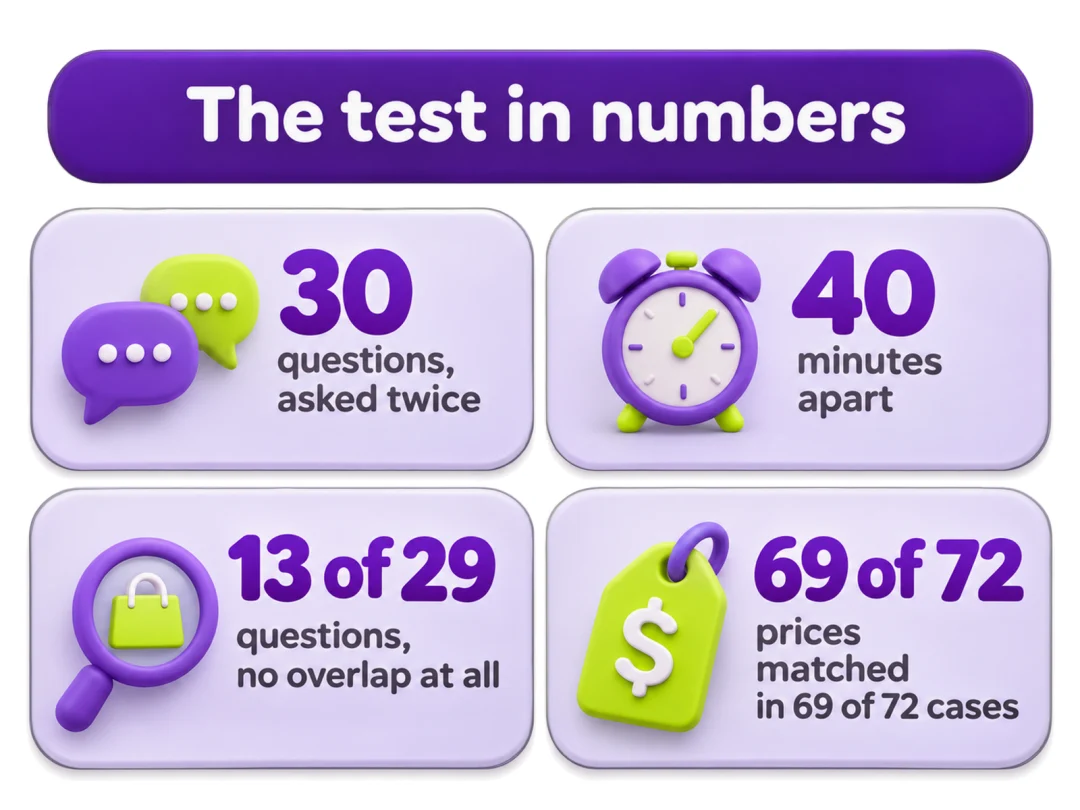
Singhal took OpenCommerce, an AI shopping service, and asked it the same 30 shopping questions twice, 40 minutes apart. The two identical requests barely matched: on average only 3 products out of 10 overlapped, and in 13 of 29 comparable questions there was no overlap at all. A search for Rolex returned 8 products the first time and one the second time.
Prices barely moved: they matched in 69 of 72 cases. Products did not sell out or get more expensive. The mix of answers changed.
His conclusion: slow stores simply timed out. Target, Best Buy, and eBay did not answer in time, so the agent skipped them. The owner of such a store sees no rejection and no drop in conversion in analytics. He only sees the absence of an order that was never placed.
Why an AI shopping agent does not wait
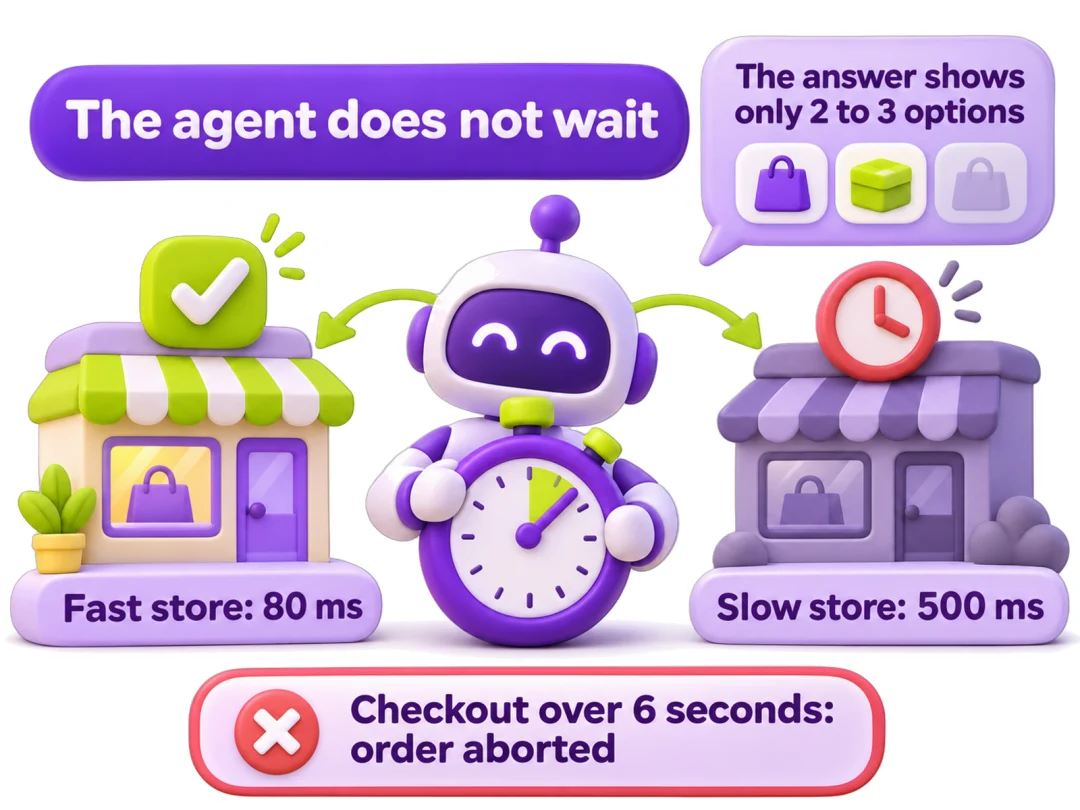
A person measures patience in seconds. An agent has a fixed time budget for the whole task. Based on 2026 practice, a full agent purchase takes 5 to 20 seconds: 8 to 15 seconds to search and compare, 5 to 10 seconds to place the order and confirm payment. If checkout takes longer than 6 seconds from cart submission to payment confirmation, the agent aborts and goes to a competitor it already checked.
The main difference from a person: the agent does not wait. It asks several sellers in parallel and takes the first complete answer. If your API answers in 500 milliseconds and a competitor answers in 80, the agent shows the competitor's product. Every time. And the answer shows only 2 to 3 options.
That leaves two separate filters that cost a store the order.
First filter: website loading speed
Based on pilot launches of Google UCP (Universal Commerce Protocol), sellers responding faster than 100 milliseconds appeared in recommendations 3 to 5 times more often than sellers responding in 300 to 500 milliseconds. If an endpoint takes longer than 300 milliseconds, the agent may skip the seller entirely.
Note what this means in practice. This is not a lower ranking, the way slow sites drop in SEO. It is removal from consideration. A slow store does not sit on page two. It is not in the answer.
Second filter: trust in the data
The agent skips products it cannot describe with confidence: no category, no GTIN, vague names, stale prices and stock, a hidden return policy. Every gap in the data is a chance to get it wrong. So the agent picks the store that left no gaps, and you never learn about the lost sale because it never touched your analytics.
The Walmart case shows how this plays out. Purchases inside ChatGPT converted three times worse than a click through to the company's own site. The reason that kept coming up: wrong data. Stock levels and delivery costs did not match reality, the agent could not trust the feed, and the shopper could not trust the agent.
The full fix for feed accuracy is a separate audit: AI Shopping Agents: Why Your Store Gets Missed.
This is already a channel, not a theory
AI traffic to US retail grew 62% year over year in July 2026 and converted 60% better than regular traffic. Those visitors brought 53% more revenue per visit and left pages a third less often.
And the channel is decided by the feed, not the page. On July 10, 2026, the share of product picks coming from integrated feeds in ChatGPT Shopping jumped from 8.26% to 61.54% in one week, while the number of unique sellers in answers fell from 13,524 to 10,607. Of 687 stores sampled, 450 lost at least a third of their visibility in seven days.
The standard that formalizes this is called the Universal Commerce Protocol, UCP. It is an open protocol from Google and Shopify, already joined by Etsy, Wayfair, Target, Walmart, Mastercard, and Visa. The idea is simple: a store gets a machine endpoint through which an agent reads the catalog, stock, and prices, and places an order without opening the site. The website becomes the secondary interface, and the endpoint becomes the main sales channel.
One honest caveat: the "3 to 5 times more often" figures and the 100 and 300 millisecond thresholds come from Google pilot data as retold by vendors who sell UCP solutions. Independent sources, Adobe and CMSWire, confirm the order of magnitude, but exact thresholds differ between agents.
Checklist for a store owner
What to check in your store, in order of importance.
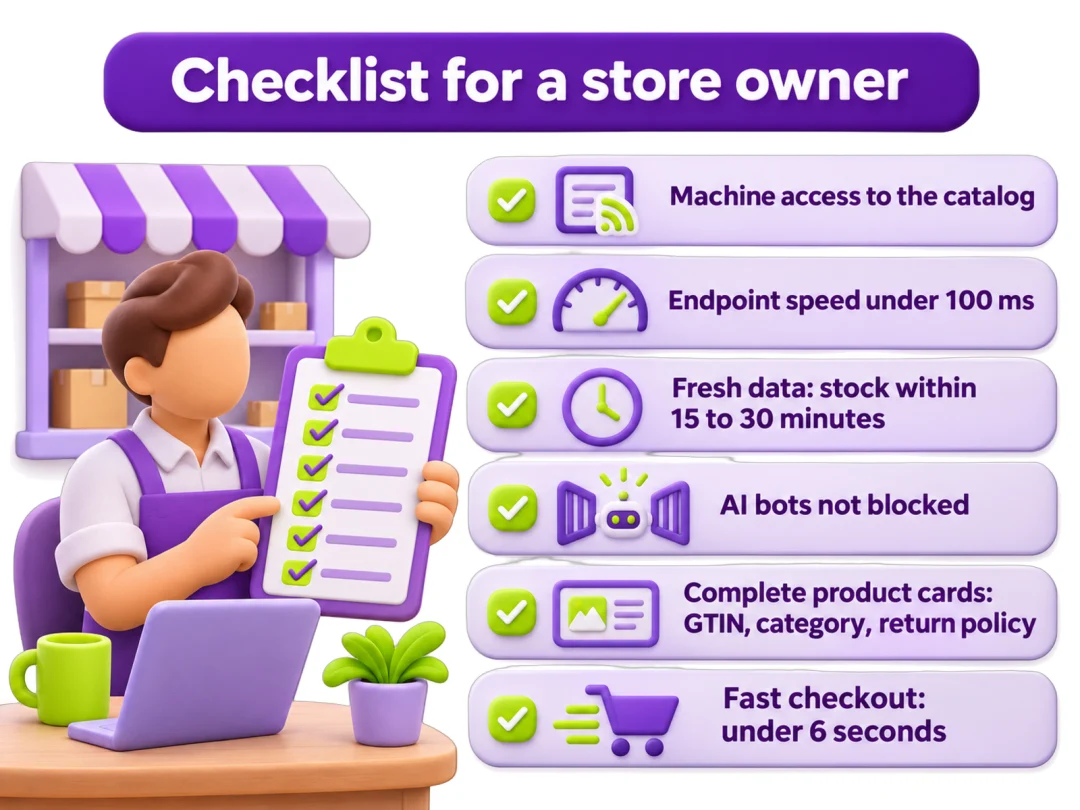
- Machine access to the catalog. A feed for OpenAI, Google Merchant Center, a UCP endpoint for Shopify. According to Adobe, up to 46% of some retailers' sites are unreadable to machines: the page looks fine to a person and returns an almost empty document to a bot.
- Endpoint speed and online store speed. Target: an answer faster than 100 milliseconds. Cache stock in memory, use edge caching, no chains of requests to the ERP on every answer.
- Fresh data. Stock should update within 15 to 30 minutes of a change.
- Do not block AI bots. Check robots.txt and Cloudflare or WAF rules: ChatGPT, Claude, and Perplexity bots are often cut off by accident, with no warning inside the company.
- Complete product cards. GTIN, category, attributes, variants, return policy in plain view, reviews and Q&A.
- Fast checkout. Under 6 seconds from cart to payment confirmation.
The takeaway
Ten years ago SEO was the same kind of new front: whoever got their site in order for Google first took the traffic. The same thing is happening now with AI agents, only harsher: in search a slow site drops lower, but with an agent it simply disappears from the answer.
A store's website loading speed is no longer a technical detail. It is a condition for existing in a channel that converts 60% better than the usual one. Whoever gets their store in order for agents first takes that traffic. The rest will only learn about it from the silence in their orders.