
CRM & Portfolio Website for Professional Artists
HugSales is an artist portfolio website with CRM for painters, printmakers, ceramicists, mixed-media makers, and studio artists who need clients and collectors to find them online—without living forever in Instagram Direct and scattered email. Showcase originals and prints on your own site, route inquiries into one client record, and keep commissions and sales moving in a modular workspace built around Website, CRM, and Finance—with Ads coming soon when you need growth tooling.
If you searched for a website for artists, an artist website builder, or CRM for artists and felt forced to choose “pretty portfolio” or “business software,” HugSales is built so those pieces share one client journey.
Focus on your art—run the studio in one place

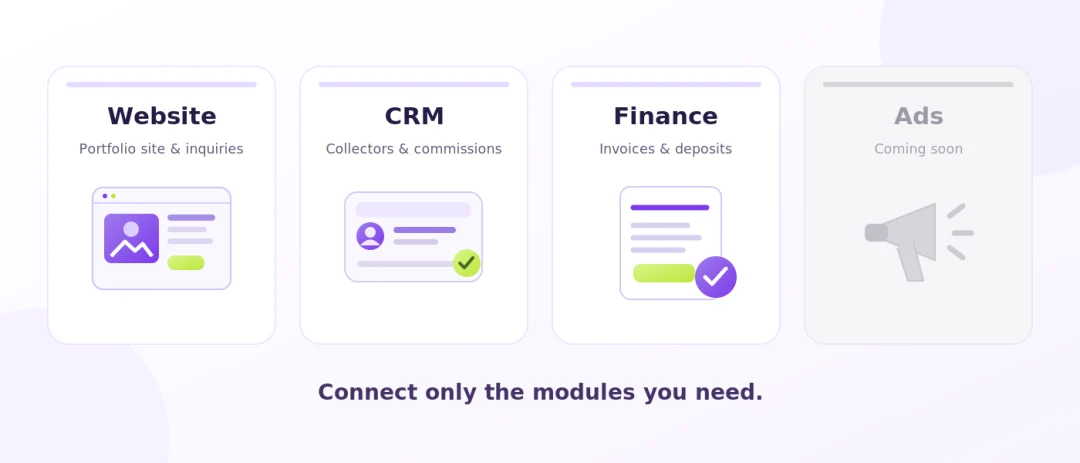
Artist business tools fail when “all-in-one” means clutter—or when the portfolio lives in one login and every buyer conversation lives in another. HugSales modules give you clear steps:
- Website — launch a professional portfolio site that showcases work and captures inquiries.
- CRM — keep collectors, commission briefs, notes, and pipeline stages in one hub.
- Finance — send invoices, take deposits, and use payment reminders when sales become routine.
- Ads — coming soon, for bringing new leads into the same pipeline you already run.
An art portfolio website alone rarely finishes the job if inquiries never become tracked clients. Whether you sell finished originals, limited prints, or custom commissions, the test is simple: can a visitor become a tracked inquiry, a paid deposit, and a delivered piece without leaving your system?
Studios that stitch a portfolio host, a separate inbox, a spreadsheet of “who asked about the blue painting,” and a third billing app often lose the thread at show season. One modular stack does not invent a new creative practice—it protects the path from first view to paid work.
Client CRM built for commissions and collectors
CRM for artists should feel like a studio file—not a generic sales funnel designed for SaaS demos. Collectors ask different questions than wedding clients; commission briefs need size, medium, timeline, and reference notes that must survive more than one chat thread.
Inquiries, notes, and commission briefs
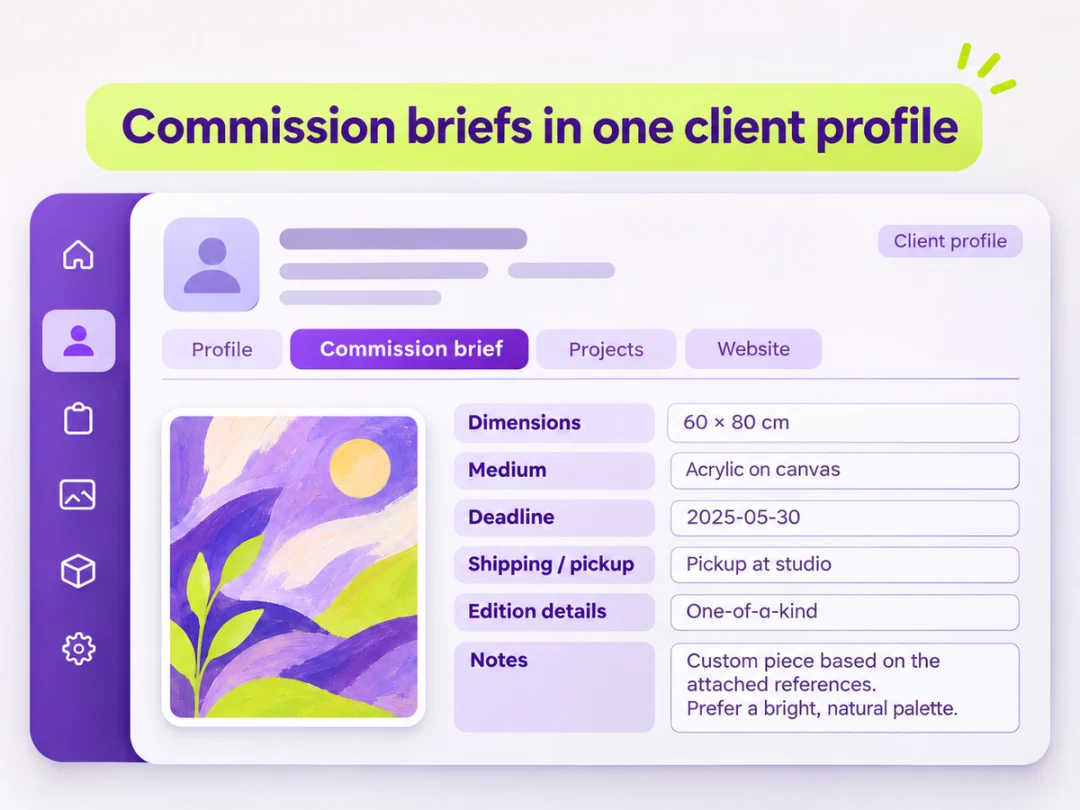
Keep inquiries, studio notes, and commission briefs organized in one profile. Capture what matters for the work—dimensions, medium, deadline, shipping or pickup, edition details for prints—so nothing lives only in Instagram DMs. Document workflows depend on how you store agreements in your workspace; we can walk through your process when you try the product.
Notes that travel with the client save you from re-asking the same questions after a fair or open-studio weekend. They also protect handoffs if an assistant helps with packing lists, shipping labels, or follow-up on unpaid deposits.
Pipeline from inquiry to delivery / sale
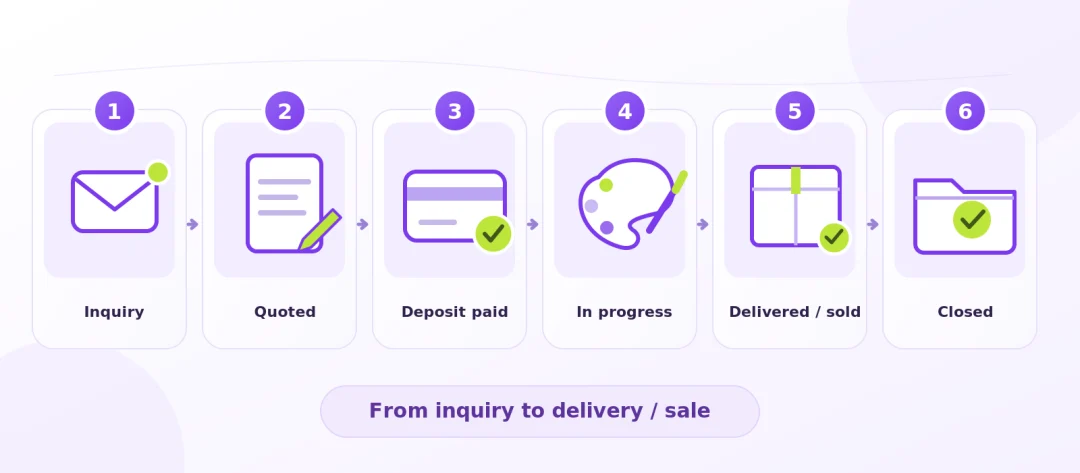
Track each collector or commission from first inquiry through consult, deposit, in-progress, ready to ship or pickup, and closed. Customizable pipeline stages make artist client management useful for real studio workflows—not just a contact list.
A short pipeline already beats a chaotic inbox: inquiry → quoted → deposit paid → in progress → delivered / sold → closed. Working artists also care about rhythm: inquiry week, studio week, finish week, ship week. A CRM that mirrors that rhythm reduces mental load when several pieces move at once.
Artist portfolio website that feeds your CRM
An artist portfolio website that feeds CRM is the HugSales differentiator: launch a professional portfolio site that showcases your work and routes inquiries into the same workspace. No-code launch with the Website module means you are not waiting on a separate web project while leads go cold. That Website module + CRM pairing is the heart of the HugSales stack for artists—closer to how photographers run sessions than to a marketplace listing alone.
Beauty without a pipeline still loses leads. CRM alone still needs a public face collectors can trust. Connecting portfolio and CRM is the practical middle path for artists who sell work, not software.
Showcase originals and prints on your own site
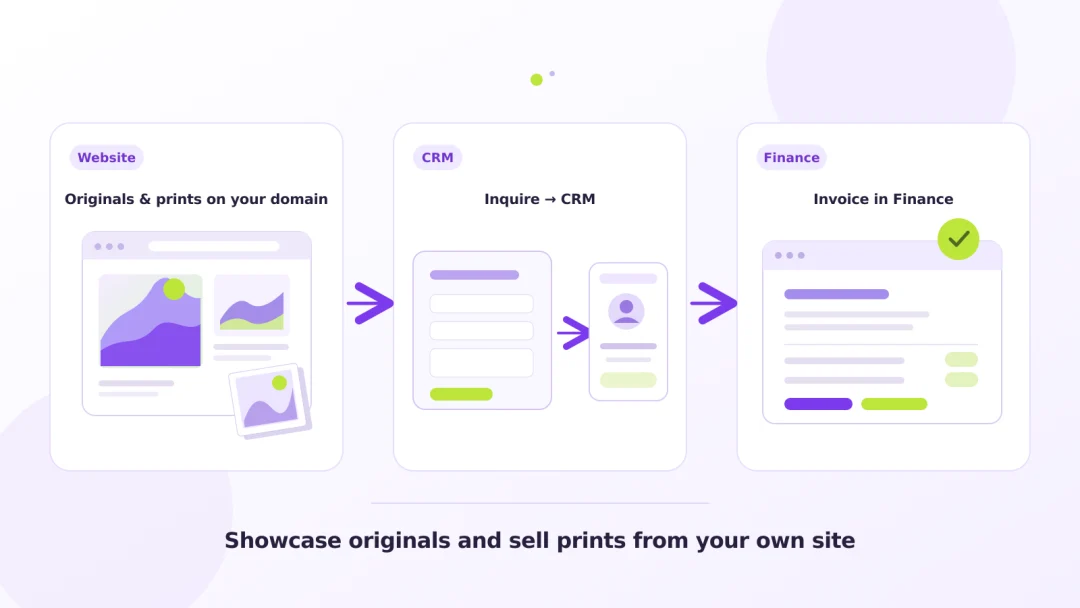
Owner studios often need both discovery and sales: available originals, open editions or limited prints, and a clear path from the website to a request—without sending every collector to a third-party shop first. On HugSales, that path stays on your owned Website:
- Publish pages for series, available works, and print options so searchers and returning collectors see what is available on *your* domain.
- Let inquire / interest forms land in CRM with the piece or series named—so “the large charcoal on the Prints page” is not a mystery email subject.
- When a sale is ready, use Finance on the same client record for invoices or prepayment (deposits) and payment reminders—the same invoice path photographers already use—instead of rebuilding the buyer story in another app.
Flow in short: works shown on the website → inquiry or request → invoice or prepayment via Finance. HugSales is not a full online store or marketplace replacement. Etsy, gallery consignment, and fair booths can stay optional channels. The product focus is your website for artists plus client records: owned presence, tracked conversations, and paid paperwork in one journey. We do not claim cart/checkout, deep art-inventory matrices, or gallery consignment accounting on this page—confirm fit when you try the product.
Also see how local service owners use HugSales for auto repair—same modular stack, different playbook.
Get found without duct-taping five tools
Searching “best website for artists” or “online portfolio for artists” often ends in a pretty template that never connects to how you actually sell. Soft, practical SEO on an owned site still matters: indexable pages for bodies of work, clear titles and descriptions, a sitemap, and a single client path from view → inquire → follow-up. A working artist portfolio website makes those pages easy to publish and keep current when a piece sells or a print edition closes.
HugSales helps you get found by giving you a real Website module instead of a disposable landing page—without turning this Solutions page into a local-SEO checklist. Keep NAP and listings consistent elsewhere if you use them; this page’s job is the product path: portfolio site + CRM (+ Finance when you invoice). Collectors who find you on search or a shared link still need a place to ask about a specific work; the Website module is that place, and CRM is where the ask becomes a record.
Many artists assemble stacks that mix a portfolio host, a separate CRM, and a billing tool. That can work—until a lead lives in three places and nobody knows which deposit was paid for which print edition. HugSales is built so the portfolio website and the CRM share the same client journey, then Finance deepens when you are ready.
Typical path: connect the Website module and CRM first; add Finance when deposits and invoices are weekly; add automations (and Ads when available—coming soon) when follow-up becomes the next bottleneck—not before billing works. Compared with stitching a portfolio host to a separate CRM and a third billing app, one stack cuts the failure modes that hide unpaid deposits and unanswered inquiries.
If you are evaluating tools after burning out on admin, start with the workflow you already know: how a lead becomes a conversation, how a deposit is collected, and how a piece is marked sold or delivered. Map those steps onto Website, CRM, and Finance before you add growth tooling. You still choose shipping carriers and packing methods; HugSales covers the business spine.
Painting, printmaking, ceramics, illustration, and mixed media share different studio habits—but the business spine rhymes: inquiry, consult, deposit, make or allocate, deliver, get paid. HugSales is built around that spine so you spend less energy reinventing admin every show season. Open-studio weekends, fair rush, and holiday print drops are exactly when fragmented tools fail hardest.
Commission-heavy studios benefit from briefs that survive more than one conversation; print-led studios benefit from edition clarity on the site and matching notes in CRM. Fair weekends and open-studio days amplify the same pattern: several people ask about different pieces in a short window, and each ask needs a named work, a follow-up, and—when ready—an invoice or deposit on the same client record. If an assistant helps with packing or shipping, shared notes cut re-asking. If you already use a specialized inventory tool for edition tracking, you can keep it alongside HugSales while Website + CRM handle discovery and conversations—confirm overlaps when you try the product.
Studios that sell both originals and prints often split attention between “is this piece still available?” and “which edition number did we reserve?” Keeping the public pages honest on the Website module and the private details in CRM reduces crossed wires without turning HugSales into a marketplace or a full online shop.
Invoices and deposits when you are ready
Artist invoicing belongs next to the client record—not in a separate login you forget to open after packing a crate. Send invoices, collect deposits before a large commission starts, and use payment reminders so creative work is not paired with an awkward money chase. Finance deepens invoicing and deposits when you need them; Website + CRM cover the foundation.
Deposits protect your calendar for custom work. Clear invoices protect the relationship when a collector buys an original or a set of prints. When booking-style scheduling is not your model, the same Finance tools still close the loop on one-off sales and staged commission payments.
You can start without Finance. Many studios begin with Website + CRM until inquire volume and sales paperwork justify the next module. There is no requirement to name packages on this page—only modules you actually use.
FAQ
Is HugSales only a portfolio host?
No. The Website module is built to feed CRM so inquiries become tracked clients and collectors—not a pretty gallery or a portfolio-only template that still dumps every message into a personal inbox. Presentation alone stops at the page; an artist portfolio website paired with CRM (and Finance when you are ready) keeps the client story in one place.
Do I need a separate website builder?
HugSales includes the Website module for an artist portfolio site. Complex custom builds can be discussed when you try the product. For most working studios, the goal is a clear online portfolio for artists that already talks to CRM.
Is this a CRM for artists or an artist website builder?
Both pieces of one path: public portfolio (and pages for originals and prints) plus a client pipeline. Search volume for “crm for artists” is niche; the product still connects both because that is how studios lose money when they do not.
Can I sell originals and prints online with HugSales?
You can show works and prints on your owned Website module, take inquiries or requests into CRM, then send invoices or collect prepayment through Finance on the same client record—similar to how photographers handle deposits. This is not a full e-commerce online store (no cart/checkout promise here). Marketplaces stay optional. Confirm what ships today when you try the product.
Can I start without invoicing?
Yes—Website + CRM first; add Finance when deposits and invoices are routine.
Do you replace gallery marketplaces?
No. Focus: owned site + client records. Marketplaces and galleries can remain parallel channels.
Where is pricing?
Shared when you try the product or on an approved pricing page—not listed here.