
30-Day SEO Plan for Small Business: A Week-by-Week Checklist
Most small businesses do not fail at SEO because they ignore it. They fail because work arrives as random tips: rewrite a title today, chase a directory tomorrow, panic about a new tool next week. A clear plan fixes that: what to finish in week one, what waits until week three, and how to know you are done.
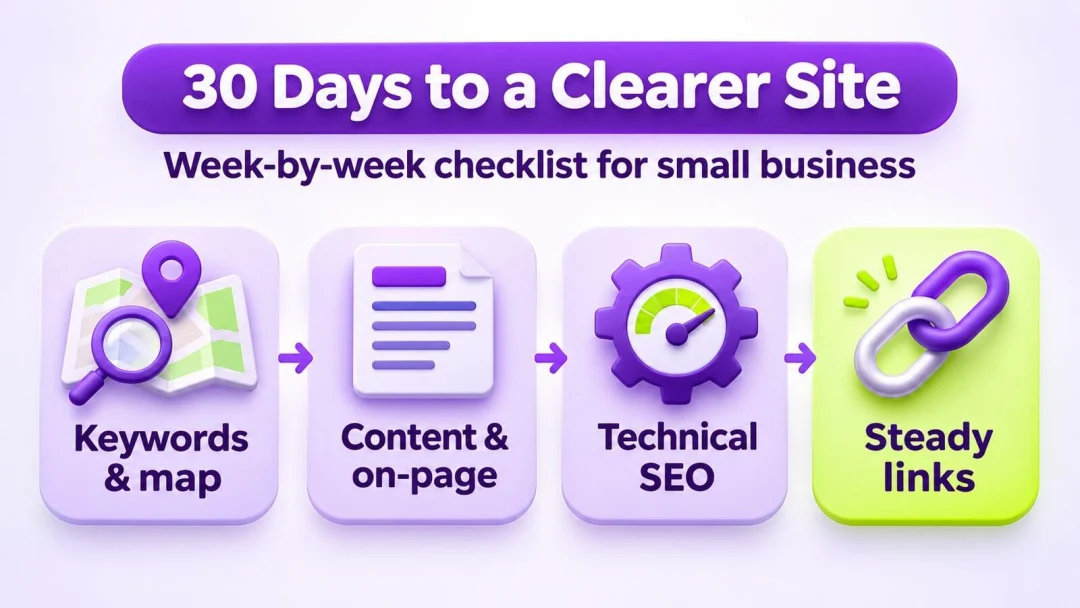
This article is a 30-day SEO plan—a week-by-week seo checklist and seo roadmap you can run in roughly three to six hours a week. By day 30 you should have four artifacts: a keyword/topic map, one or two stronger money pages, a cleaner technical baseline, and a short link log with a next-month cadence.
If you need help choosing which SEO work matters first for a smaller site, read our guide on which SEO work to prioritize first. If your customers search “near me” and you need free local search steps, keep that as a separate layer—this plan stays on the website calendar.
Why a fixed 30-day calendar beats random tactics
An seo action plan with a fixed horizon beats an endless “optimize everything” list: you ship artifacts (map, pages, crawl hygiene, link log), you protect focus when you only have a few hours, and you reuse the same cycle on the next cluster of pages.
Keep one primary query per URL, write weekly outcomes down, and paste the final recap into a spreadsheet you can reuse.
Week 1 — Keywords, competitors, and your topic map (Days 1–7)
Week 1 is foundation work. Skip it and every later page fights itself for the same vague phrase.
Find low-competition keywords your buyers actually use
Start with how customers ask for help, not how you brand services. A cafe might love “espresso bar downtown,” but buyers type “quiet laptop cafe near me.” A plumber hears “water heater not heating” more often than the formal service name.
Aim for extremely low-competition phrases first—queries where a focused page can realistically appear. Studies show long-tail, specific searches convert better for local services because intent is clearer. Collect 15–30 candidates from recent calls and chats, autocomplete ideas (service + city or problem), and your own FAQ. Mark each as informational, commercial, or transactional. That backlog is for the month—not for ranking everything by day seven.
Quick competitor snapshot (not a 40-hour audit)
Open the top results for your five most important queries. Skim three to five competing pages per query—enough to see patterns, not a full industry teardown. Week 1 should stay light.
For each page note the title/H1 promise, which subtopics get H2s, whether objections are answered (price range, timeline, service area, parking), and what you can cover more specifically. A salon comparing “balayage appointment” pages might notice every competitor lists aftercare, but none show real before/after with process steps—that gap becomes your outline.
Build a one-page topic / keyword map
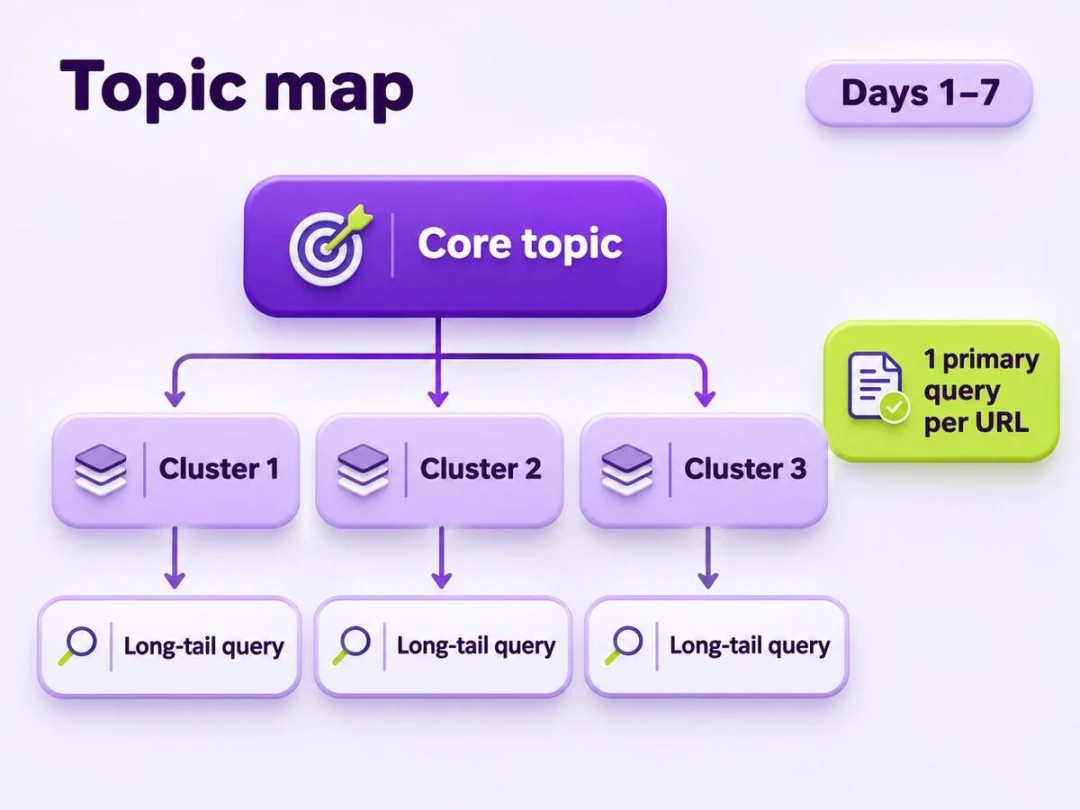
Turn research into a map: one core topic for the business (or for a service line), then clusters (service types, problems, audiences), then long-tail queries under each cluster. Rule that saves months of pain: one primary query per URL.
| Query | Intent | Target URL | Priority (1–3) |
|---|---|---|---|
| emergency drain cleaning [city] | transactional | /services/drain-cleaning | 1 |
| how to stop a slow kitchen sink | informational | /guides/slow-kitchen-sink | 2 |
| water heater repair vs replace | commercial | /services/water-heater | 1 |
Week 1 exit: a one-page table query → URL → intent → priority. That table is the core of your seo plan for month one—in spreadsheet form.
Week 2 — Content and the on-page SEO checklist (Days 8–14)
Week 2 turns the map into pages people (and search) can trust. Pick one or two priority URLs—usually a main service or category page—and finish them before starting five half-drafts.
Match semantics to the page (search intent, not stuffing)
Semantic coverage means answering the subtopics a careful reader expects—not repeating the same phrase. If the query is “kids haircut downtown,” cover ages, wait times, first-visit tips, pricing style, and how to book—without forcing the exact keyword into every sentence. Use competitor notes as a coverage list, then add what only you know: real photos, how appointments work, what to bring.
On-page SEO checklist
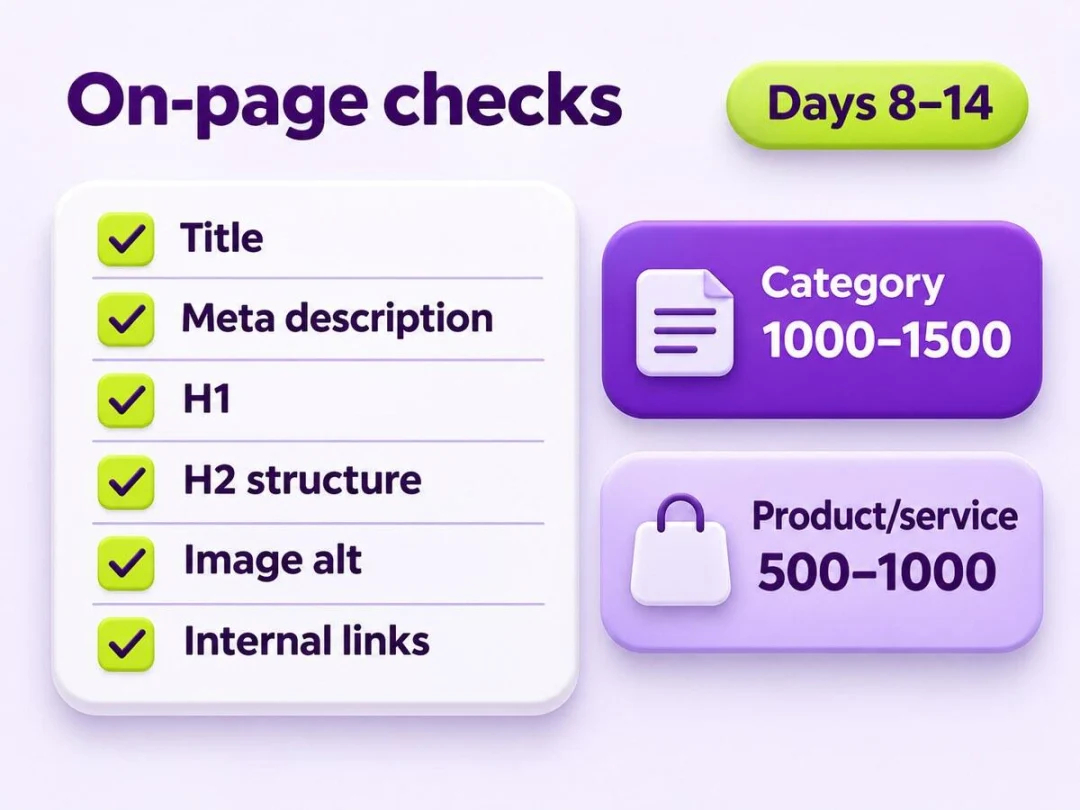
Run this list on every URL you touch in week 2:
- Title: primary idea near the front; readable; unique on the site
- Meta description: one clear benefit + who it is for; invite the click without hype
- H1: one H1 that matches the page promise (not a slogan-only line)
- H2/H3: real sections a human would skim
- Image alt: describe the image in plain language; skip keyword stuffing
- Internal links: link to related services, FAQs, and contact paths with natural anchors
How long should pages be?
Length is a floor for usefulness, not a contest:
- Category, service hub, or pillar pages: at least 1000 words, about 1500 when the topic needs examples, process, and FAQs
- Product, SKU, or single-offer pages: at least 500 words, about 1000 when specs, care, and objections matter
A cafe’s catering hub can earn ~1200 words with menus-by-occasion and lead times. A pastry product page can win with ~600 honest words: ingredients, allergens, storage. Cut fluff; keep answers.
Week 2 exit: one or two money pages updated to the checklist, with lengths in the ranges above.
Week 3 — Technical SEO checklist (Days 15–21)
Content without a healthy crawl stalls. Treat week 3 as a light seo audit checklist focused on crawl and speed—enough for an owner, not an enterprise program. The section below is your technical SEO checklist.
Page speed target: under 2 seconds on key templates
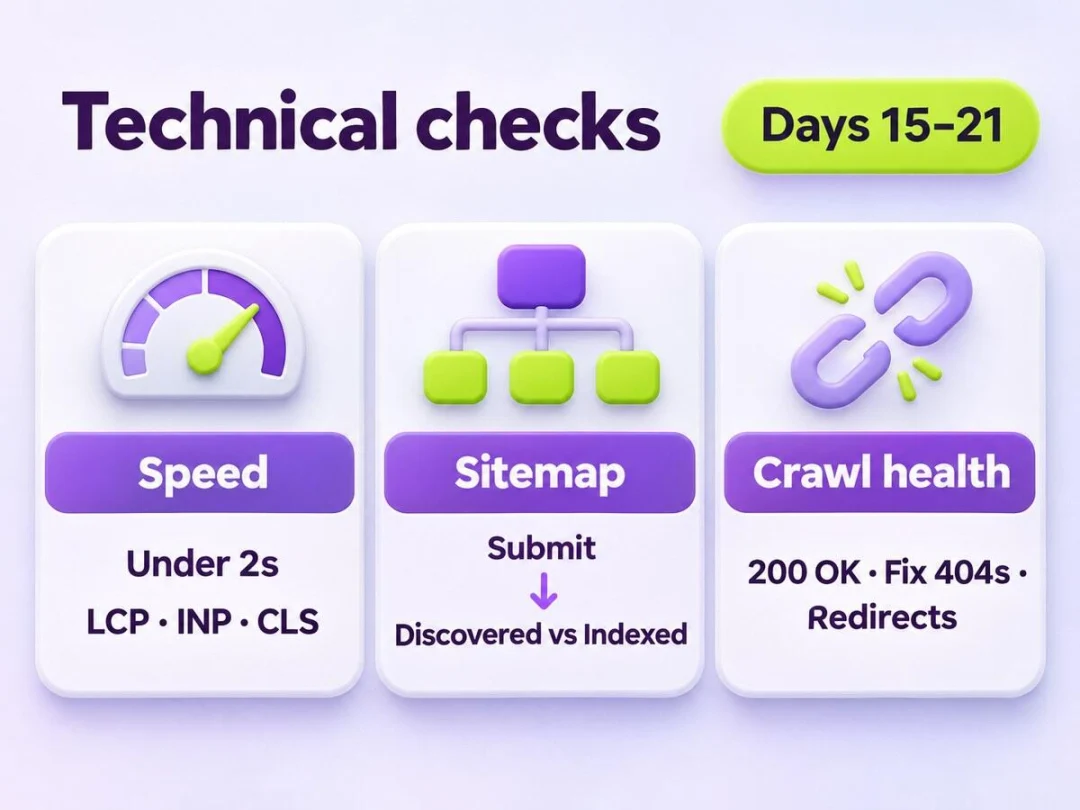
Aim for key templates (home, main service, contact) to feel fast—under about two seconds to meaningful content. In plain terms: LCP (main content appears quickly), INP (taps respond), CLS (layout does not jump). Compress phone photos, lazy-load below-the-fold media, and avoid stacking chat widgets. Test on your phone during real traffic.
Submit and verify your sitemap in Search Console
In Search Console, submit sitemap.xml (or confirm it is already there). Compare discovered versus indexed. A large gap on important URLs is a week-3 problem: thin pages, noindex accidents, robots blocks, or soft-404s.
Read crawl / indexing signals; fix 404s and soft-404s
Where you can, check logs for Googlebot hitting critical URLs with 200 responses. Never publish a page, then delete it with no redirect—that creates 404s that waste trust and crawl time. Fix broken internal links, add 301s from old URLs, resolve soft-404s, and collapse duplicate contact or service URLs.
Week 3 exit: sitemap accepted; no critical 404s on money URLs; speed issues on key templates noted and at least partly fixed.
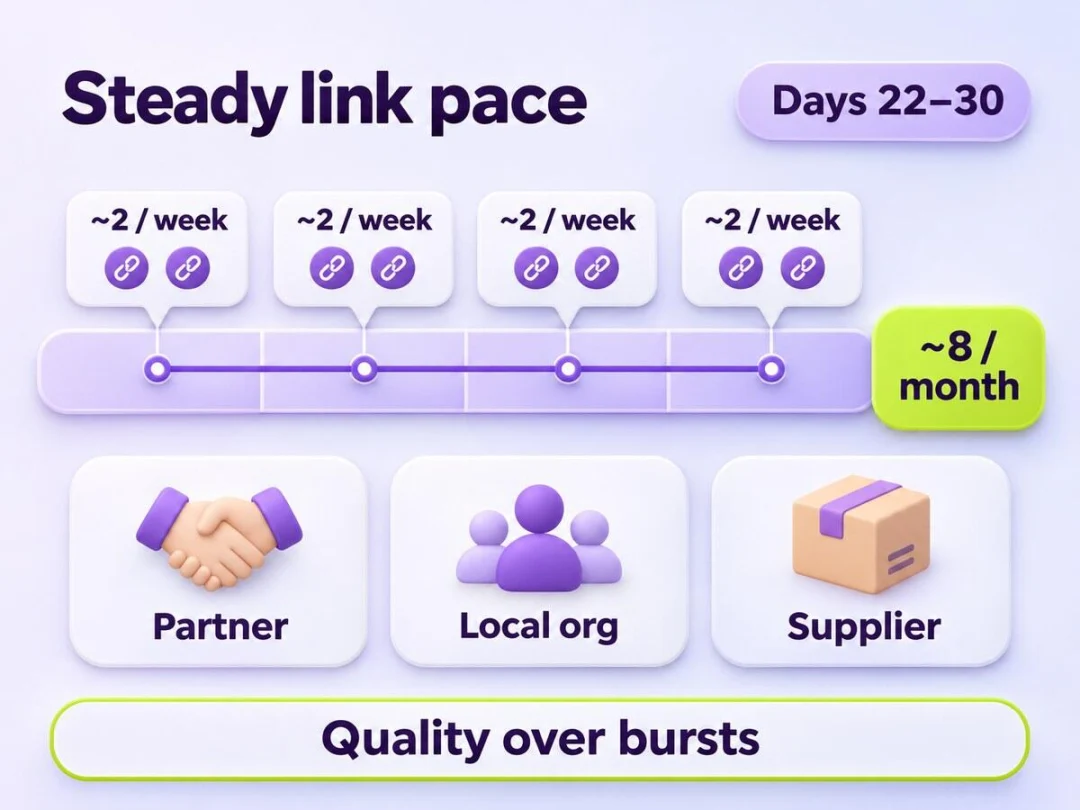
Week 4 — Links at a steady pace (Days 22–30)
Week 4 is off-page work without schemes. Mentions and links still help discovery—including in AI-assisted answers—when they come from relevant places at a human pace.
Diversify the profile
Mix types: partner referral pages, a chamber or association listing you already belong to, supplier mentions, a genuine tip on a non-competing local blog. Skip PBNs, link farms, and “500 directories overnight” offers.
Anchor text without exact-match spam
Keep anchors readable. A practical mix many teams aim toward looks roughly like:
| Anchor type | Rough share | Example |
|---|---|---|
| Branded | ~45% | Your business name |
| Naked URL | ~25% | yourshop.com (full URL, no extra words) |
| Generic | ~20% | “learn more”, “this plumber”, “website” |
| Exact match | ~3% (minimal) | the precise money keyword |
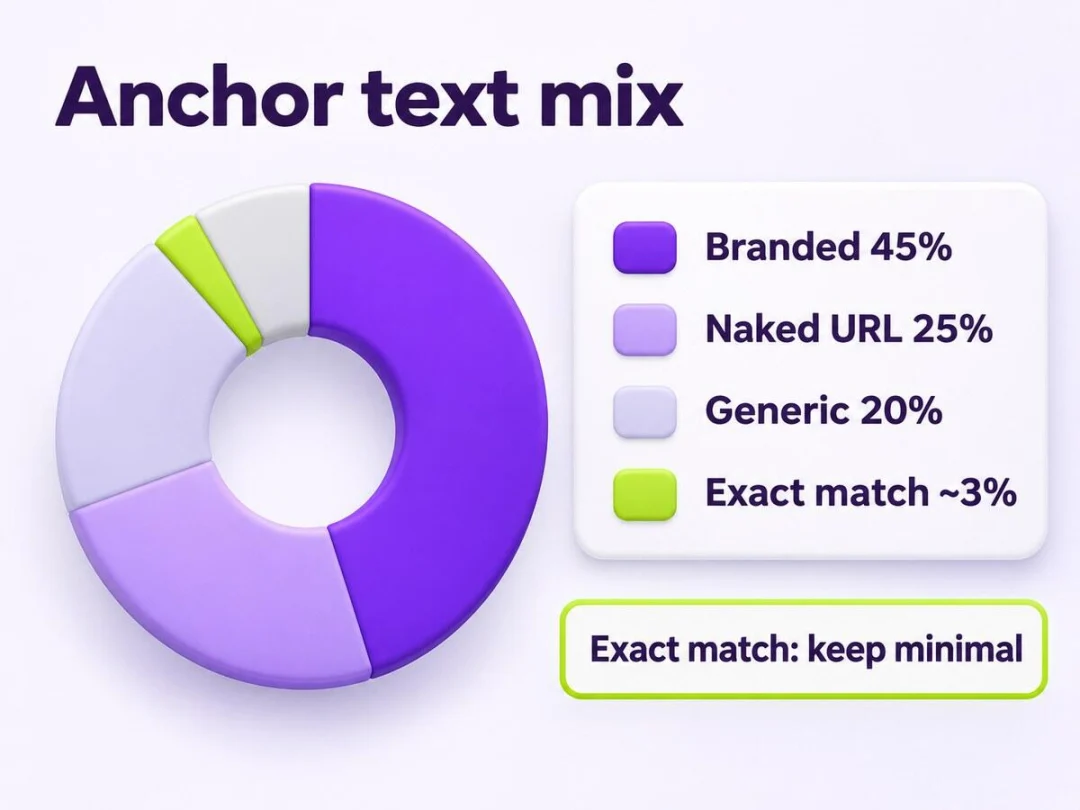
Exact-match anchors are not banned, but stuffing them looks like spam. Prefer brand and natural phrases; let the page carry the keyword.
Pace: few quality mentions beat a junk burst
Think steady velocity—about eight quality links in a calm month is a useful planning example, not a quota to buy. Two real partner mentions beat twenty directory dumps.
Week 4 exit: a link log (URL · date · anchor type · notes) and a simple next-month cadence (who you will ask, which asset they can cite).
Your reusable SEO plan template (one-page recap)
Use this one-page recap as your reusable seo checklist—the printable small business seo checklist for each new cluster:
| Week | Focus | Done when… |
|---|---|---|
| 1 | Keywords + topic map | Table: query → URL → intent → priority |
| 2 | Content + on-page | 1–2 money pages pass the on-page checks; lengths in range |
| 3 | Technical | Sitemap OK; money URLs return cleanly; critical 404s fixed |
| 4 | Links | Link log started; anchor mix sane; next month’s asks listed |
That table is the whole month in one screen. Copy it into a sheet, add owners and dates, and you have a reusable calendar for the next cluster of pages.
FAQ
How long should this 30-day calendar take each week?
Plan on three to six hours a week. Week 1 is research-heavy; week 2 is writing; week 3 is fixes and checks; week 4 is outreach. If you only have two hours, keep the same order but finish fewer URLs—depth beats unfinished breadth.
What is the difference between an SEO plan and an SEO checklist?
A plan is the calendar and the outcomes (what happens in which week, which URLs, what “done” means). A checklist is the repeatable inspection list inside a week (title tags, sitemap, anchors). You need both: the plan sets sequence; the checklist prevents skipped basics.
Can I skip technical SEO if my site “looks fine”?
No. A pretty page that returns errors, loads too slowly on mobile, or never enters the index will not perform. Week 3’s technical pass is the minimum insurance for the content you just improved.
How many keywords should I target in the first month?
Target one primary query per URL, and prioritize a small set of money pages—often three to seven URLs for month one. Collect more ideas in the backlog; do not assign twenty primaries to twenty thin pages in thirty days.
Is exact-match anchor text bad for link building?
A little natural exact-match is fine. Making most links exact-match is risky and looks artificial. Keep exact-match minimal (around a few percent) and lean on branded, naked URL, and generic anchors.
What should I measure on day 30?
Measure artifacts and hygiene first: map complete, pages updated, sitemap healthy, 404s on money URLs cleared, link log started. Then glance at Search Console for impressions on the URLs you touched. Rankings move slower than thirty days; process completion is the honest month-one scoreboard.
What to do after day 30
Repeat the cycle on the next priority cluster. Keep the same weekly rhythm: map → pages → technical pass → steady links. Revisit priority SEO tactics for smaller sites when you need to choose the next bet, and use getting found nearby without ad spend when the local layer needs its own sprint.
Thirty days will not finish SEO. They will finish a system you can run again next month.