
10 Advanced SEO Terms Explained for Small Business
Search advice is full of shorthand. An agency deck drops language-version tags and “link equity,” a tool flags “crawl depth,” and a vendor swears by “SERP features.” None of that helps if you run a clinic, an online shop, or a service business and still need a clear seo glossary—not another endless how-to.
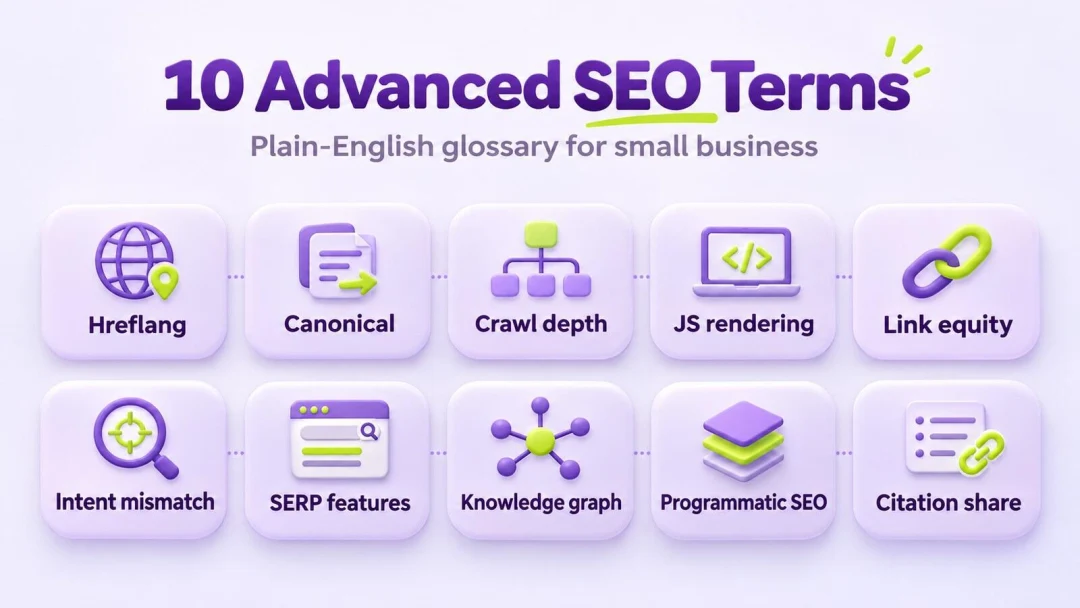
This article is a dictionary of 10 advanced SEO terms in plain English. For each term you get a short definition, why a small-business owner should care, and one practical rule. It is not a work calendar and not a ranking of tactics. When you need priority SEO tactics for smaller sites, open that guide. When customers search nearby and you want free local search steps, keep that as a separate layer. When you are ready to turn vocabulary into a calendar, use a week-by-week SEO schedule.
Why these SEO terms matter (and how to use this glossary)
Learning SEO terms is useful when a report, a developer, or a freelancer uses jargon you have to approve. A shared vocabulary cuts expensive miscommunication: you can ask “is this a crawl-depth problem or an intent mismatch?” instead of nodding through a fog of acronyms.
Use this seo glossary as a reference card. Read the term you just heard, check the “without / with” contrast, then decide whether it applies to your site size. Skip anything that only matters after you have multi-country pages, heavy JavaScript apps, or large template libraries.
A clinic, a shop, and a service van meet different jargon at different times. The clinic hears about language versions when it opens a Spanish booking page. The shop hears about canonicals when ads append tracking parameters to every product URL. The service business hears about crawl depth when a new “areas we serve” section buries the phone number three menus down. The glossary below is ordered so you can skim for the term you just heard—and ignore the rest until your stack needs it.
One more boundary: this page explains labels. It does not replace a technical audit, a content calendar, or a local-pack sprint. When a term points to deeper work, follow the internal link to the article that already owns that angle on this site.
Hreflang — showing the right language and country version
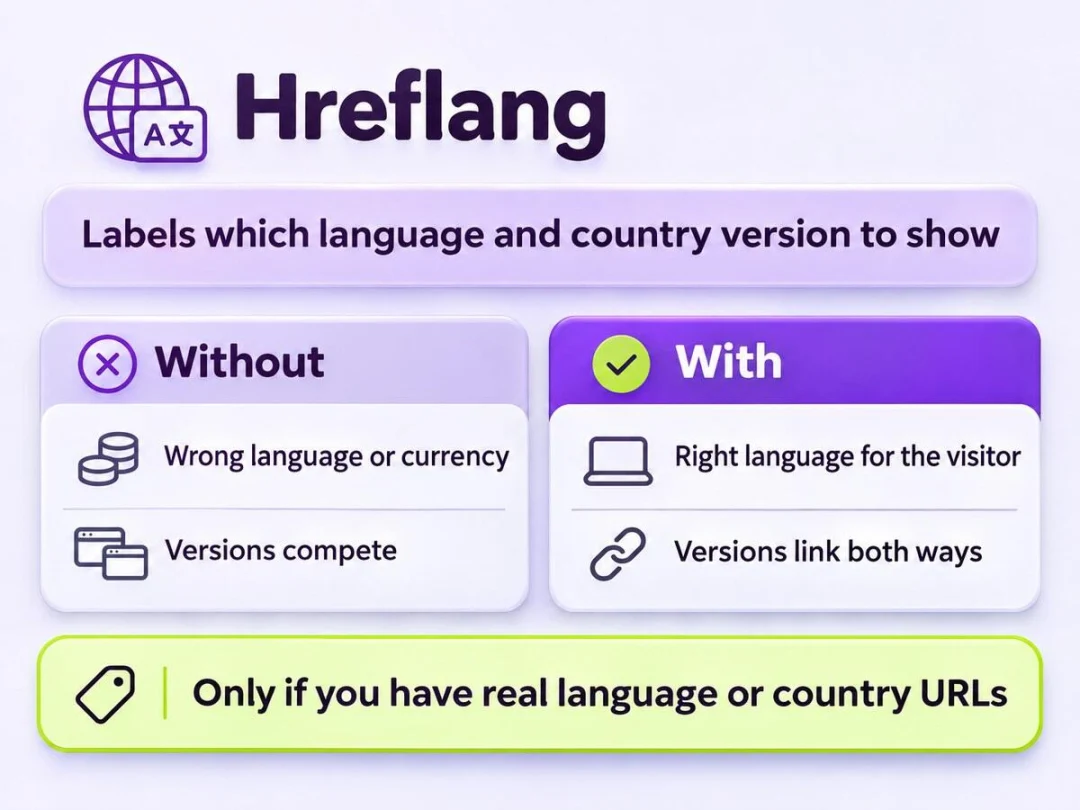
Hreflang is a set of signals (usually HTML link tags) that tell search engines which language and region version of a page should appear for a given user. Think of it as a polite label: “this URL is for Spanish speakers in Mexico; that one is for Spanish speakers in Spain.”
Without: A US dental clinic with a Spanish mirror and a separate Canadian English site can show the wrong currency, phone format, or booking rules. Language versions also compete with each other for the same queries.
With: Each version points to its siblings (and to itself). A patient in Mexico sees MX prices; a reader in Spain sees ES content. Versions reinforce each other instead of fighting.
Rule: Add these tags when you truly serve multiple languages or countries with distinct URLs. A single English US site does not need them—skip the complexity until you launch a real /es/ or country mirror.
Canonical tag — picking the one real URL
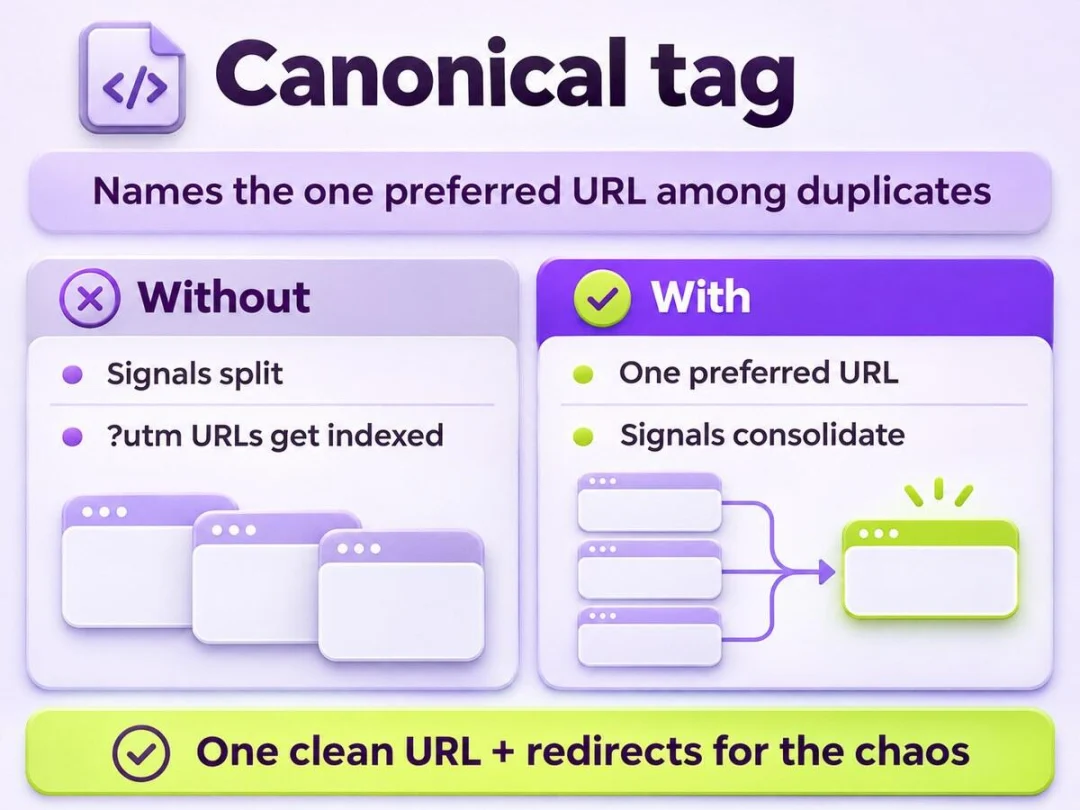
A canonical tag names the preferred URL when several addresses show the same or nearly the same content. Tracking parameters (?utm_…, ?ref=), http vs https, and trailing-slash variants often create duplicates. The tag says: “index this one; treat the others as copies.”
Without: Search engines guess. Ranking signals split across variants, and parameter URLs sometimes get indexed. Reports look noisy because the same page appears under three addresses.
With: Signals consolidate on one canonical URL. Your analytics and Search Console views stay cleaner because the preferred address is explicit.
Rule: Pick one clean URL pattern per page, set the canonical to that URL on every duplicate, and fix obvious http/https or slash chaos with redirects—not with tags alone. A canonical is a hint, not a substitute for cleaning your site structure.
Crawl depth — how many clicks from the homepage
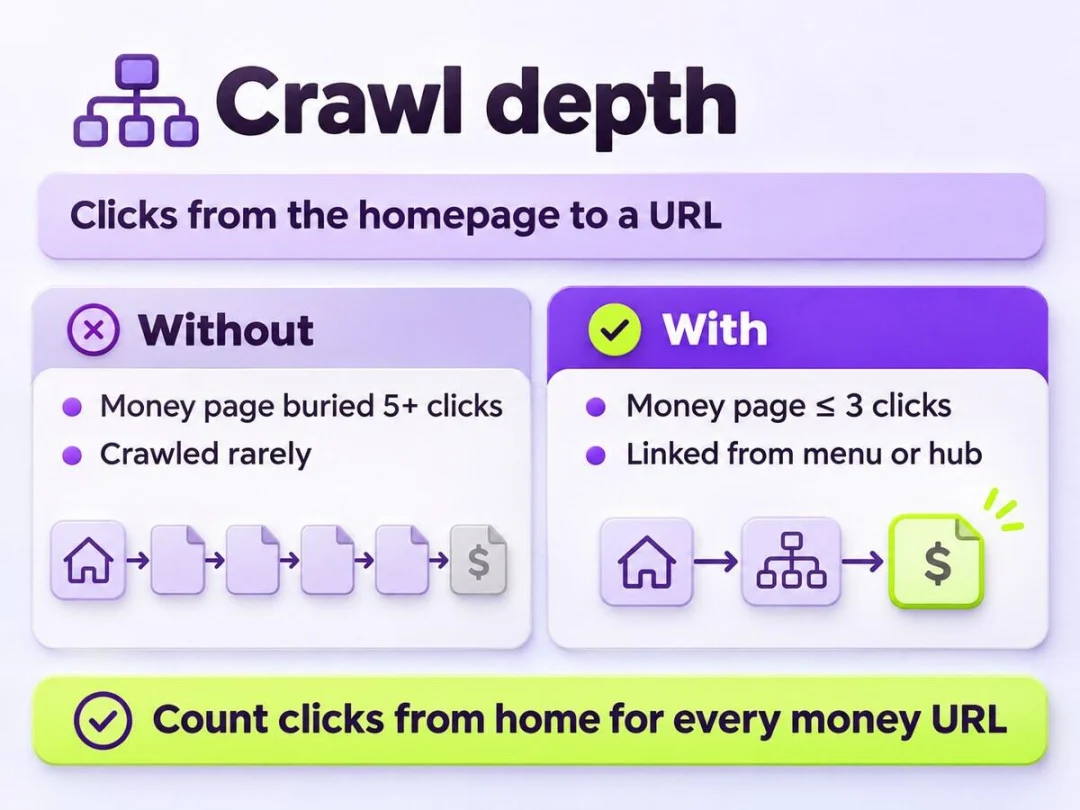
Crawl depth is how many clicks a search bot (or a human) needs to reach a URL from the homepage. Shallow pages are found and revisited more often; deep pages wait longer between visits.
Without: Important service or product pages live five menus deep, linked only from forgotten blog posts. They are crawled rarely, update slowly in the index, and underperform even when the copy is good.
With: Money pages sit within about three clicks of the home page, linked from main navigation, category hubs, or clear internal paths. Bots and people find them without a scavenger hunt.
Rule: For each booking or purchase page, count the clicks from home. If the count is four or more, promote the URL into a menu, hub, or related-service block. Depth is a map problem, not a keyword problem.
JavaScript rendering — content Google (and AI crawlers) may never see
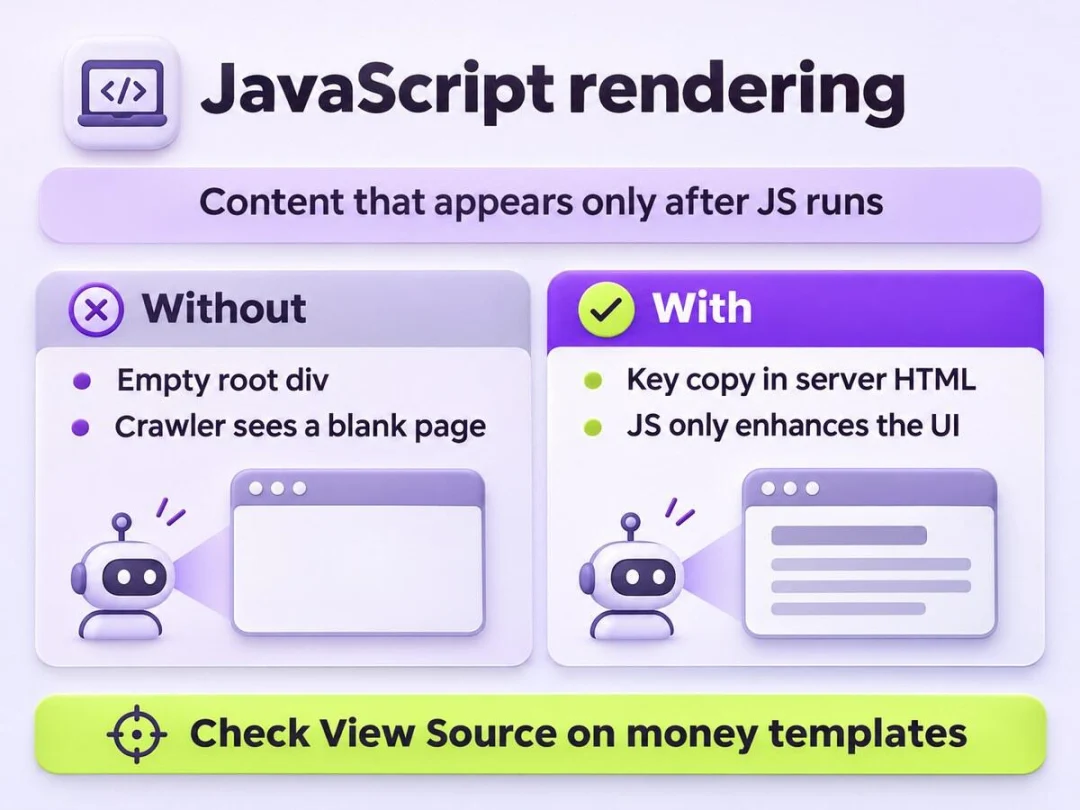
Some sites deliver an almost empty HTML shell and fill the page only after JavaScript runs in the browser. Search systems must render that JavaScript to see the text. Many lighter crawlers—including some used for AI answers—skip or partially skip heavy client-side rendering. That is the core of JavaScript SEO risk for small sites built as single-page apps without a server HTML fallback.
Without: The “root” div arrives empty. A person with a modern browser sees the full catalog; a crawler may see a blank page or a spinner. Rankings and AI citations suffer even though the design looks fine to you.
With: Critical titles, product names, prices, and service copy ship in the initial server HTML. JavaScript can still enhance the experience, but the meaning is already in the source.
Rule: View page source (not only the rendered inspector) on a key template. If the words a customer needs are missing from the raw HTML, ask your developer for server-side or pre-rendered content before you spend more on copywriting.
Link equity — ranking power that travels through links
Link equity (sometimes called link juice) is the ranking and discovery value that passes from one page to another through a link. Strong, trusted pages can lend support to the URLs they point to—when the link is crawlable and not marked nofollow (or similar).
Without: Your strongest pages (home, popular guides, well-linked about page) never point to the service or product URLs that should earn bookings. A plumber’s busy emergency guide never links to “drain cleaning,” so equity sits unused or leaks into low-value archives.
With: You deliberately link from strong pages to money pages with descriptive, natural anchors. Internal links become a routing system for attention and ranking support.
Rule: Once a month, open your top five pages by links or traffic and add one useful internal link to a priority service or product. Do not confuse this with a link-buying campaign—that is a different project and a different calendar.
A practical check for a service business: if your homepage and your highest-traffic guide both fail to mention your three money services by name with a link, equity is not reaching the pages that should answer the phone.
Search intent mismatch — ranking for the wrong kind of query
Search intent mismatch means your page ranks (or tries to rank) for a query whose job the page cannot finish. Search intent is the job behind the query: learn something, compare options, buy or book, or find a place nearby.
Without: An online shop’s thin category page ranks for an informational “how does X work?” query and people bounce. Or a clinic blog ranks for “book appointment [city]” with no booking path—clicks waste everyone’s time.
With: Informational queries get guides; commercial queries get comparison and proof; transactional queries get clear booking or purchase paths; local queries get NAP and map-friendly pages. Title, H1, and first paragraph match the job.
Rule: For every priority URL, write one sentence: “A visitor who lands here should be able to ___ in under two minutes.” If the sentence does not match the query you hope to win, fix the page or change the target query.
Owners often mix two jobs on one URL: a long educational guide that also tries to rank for “book today.” Split them. Keep the guide honest as a guide; give the booking query a page whose first screen is hours, service area, and a clear next step.
SERP features — more than ten blue links
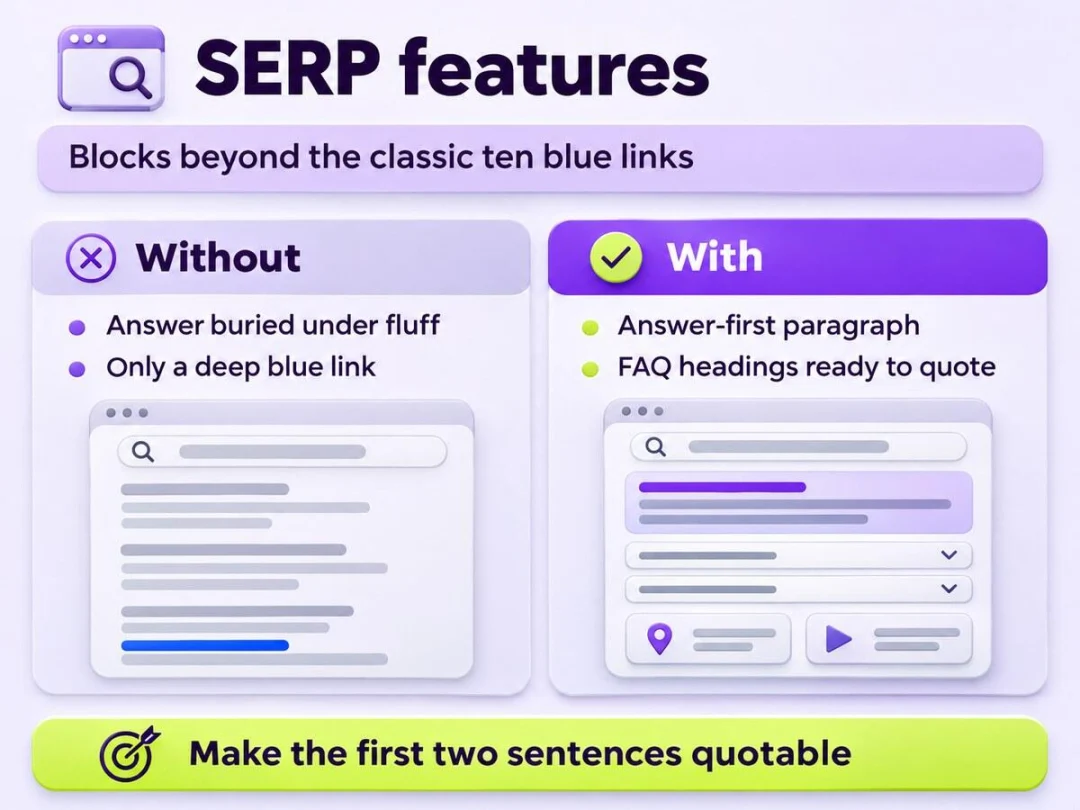
SERP features are the extra blocks on a results page beyond the classic ten blue links: AI Overviews, featured snippets, People Also Ask, local packs, video carousels, and similar modules. They often sit above or beside organic results and capture attention before position one.
Without: Your page answers the query eventually, buried under fluff. Snippet and AI modules pull clearer answers from competitors. Local pack slots go to businesses with stronger map signals.
With: The first paragraph answers the question directly. FAQ-style headings mirror real follow-ups. Short video and clear business facts support the modules you can realistically win. For the map pack specifically, follow winning the local pack without ad spend rather than turning this glossary into a local playbook.
Rule: Rewrite the opening of money and FAQ pages so a stranger could quote your first two sentences as the answer. Then add genuine FAQ headings for the next questions customers ask on the phone.
Knowledge graph — entities and consistent facts
A knowledge graph is a network of entities (brands, people, places, products) and the relationships between them. Search systems use consistent facts to understand who you are: name, address, phone, category, founders, same profiles elsewhere.
Without: Your site says one phone number, a directory shows another, and social bios disagree on the city. The entity stays fuzzy; rich results and trust signals stay weak.
With: The same core facts appear on your About page, footer, and profiles. Organization-style structured data and matching sameAs profile links help machines connect the dots—without turning this article into a schema deep-dive.
Rule: Maintain a one-page “source of truth” for NAP, hours, and legal name. Update every public profile from that sheet. Consistency beats clever markup on a messy fact set.
For a small clinic or shop, that sheet usually fits on one screen: legal name, display name, street address, phone, hours, and the two or three profile URLs you actually maintain. When those disagree, machines treat you as several weak entities instead of one clear business.
Programmatic SEO — useful pages at scale (short definition)
This label covers publishing many similar pages from templates and data—city × service, product attribute grids, or catalog filters—when each page still helps a real searcher. Done well, it is honest scale. Done poorly, it is doorway spam.
Keep the definition short here. For where programmatic SEO fits in your priorities on a smaller site—including when to skip mass ZIP pages—open that tactics guide. This page only needs the label and the warning: unique value per URL, or do not ship the template.
Rule: If a template page would not help a customer who landed on it by accident, do not generate it.
Citation share in AI answers — how often models mention you
Citation share is how often AI-generated answers—such as AI Overview citations—name or link your pages compared with competitors for the same prompts. It is not the same as a classic backlink profile, though strong pages and clear entities help both.
Without: You never check what generative answers say about your category. Competitors’ guides get cited weekly; yours never appear, and you only notice when a customer quotes someone else’s FAQ.
With: You track a fixed list of prompts every week or two, note who gets cited, and close content gaps on the topics where you are invisible.
Rule: Pick ten prompts your buyers actually ask. Recheck them on a schedule. Improve the cited-worthy pages (clear answers, facts, freshness) before chasing vanity rankings that AI modules ignore.
FAQ
Which of these SEO terms should a small business learn first?
Start with search intent mismatch, crawl depth, and canonical tag. They show up on almost every small site and fix expensive mistakes early. Add language-version tags and heavy JavaScript topics only when your stack actually needs them.
Do I need hreflang if my site is English-only in the US?
Usually no. The tags help when you publish distinct language or country URLs. One English US site with a single audience can skip them and avoid broken cross-links.
Is a canonical tag the same as a redirect?
No. A redirect sends the browser to another URL. A canonical keeps the duplicate reachable but names a preferred version for indexing. Use redirects to retire true duplicates; use canonicals when parameters or mild variants must stay available.
What is search intent mismatch in plain English?
It means you are showing up for a question your page cannot answer well—like a brochure page ranking for “book same-day repair” with no booking path. Match the page job to the query job.
How is citation share different from classic backlinks?
Backlinks are links on other websites. The AI metric measures how often generative answers mention or cite you for fixed prompts. Clear, factual pages help both scoreboards, but they are not the same metric.
Should a small local business invest in template-driven page scale?
Only if you have a real matrix of useful combinations (for example, a few services × a few cities you truly serve) and unique content for each. Most single-location businesses gain more from strong service pages than from hundreds of thin templates. See the tactics article for priority context.
Keep learning without mixing the next steps
Keep this page as your seo terms reference. When you need priorities, open priority SEO tactics for smaller sites. When the map pack matters, use free local search steps. When vocabulary should become a calendar, follow turning terms into a 30-day checklist.
A shared seo glossary will not rank your site by itself. It will keep the next conversation with a developer, writer, or consultant honest—and that alone saves months of wrong work.