
SEO for Small Business in 2026: A Practical Ranking of Tactics
Every year, SEO advice gets louder: more tools, more “must-do” lists, more panic when Google shifts something in search. Many SEO practitioners rank seo tactics in tiers—from “double down” to “waste of time”—and share those lists as a shortcut for what deserves attention among seo trends 2026.
This article is not a retelling of any one ranking. It is a practical filter for seo for small business: shops, clinics, auto shops, studios, service vans, and similar teams that win work from people nearby. For that audience, “rank everywhere” is the wrong goal. The right goal is a short stack of tactics that produce calls, bookings, and directions—without rebuilding your strategy every week.
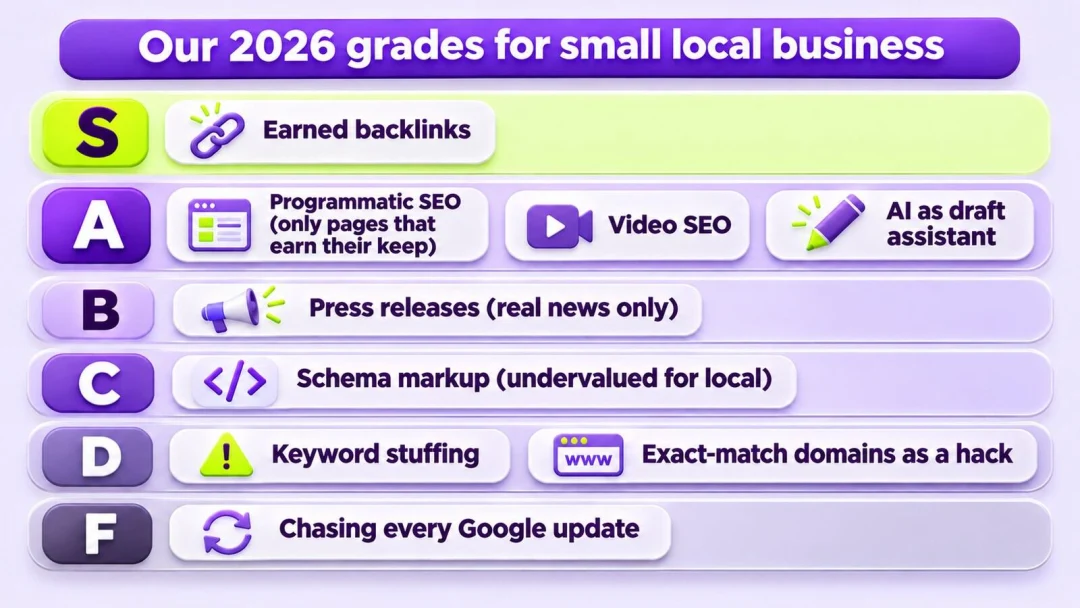
Below we walk through common 2026 tiers (backlinks and exact-match domains; programmatic SEO, video SEO, and AI content; press releases; schema; keyword stuffing; chasing every algorithm update), say where we agree or disagree, and turn each into small business seo tips an owner can actually use.
How to read “S / A / B / C / D / F” as a small business
Tier lists are built for people who live in SEO all day. A local owner usually has a website that must stay accurate, a Google Business Profile that must stay verified, a phone that must get answered, and maybe a few hours a month for content. Priorities look different:
- High leverage for you often means trust signals people can verify: correct Name / Address / Phone (NAP), useful service pages, real reviews, clear photos, and a few genuine mentions.
- Low leverage for you often means tactics that need scale, agency budgets, or a media team—or tactics that risk a penalty for a short-term bump.
- “Works for someone” ≠ “works for your shop.” Exact-match domains and mass programmatic pages can look clever on a growth-site case study and still be a bad bet for a branded local business.
Use the sections below as a decision guide, not a scoreboard. Treat them as seo best practices 2026 filtered for a busy owner—not as a mandate to chase every channel at once.
S tier claims: backlinks and exact-match domains
Backlinks — mostly agree, with a local filter
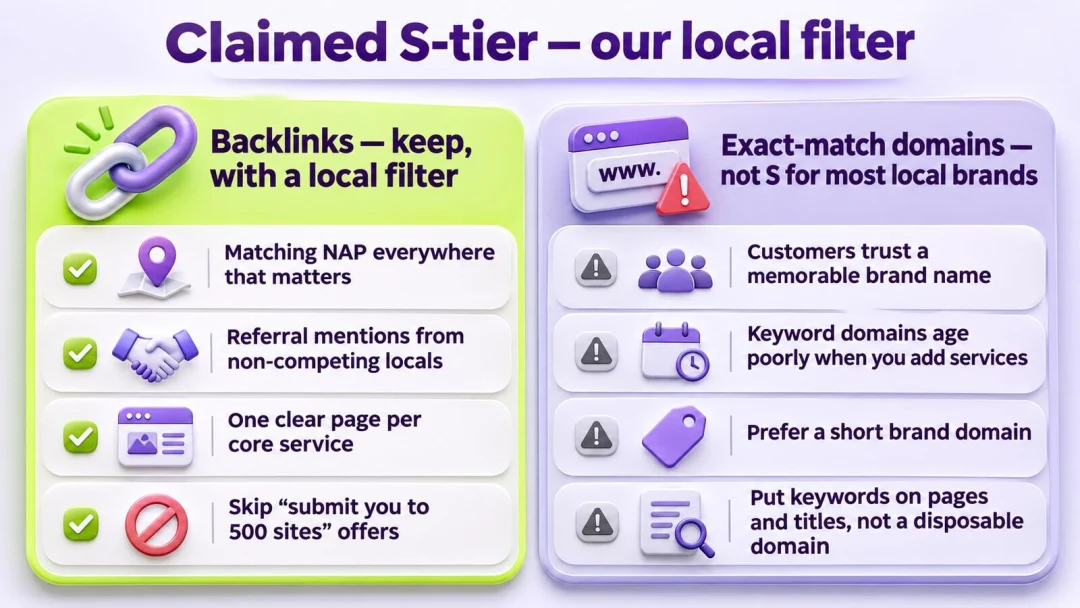
Many practitioners put backlinks at the top for 2026, and we agree that links and mentions still matter as trust and discovery signals. Where we nuance it: for a small local business, “link building” should not mean buying packages or spamming directories. It should mean earned, relevant mentions—the kind a customer or partner would recognize.
What to do:
- Keep NAP identical on your site, Google Business Profile, Bing Places, Apple Maps, and the few directories customers actually open.
- Ask complementary, non-competing locals for a referral mention when you already send each other work (detail shop ↔ mechanic, florist ↔ photographer).
- Publish one clear page per core service so partners and chambers have something useful to link to.
- Skip paid “submit you to 500 sites” offers. Conflicting citations hurt more than empty volume helps.
Quality over quantity is not a slogan here—it is how search stays clean enough for maps and for people checking you on a phone.
Exact-match domains (EMD) — disagree with “S” for most local brands
Exact-match domains (think a domain that is literally the search phrase) still get praised as a strong 2026 play. Some practitioners argue search still struggles to separate brands from keyword domains. We disagree that EMD deserves top-tier priority for a typical local business.
Risks that matter more than a theoretical ranking bump:
- Customers trust a brand name they can remember and recommend.
- Keyword domains age poorly when you add services or change cities.
- Aggressive EMDs often sit next to thin or spammy sites in a searcher’s mental model—even if your shop is excellent.
- Renaming or migrating later is expensive and confusing for reviews and citations.
What to do: Prefer a short brand domain you can own for years. Put the keywords on pages and titles, not in a disposable domain. If you already own an EMD that is also your real trade name on the sign, keep it—but do not chase a new keyword domain as a 2026 “hack.”
A tier claims: programmatic SEO, video SEO, AI content
Programmatic SEO — agree on the idea, reject the spam version
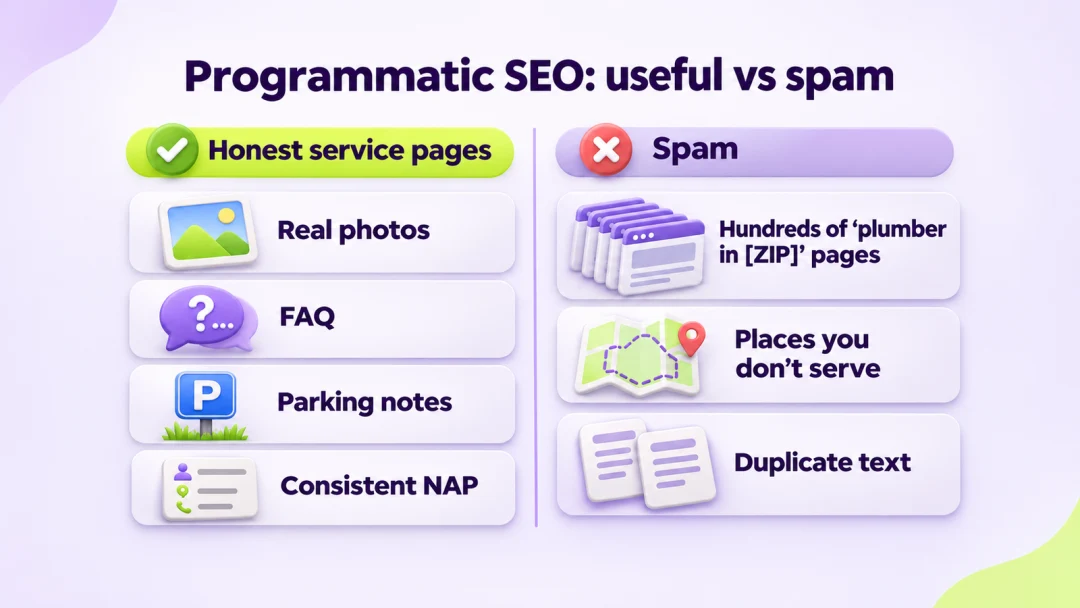
Programmatic SEO usually means generating many pages from templates and data (cities, services, FAQs). Practitioners often rank it high because scale can cover long-tail queries. For a small local business we agree with the useful half: structured pages beat one bloated homepage. We disagree with the factory half: hundreds of near-duplicate “plumber in [every ZIP]” pages that say nothing real.
What to do:
- Build a small set of honest service pages (and, if needed, a few area pages) with parking notes, process, photos of real work, and FAQs customers ask.
- Reuse a clean template—hours, contact block, NAP in the footer—so pages stay consistent.
- Do not auto-generate pages for places you do not serve. Thin geographic spam is easier for systems to ignore than it used to be, and it wastes your crawl and your reputation.
If you use a modular site builder, keep those service pages and contact details in one place so the phone number and address stay consistent as you add pages—messy NAP quietly kills leads.
Video SEO — agree, start small
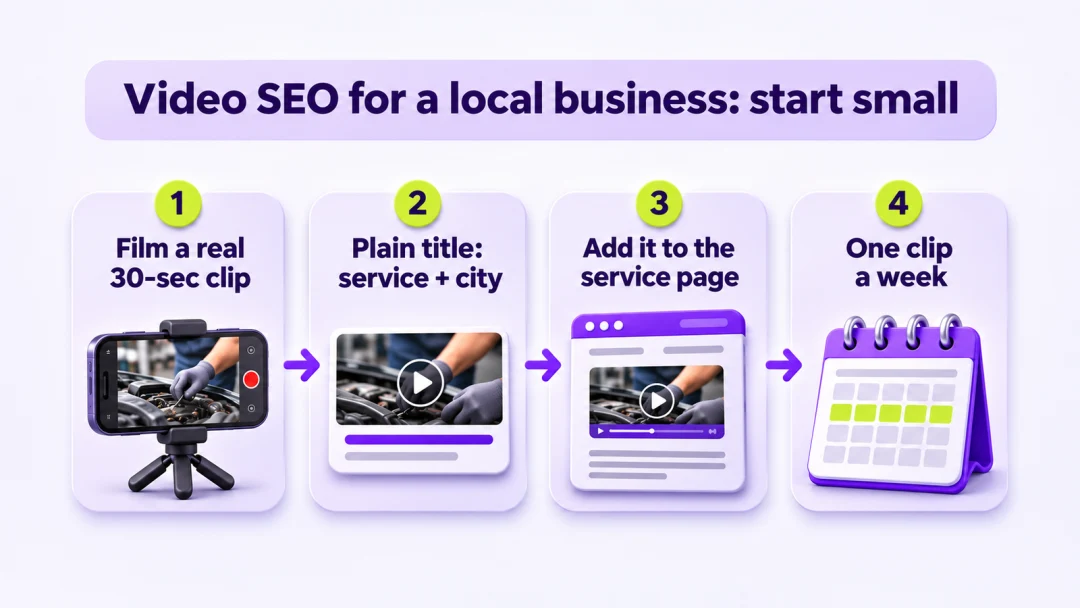
Video SEO (especially YouTube and short vertical video) is widely ranked as a strong 2026 channel, and we agree it deserves attention. Video answers “what does this place look like?” and “how does the job go?” better than another paragraph of text. It also shows up in search surfaces where people still browse before they call.
What to do:
- Film short, real clips: a finished job (with permission), a walk-through of the shop, a 30-second explanation of a common service.
- Use a clear title and description in plain language (service + city when natural).
- Put the same video on your site service page when it helps trust.
- Consistency beats production value. One honest clip a week beats a polished film you never finish.
You do not need a studio. You need proof you exist and work carefully.
AI-generated content — disagree with “manual writing is dead”
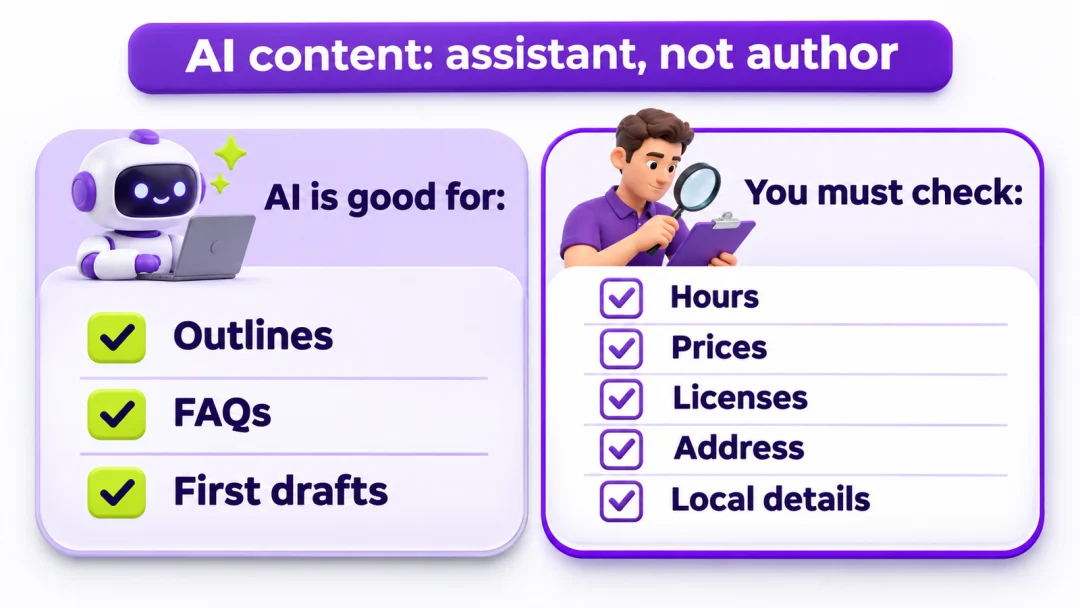
AI content often lands in the high tiers because drafts are fast. Some voices say the days of writing everything by hand are over. Speed is real; “publish raw AI and rank” is not a safe plan for a local business.
Nuance we stand on:
- AI is a good assistant for outlines, FAQs, and first drafts.
- AI is a bad author of record when it invents hours, prices, licenses, or local details you never checked.
- Search systems and customers both punish generic pages that could belong to any city.
- Your reviews, photos, and staff knowledge are the differentiator AI cannot copy cleanly.
What to do: Draft with tools if you want, then rewrite in your voice. Add specifics only you know. Fact-check every address, hour, and claim. Prefer fewer accurate pages over a pile of interchangeable posts.
B tier: press releases — useful only when there is real news
Press releases often get a mid-high grade as a way to earn mentions. For national brands with PR teams, that can make sense. For a neighborhood shop, we rate the tactic lower than a generic “B” implies—unless you have something genuinely newsworthy.
What to do:
- Use a release (or a simple announcement) for real events: opening, expansion, award, community sponsorship, hiring a specialist.
- Pitch local outlets and chambers; skip wire services that spray low-quality syndication.
- Do not buy “SEO press release” packages that recycle the same keyword article across junk sites.
A good story plus one solid local mention beats ten invisible releases.
C tier: schema markup — undervalued for local businesses
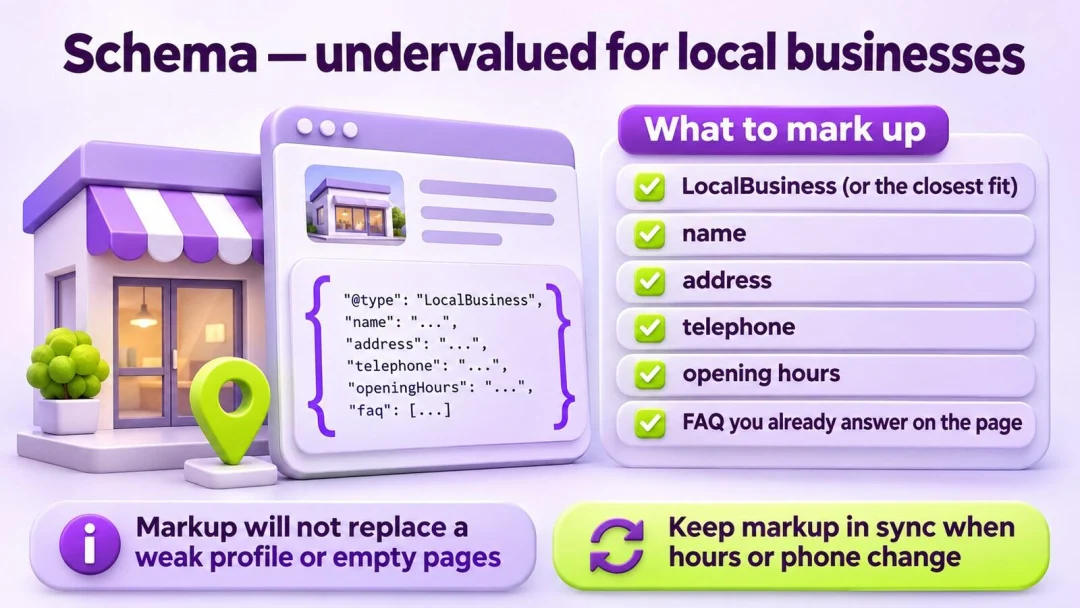
Schema markup seo is sometimes ranked as merely “nice to have,” with the claim that structured data is not that effective right now. For local businesses, we disagree with parking schema in the bottom half of the list. Markup will not replace a weak profile or empty pages—but LocalBusiness (or a more specific subtype), name, address, telephone, opening hours, and FAQ blocks help machines understand the same facts your customers need. That matters as search results mix classic links, maps, and AI-style answers that prefer clear, owned content.
What to do:
- Add LocalBusiness (or the closest fit: AutoRepair, Dentist, HairSalon, and so on) with accurate NAP and hours.
- Mark up FAQs you already answer on the page—do not invent questions for keywords.
- Keep markup in sync when you change hours or phone numbers.
- Validate that the page still reads well for humans; schema is a helper, not the product.
If you only “optimize” titles and ignore structured facts, you leave easy clarity on the table.
D tier: keyword stuffing — agree, avoid it
Keyword stuffing has been a losing tactic for a long time, and practitioners who put it near the bottom are right. Stuffing shows up as awkward titles, city lists in the business name, or paragraphs that repeat the same phrase until they sound robotic. Modern ranking systems are good at spotting that pattern, and customers bounce from it.
What to do: Write like you talk to a customer at the counter. Use the service name naturally in the title and first paragraph. Name neighborhoods the way locals say them. Never put “Best Cheap [Service] [City] [ZIP]” in your Google Business Profile name or domain.
F tier: chasing every Google update — agree, stop the panic loop
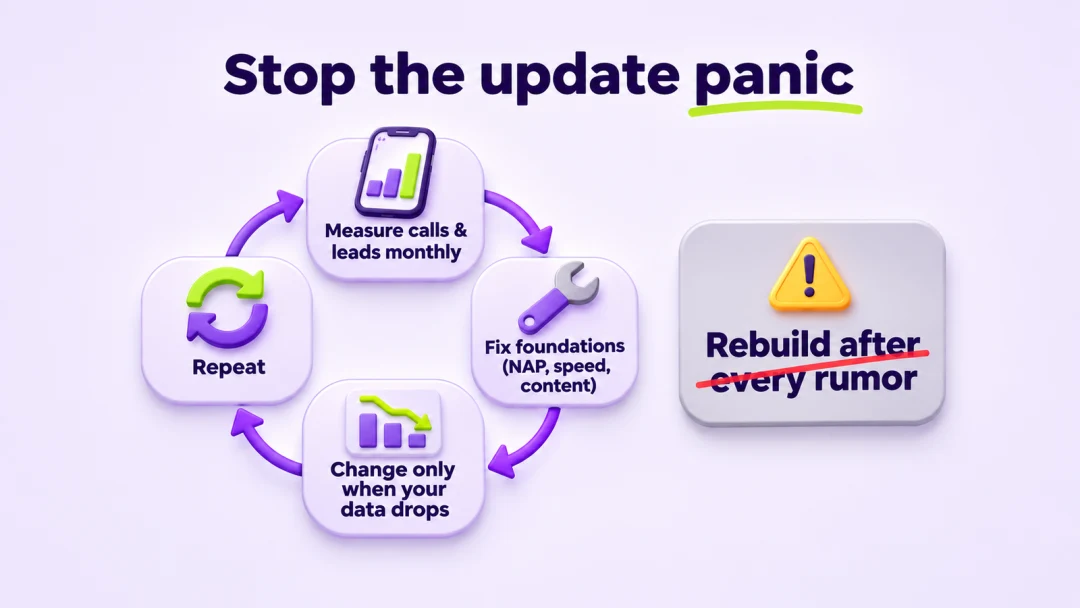
Chasing every algorithm update is correctly treated as a failing strategy. Updates happen. Panic-rebuilding your site after each rumor burns time you could spend on hours, photos, reviews, and service pages.
What to do:
- Follow official guidance at a calm cadence—not every thread that claims “Google killed X today.”
- Measure your own calls, form leads, and profile actions monthly.
- Fix foundations first: verified profile, matching NAP, fast mobile pages, honest content.
- Change strategy when your data says something broke—not when a feed says someone else’s niche shifted.
Stability is a competitive advantage for small teams.
A simple 2026 priority stack for a local owner
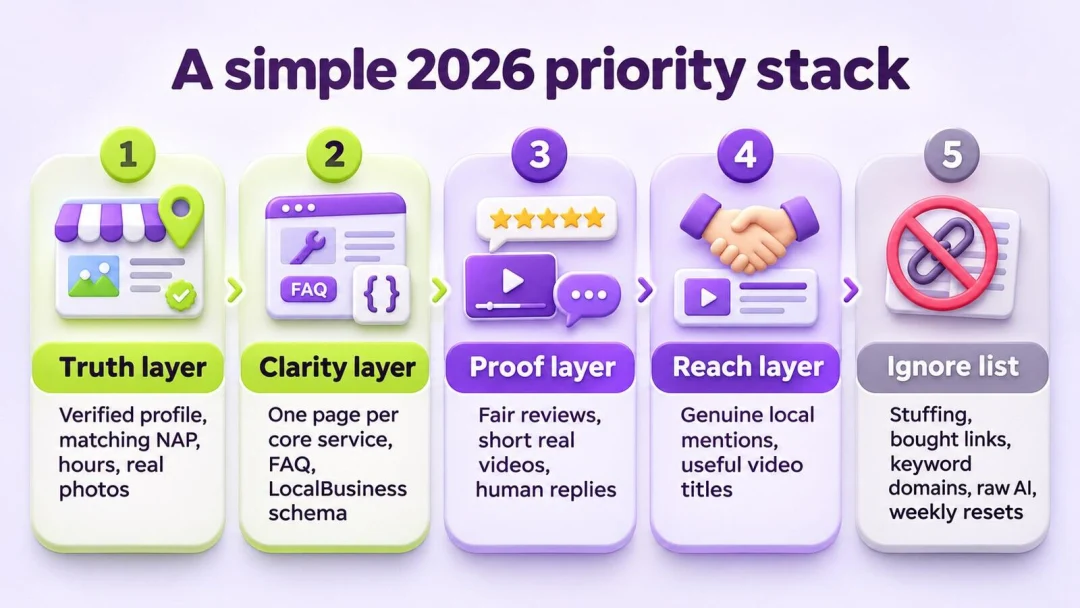
If you want one sequence instead of a tier meme—an seo strategy for small business you can keep for a year—use this:
- Truth layer — verified Google Business Profile, matching NAP, correct hours, real photos. For a step-by-step checklist on profile basics, citations, and reviews, see our guide to local search visibility for small businesses.
- Clarity layer — one strong page per core service; FAQ in plain language; LocalBusiness schema.
- Proof layer — reviews you ask for fairly; short videos of real work; replies that sound human.
- Reach layer — a few genuine local mentions and partnerships; useful video titles; optional area pages only where you truly work.
- Ignore list — keyword stuffing, bought link blasts, keyword domains for vanity ranking, raw AI dumps, and weekly strategy resets.
That stack fits a busy owner. It does not require a full-time SEO department.
FAQ: SEO tactics for small businesses in 2026
What SEO tactics should a small business prioritize in 2026?
Start with accurate NAP and a verified profile, clear service pages, and real proof (reviews and short videos). Add honest mentions and schema once the basics are solid. Skip keyword stuffing, bought link blasts, and rebuilding after every rumor. A short stack done well beats a long list done once.
Are exact-match domains worth it for a local brand?
Usually no. A memorable brand domain ages better than a keyword domain when you add services or move. Put search phrases on page titles and content. Keep an EMD only if it is already your real trade name on the sign—not as a ranking hack.
Is programmatic SEO safe for a small local site?
Yes when it means a few useful templated service or area pages with real details. No when it means hundreds of thin “service + ZIP” pages you never visit. Publish only places and services you actually offer, with photos and FAQs customers ask.
Should small businesses use AI to write all SEO content?
No. Use AI for outlines, FAQs, and first drafts if it saves time, then rewrite in your own voice and fact-check every hour, price, license, and address before you publish. Generic AI pages that could fit any city rarely earn trust—or lasting rankings—for a neighborhood business. Your photos, reviews, and real process details are still what customers and search systems need to see.
Does schema markup still help local businesses?
Yes as a clarity layer, not a magic boost. LocalBusiness (or a closer subtype), hours, phone, and real FAQ markup help systems read the same facts customers need. Keep markup synced with the live page; empty or wrong schema helps nobody.
Should I rebuild my site after every Google update?
No. Measure your own calls, form leads, and profile actions monthly, and fix foundations first: accurate NAP, honest service pages, and real proof. Change course when your data shows a real drop that lasts more than a short blip—not when a feed claims someone else’s niche shifted overnight. Calm iteration beats panic rebuilds that waste weeks and confuse customers.
Closing
Choosing seo for small business priorities in 2026 is useful when it forces a cut. Backlinks still matter if they are real. Exact-match domains are overrated for most local brands. Programmatic pages help only when each page earns its keep. Video is worth starting. AI is a draft tool, not a substitute for local knowledge. Press releases need real news. Schema is more valuable for local businesses than mid-tier rankings suggest. Keyword stuffing and update-chasing still deserve the bottom shelves.
Pick fewer tactics. Do them carefully. Let the phone ring from people who already trust what they found.