
Long Tail Keywords for Small Business: How to Find and Use Them
If you run a small business, you will rarely outrank national brands for a two-word phrase like "roof repair" or "yoga classes." You do not need to. The people most likely to call, book, or buy usually type something longer and more specific: "roof leak repair after hail storm," "beginner yoga classes for seniors in the evening." Those phrases are long tail keywords, and they are where small sites quietly win.
This guide explains these phrases in plain English, how they differ from broad two-word phrases, why they fit small business SEO, and—most importantly—where to put them on your service pages and blog posts. Plan on one to two hours to build your first list. No paid tools required.
What are long tail keywords? (plain English)
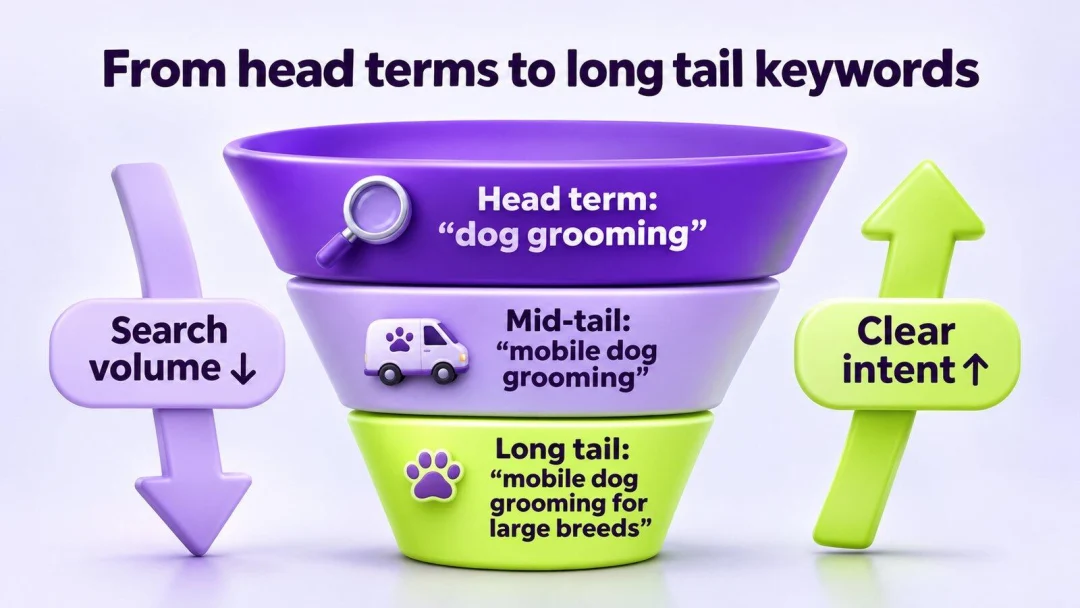
A long tail keyword is a longer, more specific search phrase with a clear intent behind it. "Long tail" does not strictly mean "many words"—it means the phrase sits in the long, thin end of the demand curve: each one has modest search volume, but together they make up most searches people actually run.
A few examples of the difference:
| Broad (head) | Long tail |
|---|---|
| dog grooming | mobile dog grooming for large breeds |
| bookkeeping | monthly bookkeeping for food trucks |
| wedding cake | gluten free wedding cake tasting |
| hvac repair | furnace making clicking noise but not starting |
Notice what happens as the phrase grows. The searcher tells you who they are, what problem they have, and sometimes how ready they are to act. That specificity is the whole point.
Long tail vs short tail keywords (and head terms)
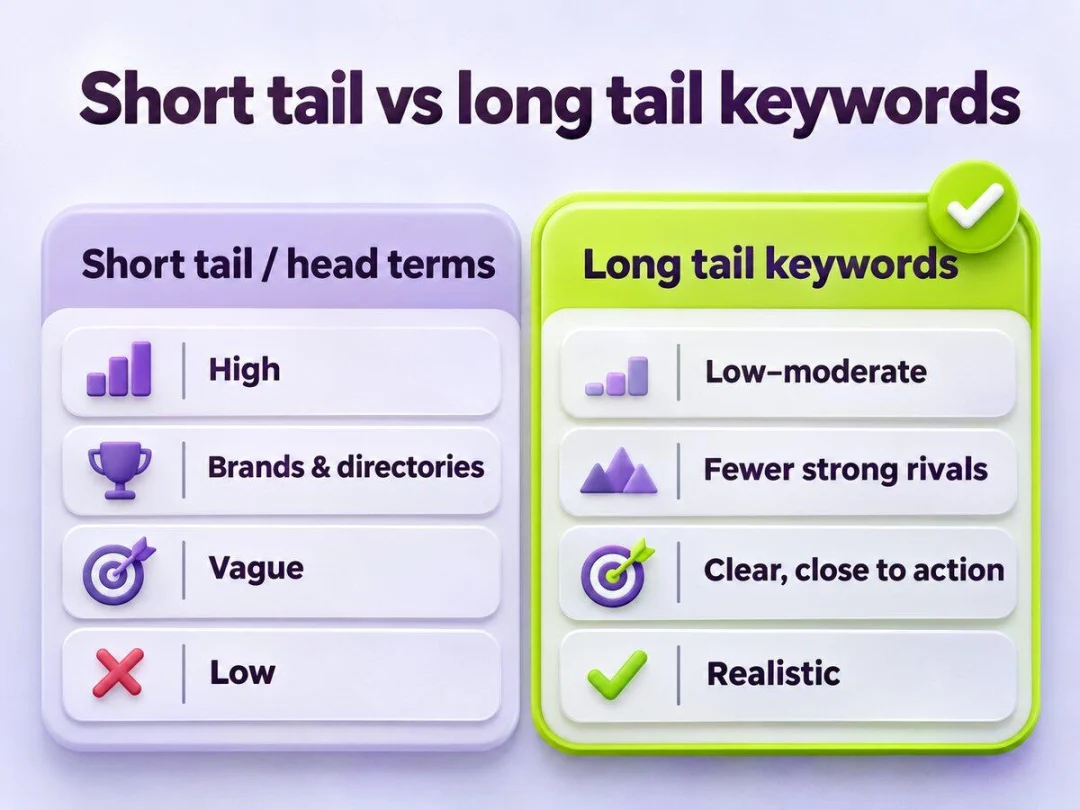
Short tail keywords are one- to two-word phrases such as "plumber" or "accounting." The very broadest sit at the "head" of the demand curve. They carry big volume, but the intent is fuzzy: someone typing "plumber" could be a homeowner with a burst pipe, a student researching careers, or a person looking for a meme.
Here is how the two groups compare for a small site:
| Factor | Broad phrases | Long tail phrases |
|---|---|---|
| Search volume per phrase | High | Low to moderate |
| Competition | Brands, directories, big publishers | Fewer strong competitors |
| Intent | Vague, mixed | Clear, often close to action |
| Chance for a small site | Low, slow | Realistic, faster |
| Conversion rate | Lower | Usually higher |
Broad phrases still matter as the theme of a page. But the phrases that bring you leads in the first months tend to be the specific ones.
Why long tail keywords fit small business SEO
Lower competition. Large brands and aggregator sites optimize for broad terms because that is where their scale pays off. Very few of them bother writing a page for "same day screen repair for cracked tablet." You can.
Closer to a purchase. Studies show that longer, more specific queries convert at noticeably higher rates than broad ones. A person who types "emergency water heater replacement cost" is not browsing. They have a problem and a budget question.
Easier to rank, easier to answer. A narrow phrase lets you write a focused page that answers one question completely. Search engines reward that kind of match, and readers stay longer because they found exactly what they wanted.
They add up. Ten pages that each pull a handful of qualified visitors a week can outperform one page chasing a broad phrase you never crack. If you are deciding which SEO work to prioritize first, long tail coverage of your core services is usually near the top of the list.
How to find long tail keywords (without repeating full keyword research)
You do not need an elaborate spreadsheet to start. Long tail keyword research can be as simple as listening to what Google already suggests and what customers already ask.
Related searches, autocomplete, and People Also Ask
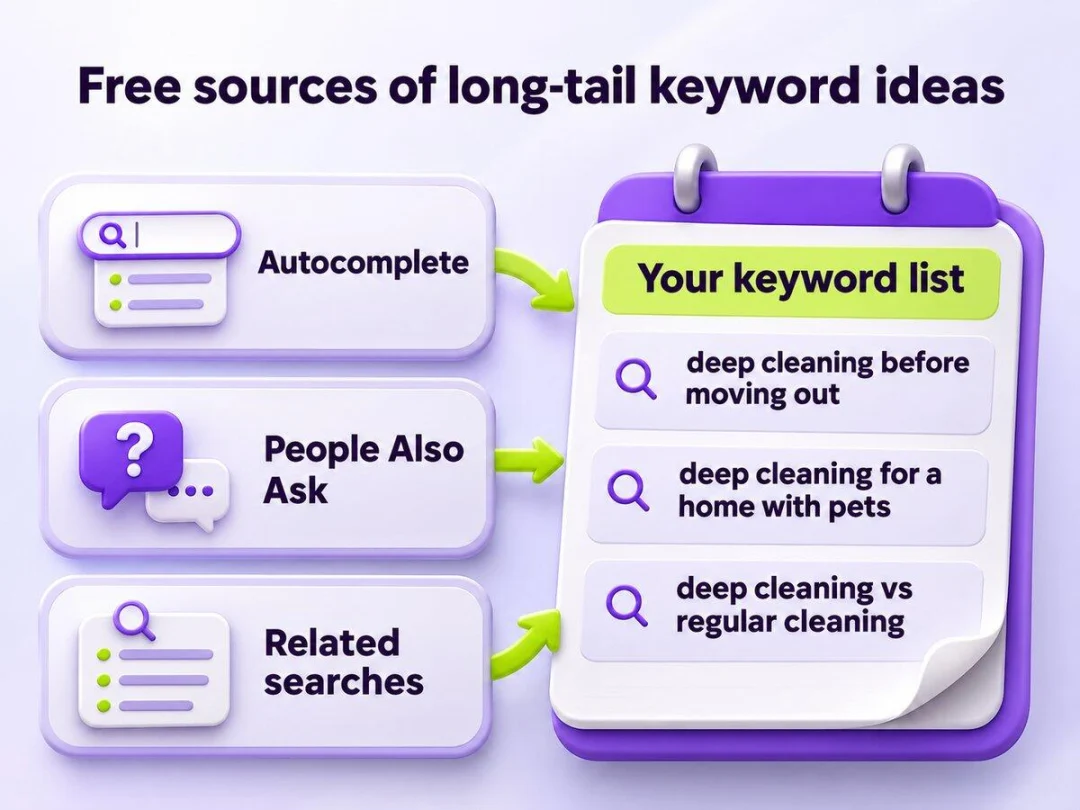
Google gives away keyword ideas for free in three places:
- Autocomplete. Type the start of a service phrase and watch the suggestions. Add a letter after it ("drain cleaning a…", "drain cleaning b…") to surface more variants.
- People Also Ask. The expandable question box on many results pages is a ready-made list of long tail questions. Each one you open loads more.
- Related searches. At the bottom of the results page you will find a block of phrases people commonly run next. They often reveal modifiers you had not thought of: price, near me, for beginners, vs, how long.
Copy anything that matches a service you offer or a question you can answer well.
Turn one service into a keyword list of specific phrases
Take a single service and stretch it with modifiers. A simple formula: service + who + problem + situation.
For a residential cleaning company, one service ("deep cleaning") becomes:
- deep cleaning before moving out
- deep cleaning for a home with pets
- deep cleaning after renovation dust
- how long does a deep cleaning take for a 3 bedroom house
- deep cleaning vs regular cleaning
Do the same with your own customer language: questions from calls, emails, quotes, and reviews. Within an hour you will have a keyword list of 20–40 specific phrases for your main services.
When to open the full keyword research process
This quick method is enough to start using long tail phrases on existing pages. When you are ready to plan the whole site—starting from seed keywords, grouping phrases, and assigning one primary query per URL—follow the full DIY keyword research process. That guide covers the mapping in depth so you do not have to reinvent it here.
How to choose which long tail keywords to use first
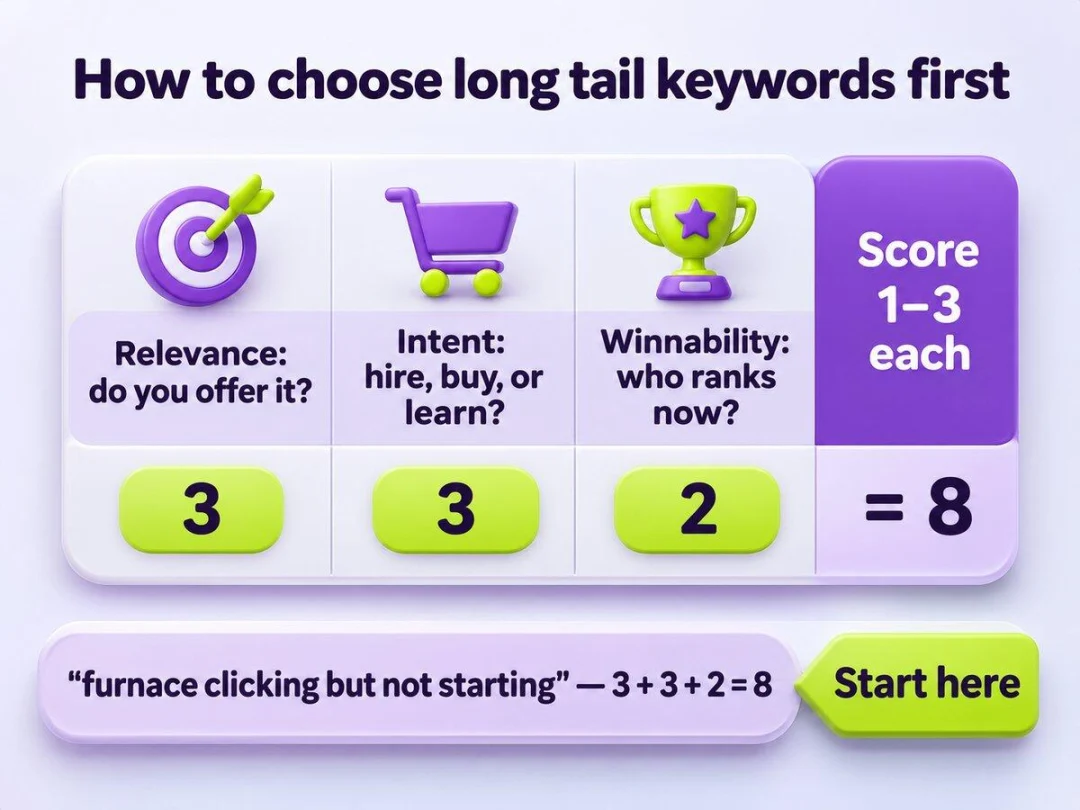
A list of 40 phrases is only useful if you know where to start. The most practical answer to how to choose keywords for a small site is a quick score on three questions:
- Relevance. Do you actually offer this, in this area, for this type of customer? If not, skip it no matter how tempting.
- Intent. Is the searcher looking to hire, buy, compare, or just learn? Hire-and-buy phrases go to service pages; learn phrases go to blog posts and FAQs.
- Winnability. Search the phrase yourself. If the first page is full of national brands and giant directories, park it. If you see forums, thin pages, or small competitors, you have a chance.
Give each phrase a 1–3 score on each question and start with the highest totals. Keep one primary phrase per page; related long tail variants can live on the same page as supporting headings or FAQ answers.
Where to place long tail phrases on your site
Finding phrases is half the job. The other half is putting them where both readers and search engines notice them—without sounding like a robot.
Service and money pages
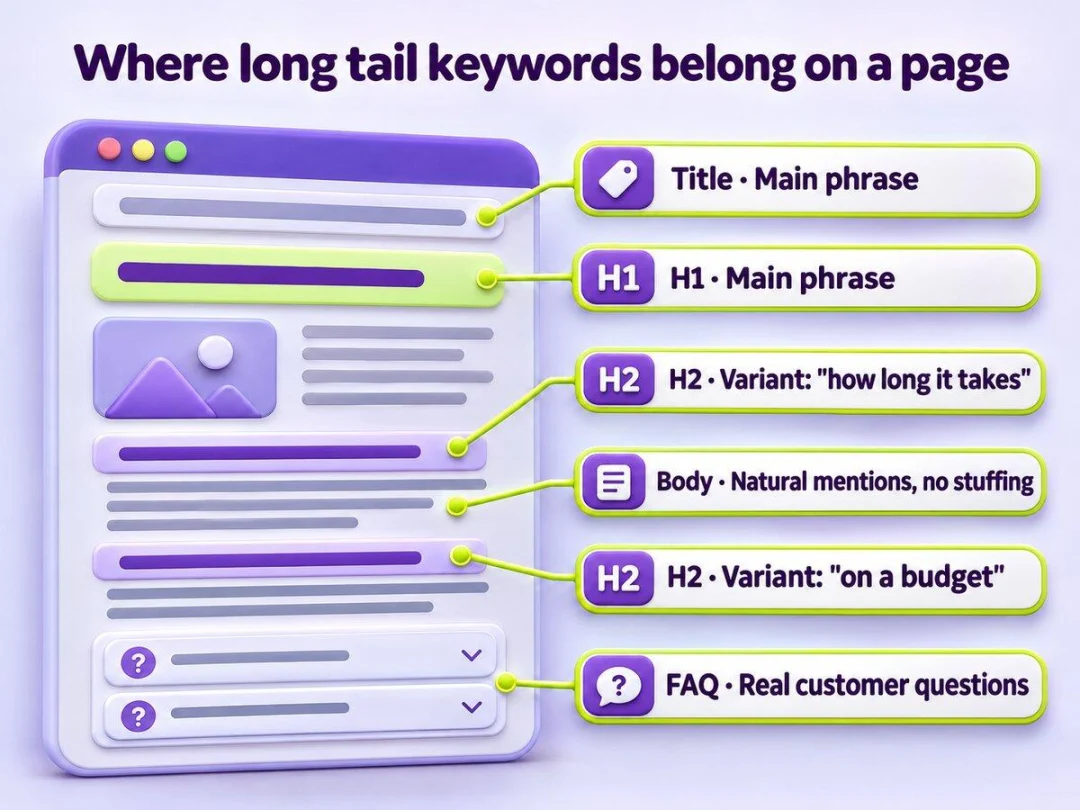
Each core service page should target one main phrase and absorb several close long tail variants. For a page about kitchen remodeling, the main phrase might be "kitchen remodel" plus your city, while H2 sections cover "small kitchen remodel ideas on a budget," "how long a kitchen remodel takes," and "kitchen remodel permits." Each section answers a real question a buyer has before calling.
Blog posts and FAQs
Question-style long tail phrases ("why is my furnace clicking," "how often should a restaurant hood be cleaned") make strong blog posts. Each post should answer the question fully, then point readers toward the related service page. Shorter questions that do not justify a full article belong in an FAQ section on the most relevant page.
Titles, H2s, and natural body copy (no stuffing)
Use the main phrase in the title and H1, a variant in one or two H2s, and let the rest appear naturally in the text. Write for the person first: if a sentence sounds odd when read aloud, rewrite it. Repeating the exact phrase ten times does not help; covering the topic thoroughly does. If you want to know where this work slots into a calendar, the week-by-week SEO action plan shows when on-page updates fit best.
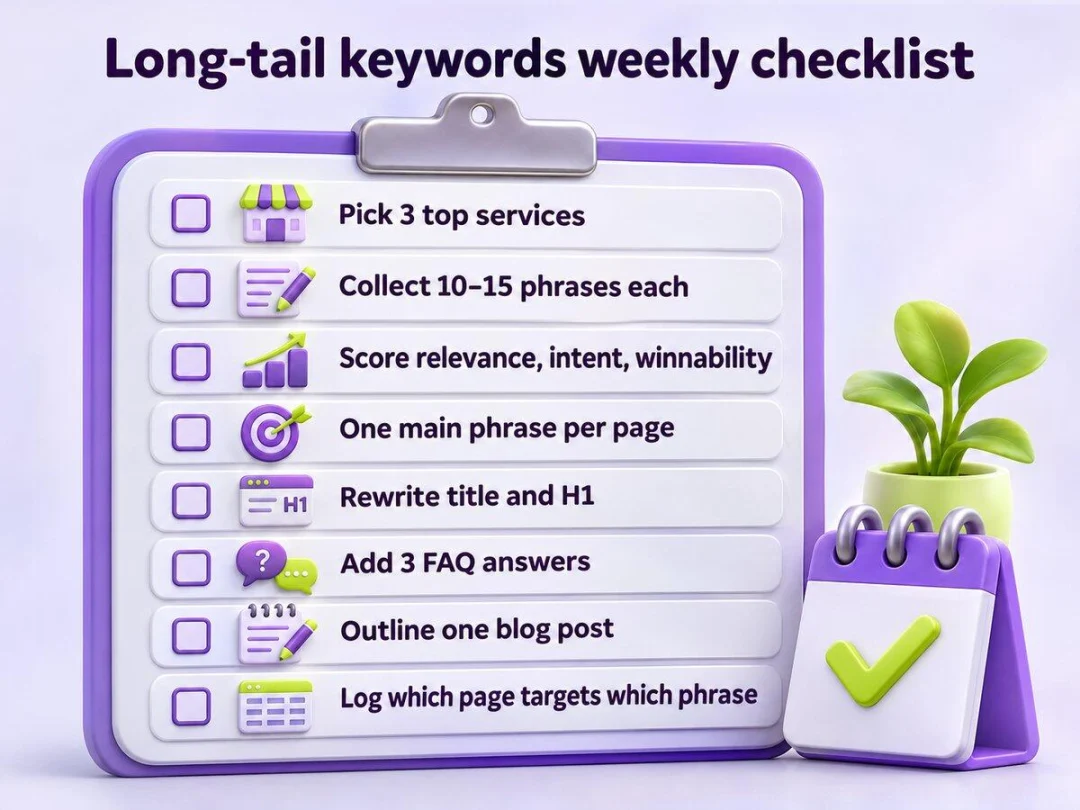
Quick checklist: put specific phrases to work this week
- Pick your three most profitable services.
- Collect 10–15 specific phrases per service from autocomplete, People Also Ask, the bottom-of-page suggestions, and customer questions.
- Score each phrase for relevance, intent, and winnability.
- Assign the top phrase to each service page; note two or three variants for H2s.
- Rewrite one title and H1 per page to include its main phrase naturally.
- Add an FAQ block that answers three real long tail questions.
- Choose one question-style phrase and outline a blog post for it.
- Note which page targets which phrase, so two pages never compete for the same one.
That last point matters more than it looks. If you want the language for it, the plain-English definitions of advanced SEO terms cover search intent and keyword cannibalization in a few lines each.
FAQ
How long should a long tail keyword be?
There is no fixed word count. Most are three to six words, but a two-word phrase can be long tail if it is specific and low volume. Judge by specificity and intent, not length.
Are long tail phrases always low competition?
Usually, but not always. Some specific phrases in finance, legal, or health are still dominated by large sites. Always search the phrase yourself before you invest in a page.
Can I target long tail phrases on my homepage?
Your homepage should stay broad and describe what you do overall. Specific phrases work better on dedicated service pages and posts that can answer them fully.
How many long tail phrases should one page target?
One primary phrase plus a handful of close variants that share the same intent. If two phrases need different answers, they need different pages.
Do long tail phrases still matter if AI Overviews appear?
Yes. AI summaries tend to draw from pages that answer specific questions clearly, and specific searchers still click through when they want details, prices, or someone to hire.
Should I rewrite old posts around long tail phrases?
Often, yes. Review older posts that get a few impressions but no clicks, find the specific question they almost answer, and sharpen the title, headings, and intro around it.
Next steps after you pick your phrases
Long tail keywords are not a trick; they are a way of matching your pages to the exact problems your customers bring. Start with three services, a short scored list, and one rewrite per page this week. When you are ready to map the whole site, use the guide on how to build a one-page keyword map, then fold the work into your monthly SEO calendar and revisit your SEO priorities.
As your new pages go live, connect them to related pages so readers and crawlers can find them, and give your photos descriptive names and alt text. Small, specific improvements like these compound over months.