
SEO vs PPC for Small Business: How to Choose or Combine Them
A small workshop owner has a limited budget for the month and two needs at once. A seasonal offer should start bringing inquiries this week. The shop also wants service pages that a nearby customer can find later without paying for every click. This owner is a fictional teaching example, not a client case, and there is no single "right" channel for every shop.
SEO vs PPC is a choice about the job, the deadline, and what you can measure—not a contest with a permanent winner. Some months paid search is the more useful tool. Some work is better invested in pages that can keep appearing without a per-click fee. The same business can use both, with a clear role for each.
What SEO and PPC each do
The contrast in SEO vs PPC is easiest to see in the results a person actually gets after a search. One set of listings usually appears because a page was considered relevant, and you do not pay for each click. Another set appears because an advertiser is willing to pay for the placement, typically for as long as the budget and approval allow.
Organic results vs paid placements
Organic vs paid search is that split. Organic results are the unpaid listings—the pages, maps results, or other unsponsored placements a person can open without you owing a click fee. SEO is the work you do so those pages are clear, useful, and eligible to appear.
PPC, or pay-per-click, is paid search advertising. In practice, for many small service businesses in the United States, that often means ads in Google—so a comparison of SEO vs Google Ads is, in daily use, a comparison of organic work and those ads. PPC is a broader term and can include ads on other sites; this article does not survey those networks. You may also hear "SEM," used either for paid search or for search marketing as a whole. It is a wider label, not a third channel this guide will treat as a separate target. SEO vs paid search is the same contrast under a slightly different name: unpaid visibility you build over time, versus placements you rent while you pay.
Time, payment, and what you actually buy
With SEO, you are not buying a guaranteed slot in today's results. You are spending time—and sometimes money on the site itself—so a page can be found later without a charge on each visit. The result, if it comes, can continue after you stop paying a media fee, but it is not automatic and it is not immediate.
With PPC, you are usually buying the chance for an ad to be shown, and then paying when someone clicks, or in some formats when a defined action happens. When the budget stops, or the ad is no longer approved to run, that placement typically stops with it. You do not buy the inquiry or the profit; you buy a placement and a click, which may or may not become a customer. Neither channel is "free": organic work costs time, and paid search costs budget plus the time to write a clear offer.
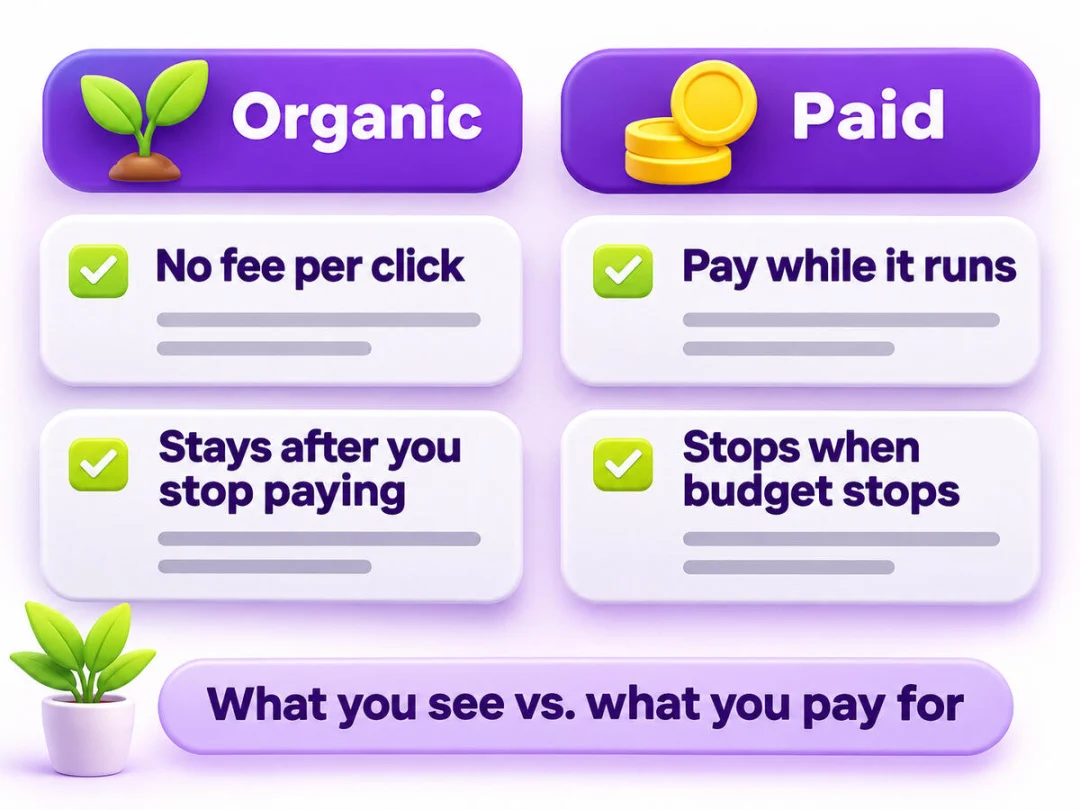
What you see vs. what you pay for
When paid search is the more useful short-term tool
Paid placements can be the more useful tool when you need visibility on a short clock and you can fund the clicks for that period. They are not a promise of inquiries this week, and they are not a reason to skip a clear page behind the ad.
A launch, a seasonal offer, or a test of demand
A new service, a seasonal window, or a temporary offer often has a deadline the organic pages cannot be expected to meet on their own. If the workshop in the example wants to advertise winter tire checks for the next three weeks, a paid placement can put that offer in front of people who are searching now. The same is true when you want to test whether a wording or an offer attracts real inquiries, before you invest months in a page for a demand that may not be there.
Use paid search in those cases as a time-bounded tool: a start date, a stop date, a budget you can actually spend, and a definition of a useful result, such as an inquiry or a booked visit. Keep the message on the page aligned with the ad so the person who clicks recognizes the offer. This is not a campaign-setup guide. It does not cover bidding or advertising policies, and it does not quote other people's cost-per-click figures. Those numbers vary by market, and a figure copied from another article would not be your cost.
Limits of “results this week”
An ad that is shown is not an inquiry. A click is not a booked job. A booked job is not automatically a profitable job. "Results this week" only means something if you have defined the result and you have a page that can receive it.
Paid search also stops when the budget or approval stops. If the only way a customer can find the offer is by clicking an ad, the offer becomes hard to find the day you pause spending. Weak pages waste paid clicks: if the page does not answer the query or explain the next step, you can pay for visits that go no further. A short test can be useful. It is not a lifetime cost for the channel, and it is not proof that organic work is unnecessary.
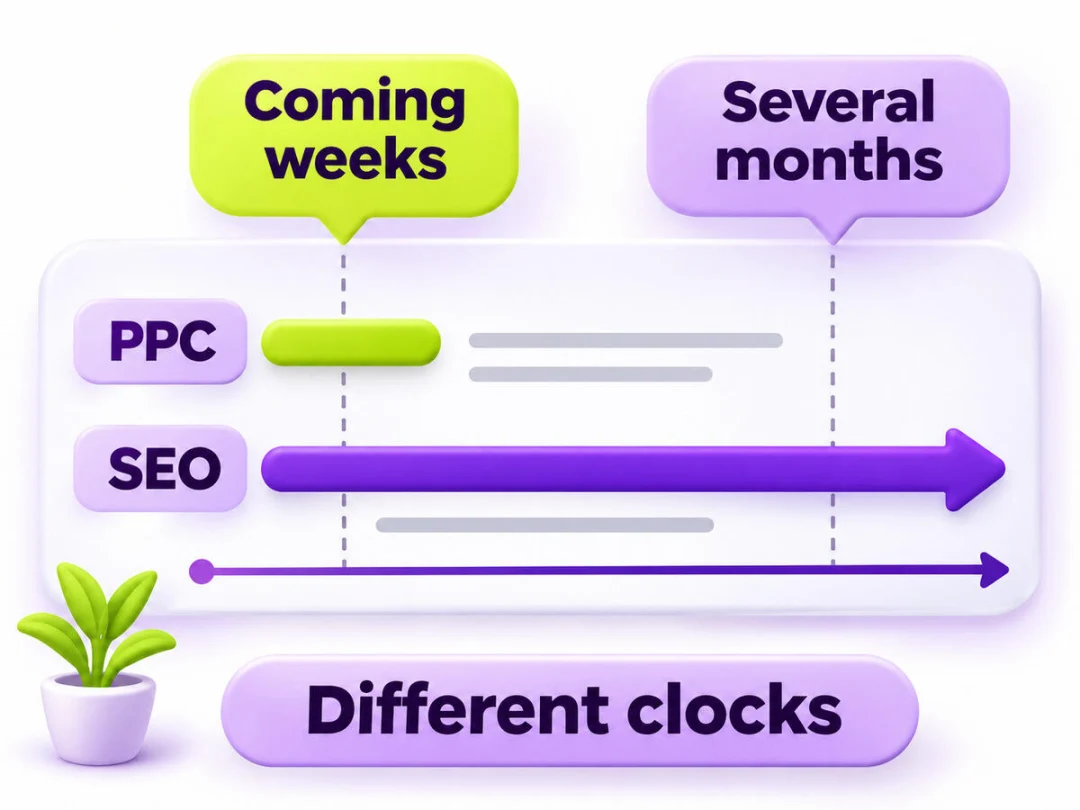
Different clocks
When organic search is the better long-term investment
Organic work is often the better long-term investment when you care about queries you would like to keep earning without paying for each click, and when you can wait longer than a media flight. It is still work. It is not a free, automatic alternative to advertising.
Queries you want to keep earning without paying per click
Core services, plain explanations of how you work, and pages that help a nearby customer choose you are typical organic investments. If people will still search for "brake inspection" or "family session" next year, a clear page can keep answering that question after a seasonal ad has ended.
For a business that serves a local area, unpaid visibility near the place of work is part of that organic picture. Free local visibility work is separate from ads: useful pages, consistent business facts, and the other durable details of a local presence. That neighboring guide is not a lesson in running ads, and this article will not repeat a profile-management walkthrough.
You still need time and useful pages
Organic search uses a longer clock than a week of ads. A new page, or a newly improved one, can take time to be found, and there is no honest "top in 30 days" promise that fits every query. If you need a fuller picture of that timing, organic search uses a longer clock than a short paid flight; this article will not copy a universal week count.
You also need pages that deserve to be found: a specific service, a clear process, and facts a customer can use. A month of calm organic work looks like improving those pages and checking the basics, not like buying a slot. In that sense, a month of organic work looks like a checklist, not a media buy. This is not a second copy of that plan.
If you cannot yet describe the service, the area, and the next step on a page, paid traffic will not fix the gap, and organic work has little to stand on. Build the page first, then decide which channel should carry it in the near term.
Using SEO and PPC together without wasting budget
PPC and SEO can sit side by side when each channel has a role and you measure both. Using them together is not automatically twice the result, and it does not settle SEO vs PPC as a contest. It is useful when paid placements cover demand you need now, and organic pages cover the queries you want to keep, without the two messages fighting each other.
Let paid results answer immediate demand
Give paid search the jobs with a short deadline: the seasonal offer, the launch, the test of a new wording, or the query you cannot yet earn organically. Keep the budget and the date range visible so the spend cannot silently become a standing bill you never reviewed. Organic pages can keep working on the durable offers in the meantime. You do not have to advertise every service you also want to rank for, or pause every organic effort because an ad is running. The discipline is to know which channel is supposed to do which job this month.
Do not bid and publish blindly for the same confused promise
A paid ad and an organic page that both promise "all auto repairs, best prices, call now" give a person two vague doors to the same unclear offer. If you run both, let each message be specific. The ad can carry the time-limited offer. The page can explain the service, the limits, and the next step, and it should match what the ad claimed.
Paid demand can inform the page. If a particular wording or offer consistently leads to real inquiries in your own account, that is a reason to say the same thing clearly on the organic page. Use your observations, not someone else's bid prices. There is no universal rule that you should always turn ads off once an organic listing appears, or always keep ads running on every query you care about. Those decisions depend on cost, capacity, and whether the ad still earns a result you want. Do not let a seasonal paid promise linger on a page after the offer has ended.
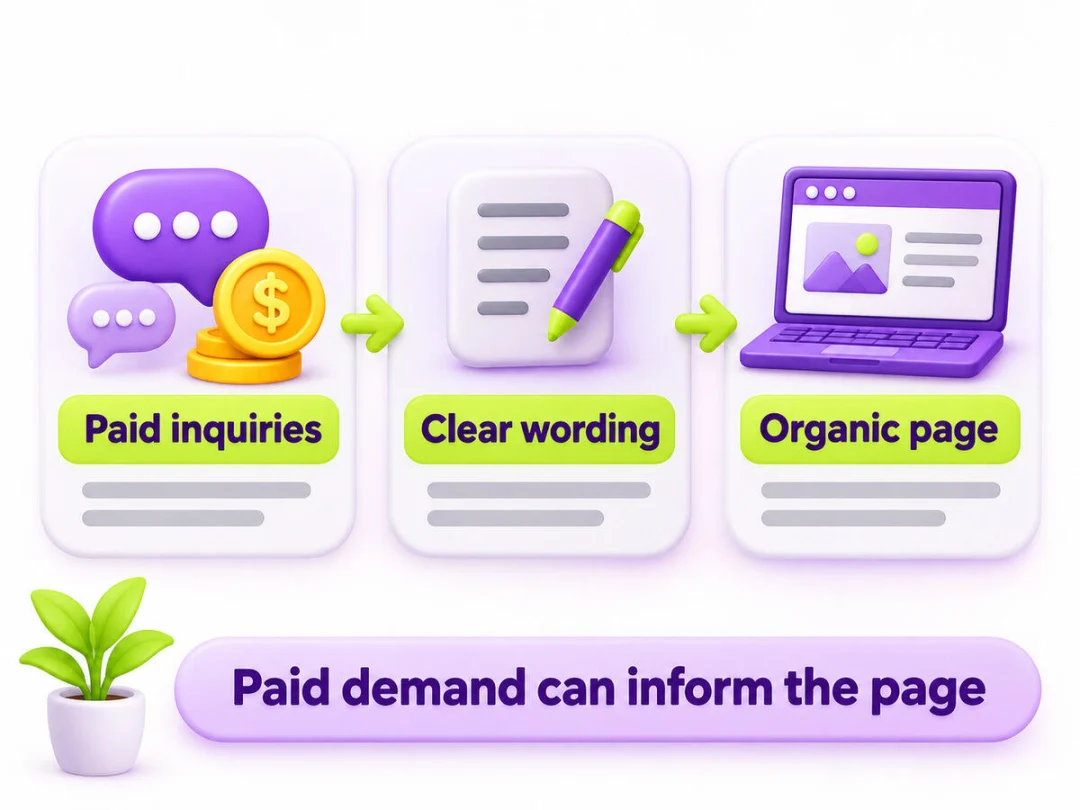
Paid demand can inform the page
Compare results over a fair time window
A week of ads and a week of SEO are not the same experiment. Paid placements can be judged inside the flight you funded, as long as you count inquiries (or other defined results) against the money and time you spent in that window. Organic work needs a longer window, and a quiet week after you publish a page is not a verdict.
Decide in advance what you will count and over which period. Inquiries, booked visits, and revenue are different events, and so are clicks and calls. If you declare a channel "cheaper," you need a cost per inquiry (or per booked job) and a time range. Without those, "cheaper" is only a feeling.
The figures below are a fictional breakdown for the same workshop, invented for teaching, not market rates and not a result you should expect.
In this invented month, the shop spends a planned $800 on ads over three weeks and records 16 inquiries from those ads, of which 6 became booked visits. Separately, the shop spends time improving two service pages and records 9 organic inquiries over eight weeks, of which 5 became booked visits. None of those numbers is a benchmark. They only illustrate the arithmetic: you cannot call one channel cheaper until you name the cost, the result, and the period. In the example, the paid inquiries arrived sooner, and the organic inquiries continued after the ad spend stopped. That is a comparison of clocks and costs, not a rule for every business.
If you change the offer, the page, or the budget mid-window, note the change. Comparing a revised page to an old ad flight, or a holiday week to a quiet one, will mislead you.
A decision path for a small service business
You do not need a fixed split of the budget, and you do not have to use both channels. A simple path is enough:
- What do you need in the coming weeks? If you need inquiries before a short deadline, and you can fund a clear offer, paid search is the more plausible short-term tool. If you cannot fund it, do not start a campaign you will have to abandon mid-flight.
- What do you want to keep finding you without paying for each click? Those queries belong on useful organic pages, with time allowed for that work.
- What will you measure after a month, and over a longer organic window? Write down the result, the period, and the cost or time you will compare. If you cannot measure either channel, you will not know whether to continue it.
It is acceptable to choose only organic work, or only a short paid test, or both. It is not useful to copy an "80/20" split from an article that does not know your margins, your capacity, or your calendar.
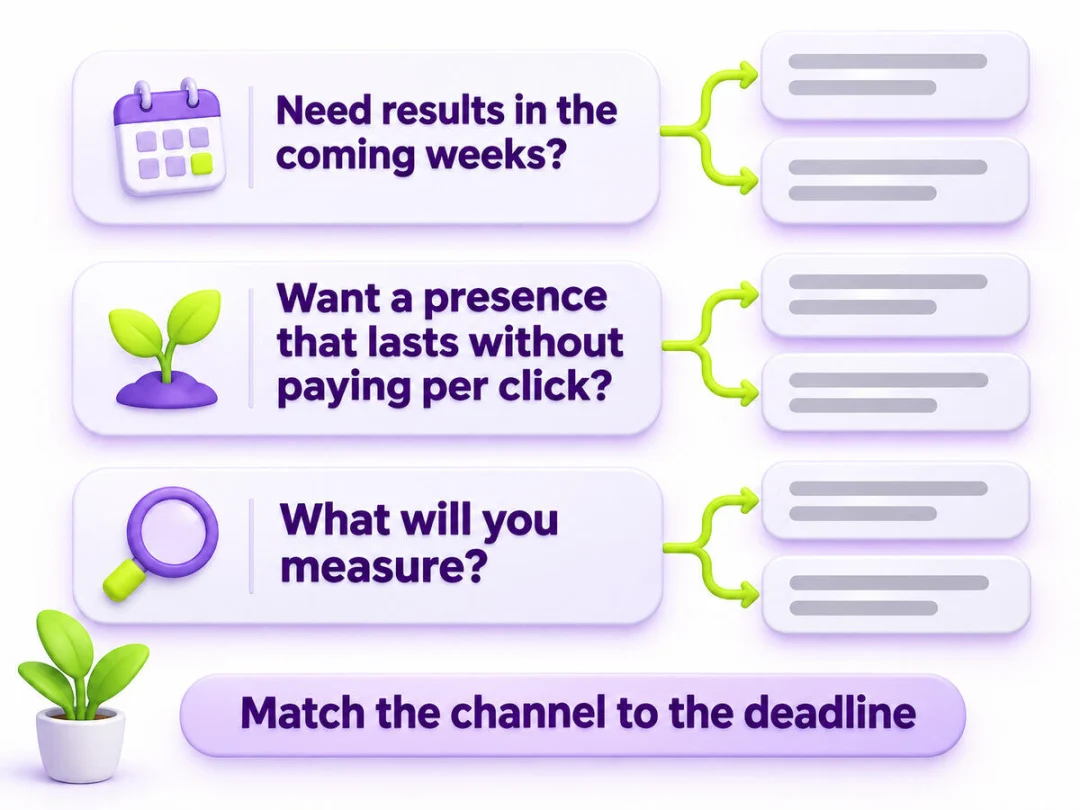
Match the channel to the deadline
FAQ
What is the difference between SEO and PPC?
SEO is work on unpaid, organic results: useful pages that can appear without a fee on each click. PPC is paid placement, usually charged when someone clicks an ad (or when another billed event happens), and it typically lasts only while the budget and approval last.
Is SEO cheaper than PPC?
There is no universal "cheaper." The answer depends on what you spend or what your time is worth, how long you measure, and what an inquiry or a booked job costs in each channel. A short burst of ads can look costly; a year of unpaid time on weak pages can also be costly. Compare cost per result over a fair window.
Should a new small business start with SEO or PPC?
It depends on how soon you need inquiries and whether you already have pages that can receive them. If the deadline is short and the offer is clear, a limited paid test may be the more practical first step. If you can wait and you need a durable presence, start with useful pages. Neither path is required.
Can I use SEO and PPC together?
Yes, if each channel has a role and you record results for both. Paid placements can cover immediate demand; organic pages can cover the queries you want to keep. Using both does not guarantee a double effect, and the messages should not contradict each other.
Is Google Ads the same as PPC?
In practice, for many small businesses, the paid search they mean is Google Ads. PPC is the broader idea of paying for a click or a similar event, and it can include other sites. This article does not review those networks. The contrast with SEO stays the same: unpaid results versus paid placements.
How long should I run ads before I judge SEO?
You should not judge organic work on the same clock as a short ad flight. Ads can be reviewed inside the period you funded. SEO needs a longer window, and the right length depends on the query and the site. The neighboring article on how long SEO takes is the better place for that timing; this page will not invent a single number of weeks.
Choose the channel that matches the deadline you can actually fund
The useful way to read SEO vs PPC is not "which channel wins." It is which job you need done, by when, and how you will measure it. Fund a short paid placement only when you can afford that clock. Invest in organic pages when you want a result that can last after the ads stop. Keep the comparison honest, and skip the borrowed budget recipes.