
How to Respond to Negative Reviews: A Small Business Playbook
A single angry star can feel personal. For a small business, the bigger risk is what the next shopper reads: silence, a defensive rant, or a clear plan to make things right. This playbook shows how to respond to negative reviews by hand—from your phone or laptop—with calm wording, offline follow-up, and ready review response templates. No review-management software, no auto-replies, and no promises that a third party will “delete” a post for you.
Think of online reputation management for small business as a daily habit: read what people write, answer like a human, and fix what you can. The goal is not a perfect 5.0 wall. The goal is a public trail that says you listen.
Why a hard review matters more than the star you lost
Negative reviews and other customer reviews sit next to your name in search and maps. Shoppers compare rating, freshness, and whether the business answers. A low score with no reply reads colder than a low score with a professional note and a phone number. The star you “lost” is one data point; the public reply is the part you still control.
This guide is the deep dive on responding to negative reviews. Asking every happy customer for a fair review is a separate habit—see how to ask for reviews the right way in the free local steps article. Here we stay on the reply.
Why customers leave hard reviews
Most one- and two-star posts fall into a few patterns. Naming the pattern helps you choose tone before you type.
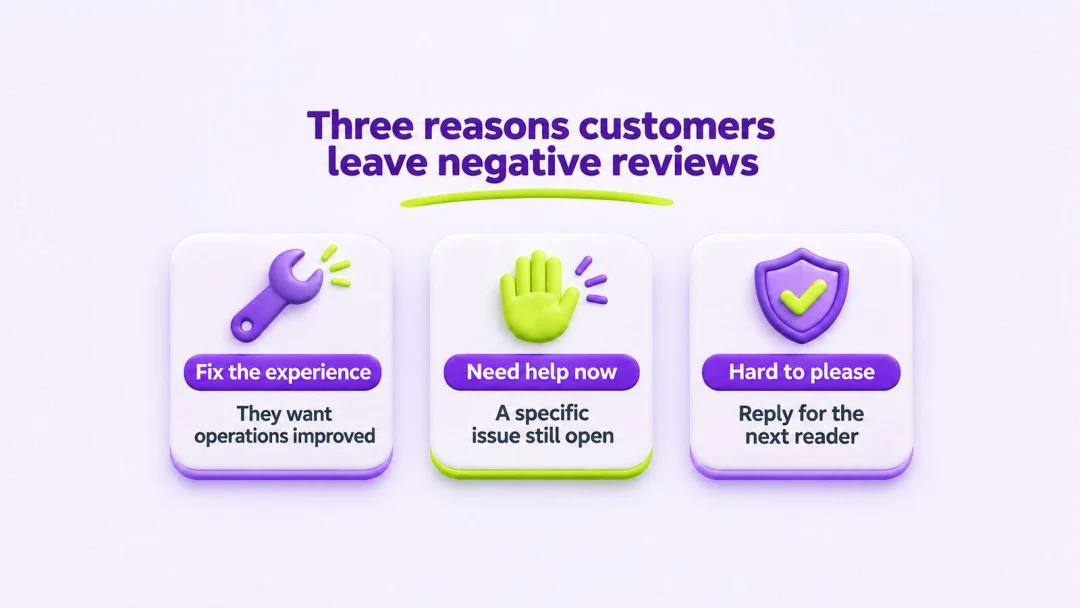
They want the experience fixed
Some people write because something in the visit felt broken—wait time, unclear pricing, a missed callback—and they want the owner to notice. Treat these as operational notes in public form. Thank them for the signal, own the miss without inventing facts you cannot verify, and say what you are changing.
They need help on a specific issue
Others are raising a hand: billing stuck, appointment canceled, part wrong, message unanswered. They often edit or soften the review after a real fix. Your public reply should open a channel (phone or email) and keep private details offline.
Some people won’t be satisfied — reply for the next reader
A smaller set of reviews will not turn into five stars no matter what you do. You still reply. Future customers are reading you, not only the reviewer. A short, polite note shows standards even when you cannot win the person back.
How a good reply can help your brand
Handled well, a tough review can still support trust. That does not mean you should manufacture conflict. It means you should not panic when a profile is not all five stars.
Authenticity beats a perfect 5.0 wall
Shoppers are used to mixed feedback. A wall of only perfect scores can look less believable than a mix with thoughtful replies. You do not need a quota of bad reviews; you need honest answers when hard feedback appears.
Reviews as free feedback on operations
Themes that repeat—parking, wait times, follow-up calls—are free diagnostics. Capture them in a simple note after each reply. Fixing the pattern matters more than arguing with one paragraph online.
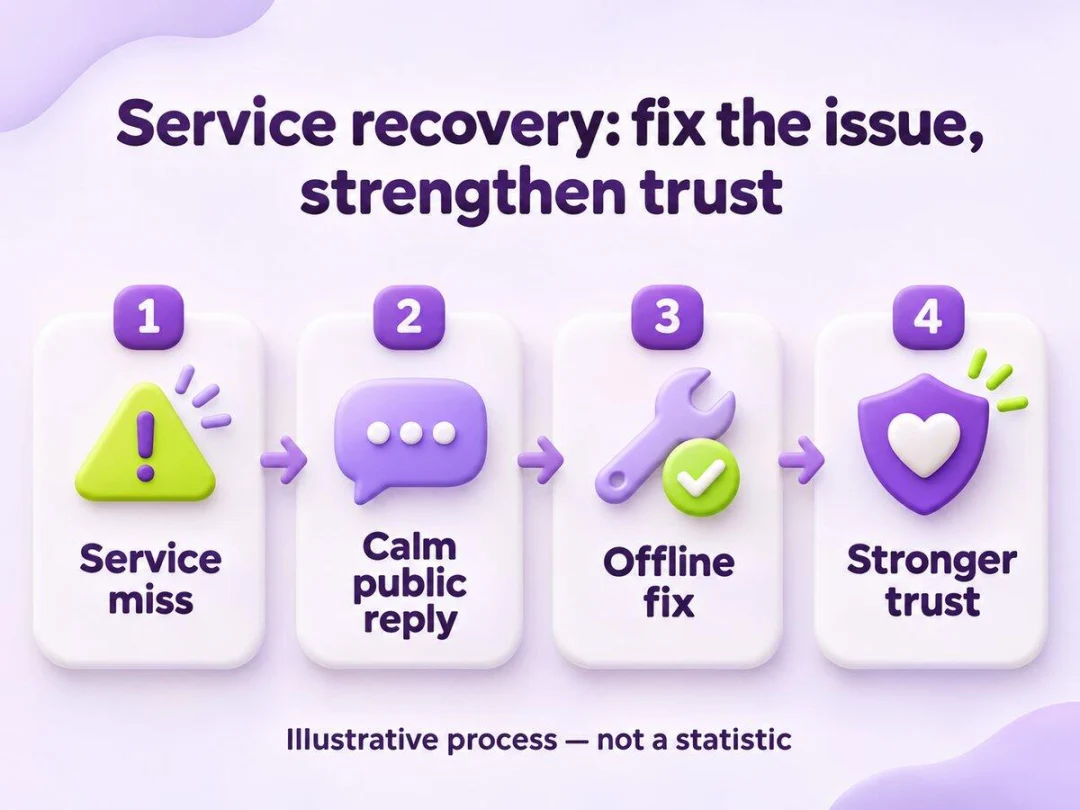
Service recovery (fix the relationship offline)
Service recovery is the idea that a quick, fair fix after a failure can rebuild trust—sometimes more strongly than if nothing went wrong. We will not invent loyalty percentages. What you can do in practice: apologize for the concrete miss, invite a private conversation, solve the issue if you can, and leave the public thread short. The recovery happens mostly offline; the reply only opens the door.
The approach that never works: “just delete it”
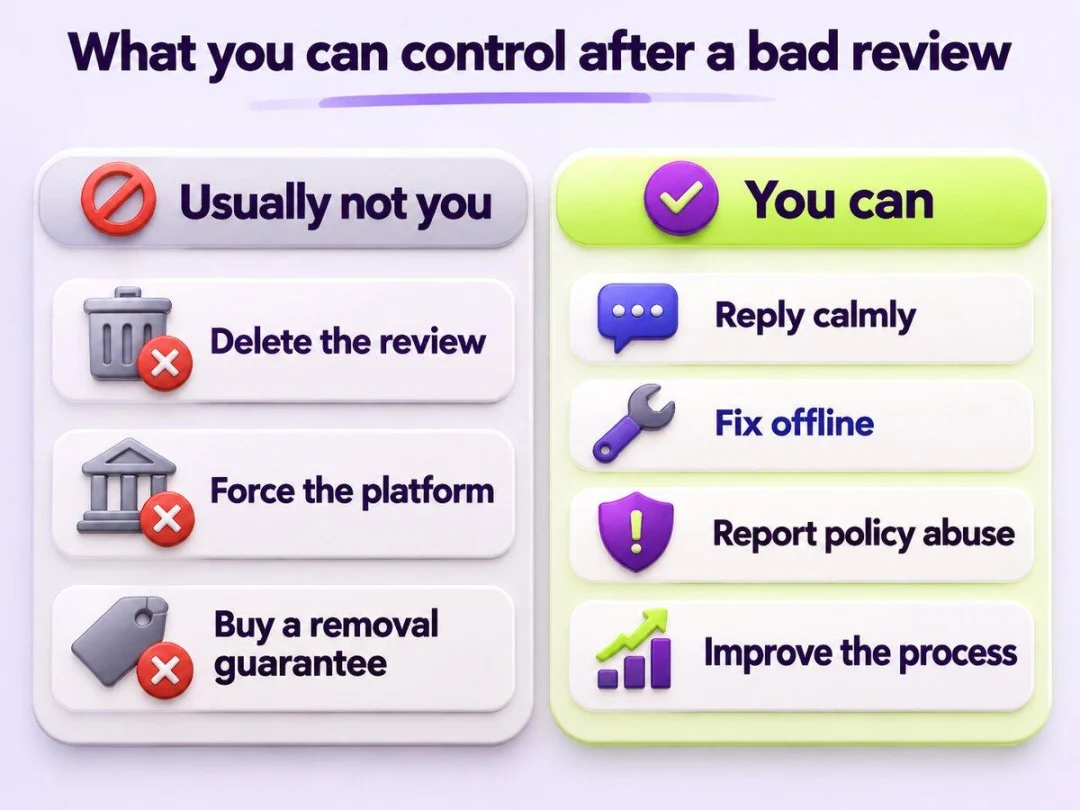
Search results are full of ads that promise to wipe bad posts. For ordinary consumer reviews, that pitch is the wrong plan. Once a review is live, you usually cannot force it down. In practice, the people who can remove it are the review platform (under its policies) or the person who wrote it. A third-party “removal” shop cannot rewrite those rules for you.
Your job after a bad review is not to buy silence. It is to reply well, fix what you can, and—if the post looks fake or violates policy—report it through the platform and wait. There is no guarantee the platform will remove it. Keep documenting; keep your public tone steady.
How to respond to negative reviews: 5 practical rules
Here is a short checklist you can reuse every time. It is also the core of how to reply to negative reviews and how to respond to bad reviews without scripts that sound robotic.
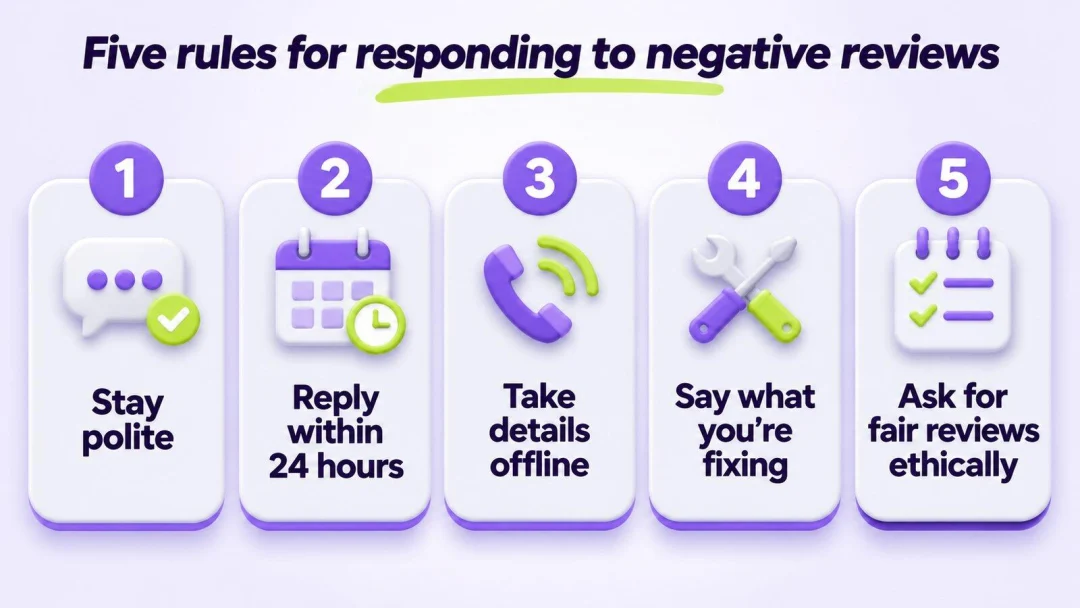
Stay polite (future customers are reading)
Assume strangers will judge your tone more than the original complaint. Skip sarcasm, ALL CAPS, and private details (medical notes, account numbers, “you still owe us”). Name the person if the platform shows a name. Thank them for writing even when the words sting.
Reply within 24 hours when you can
Speed signals that someone is watching the inbox. Aim to reply within a day when you are open for business. If you need time to investigate, say that briefly and still offer a contact path. A late, careful reply beats a fast, angry one—but silence for a week hardens the story.
Take the details offline (phone / email in the reply)
Public threads that turn into debates help nobody. Invite a call or email. Put a real phone number or inbox you actually check. Do not ask for card numbers or passwords in the comment field.
Say what you’re fixing
If the review names a concrete miss, say what changed or what you are checking: staffing at peak hours, a callback process, a parts check. Keep it honest. Do not invent a “new system” that does not exist. Future readers care that you learn.
Keep collecting fair reviews the right way
Angry customers self-select into writing more often than quiet happy ones. Balancing the picture means asking all completed customers fairly—not filtering for five-star-only people, and not offering pay or discounts for a star rating. Keep that ask short; the full habit lives in the free local steps including reviews. This article stays on the reply.
How to respond to negative Google reviews (without automation)
How to respond to negative Google reviews is the same playbook on a public map listing: open the review where your business already manages replies, write as yourself or a named owner/manager, and stay manual. Do not paste a generic auto-reply. Mention the specific issue when you can. End with a phone or email. You do not need a tutorial on profile setup here—only a human answer next to the stars.
Tone for Google (and similar platforms named without links): short paragraphs, plain English, no legal threats in the first reply, no dumping of private customer history. If you disagree on facts, say you want to review the appointment record offline rather than litigate in public.
Google review response templates you can adapt
Use these as google review response starters—illustrative templates, not quotes from real customers. Replace the placeholders. Never admit to a failure you have not verified, and never publish sensitive details.
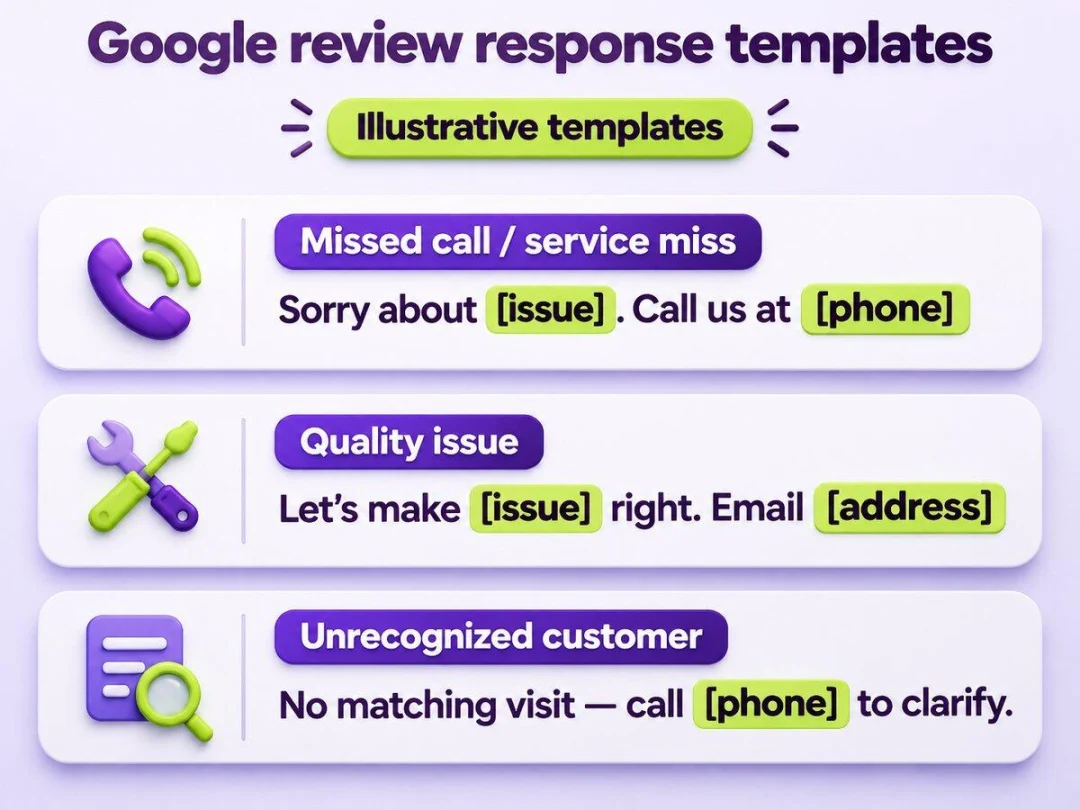
Template — service miss / missed call
Hi [Name], thank you for telling us. We are sorry you had trouble reaching us about [issue]. That is not the standard we want. Please call us at [phone] so we can sort this out directly. We are also reviewing how we return calls during busy hours.
Template — product or job quality issue
Hi [Name], we appreciate you flagging [issue] after your visit to [Business name]. We want to make this right. Please email [address] or call [phone] with a good time to connect. Separately, we are checking [process you are actually reviewing] so the next visit is smoother.
Template — unclear if they were your customer
Hi [Name], we take feedback seriously and could not find a matching visit under the details in your review. If this was meant for our team, please call [phone] so we can look into it. If the review was left for another business by mistake, we would be glad to help point you to the right place.
Rewrite every line in your own voice. Swap industries (shop, clinic, salon, contractor) as needed. Three solid starters beat twenty identical canned replies.
How to handle fake Google reviews
Fake Google reviews—wrong business, never a customer, or clear policy abuse—hurt, but the playbook stays calm.
Report through the platform (no guarantees)
Use the platform’s report or flag tools when the post looks fake, spam, or off-policy. Keep screenshots for your records. Expect that many reports will not result in removal. Do not promise customers (or yourself) that the star will vanish.
Leave a calm public reply for the next reader
While you wait, leave a short public note. Future readers need to see that you checked your records and invited a private conversation. Avoid calling the person a liar in public. Avoid dumping private data to “prove” your side.
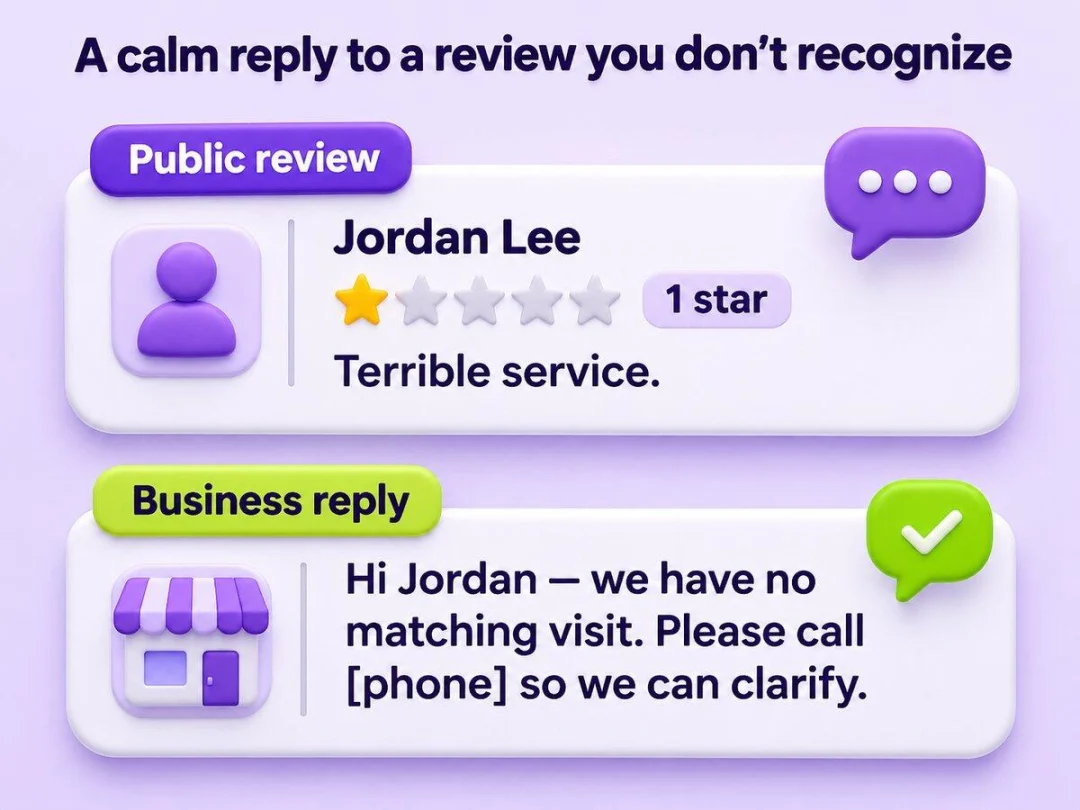
Illustrative reply (fictional names):
Hi Jordan, we have no matching customer record for this visit. If you were with us, please call [phone] so we can straighten out any confusion. If this review was meant for another business, we hope you find the right listing.
That tone protects privacy and avoids false admissions.
FAQ
Should I reply to every negative review?
Yes, when you can. Even a short, polite note is better than silence for most public platforms. Skip only rare cases where legal counsel tells you not to engage—and still document the post.
How fast should I respond to a negative Google review?
Aim for within 24 hours during business days. If you need to investigate, say so and still offer a phone or email. Speed without accuracy is worse than a careful same-day or next-day reply.
Can a company legally force Google to delete a bad review?
Usually no. Platforms remove content under their own policies; authors can edit or delete their own posts. A paid “removal” vendor cannot override that. Report policy violations; do not build your plan on guaranteed deletion.
What if the review is fake or from someone who wasn’t a customer?
Report it, keep evidence, and leave a calm public reply that invites offline contact and notes that you could not match the visit—without publishing private customer data. Do not invent admissions to “appease” a post you do not recognize.
Should I offer a discount in the public reply?
Prefer fixing the issue offline. Public discounts tied to a star rating can look like buying praise and may conflict with platform rules. If you offer a goodwill gesture, do it privately after you verify the visit—and never condition it on changing the review text.
Do I need software to respond to reviews?
No. A phone, an email inbox, and a calendar reminder to check reviews are enough for most small businesses. Tools can help later with volume; they are not required to leave a human reply today—and this guide does not recommend auto-replies.
Next steps after you reply
- Post a calm public answer with a real contact path.
- Reach the person offline and try to resolve the concrete issue.
- Note any process change you actually make.
- Keep asking completed customers for fair reviews the ethical way (link above).
- If you want which local visibility tasks to prioritize or where reputation work fits a weekly plan, use those guides after the reply habit sticks.
Learning how to respond to negative reviews is less about clever lines and more about consistency: polite, timely, offline when needed, honest about fixes, and firm about what you cannot control. Do that by hand, and the next shopper sees a business that shows up.