
EEAT SEO for Small Business: How to Show Experience and Trust
A photography studio's service pages say "a professional team with years of experience," but they never name the photographer, never explain how a session runs, and never show a photo the studio took with permission. A visitor can finish the site and still not know who would show up or how to check a single claim. This is a fictional studio, used only as a teaching example.
EEAT SEO is not a tool you buy and not a score you raise. It is the work of making experience and responsibility visible on the pages people already read: who does the work, how it is done, and which facts a customer can verify.
What EEAT SEO means
People often ask what is EEAT when they first meet the letters in an article about search. E-E-A-T stands for Experience, Expertise, Authoritativeness, and Trust. Those words describe qualities of reliable content, not a grade in a dashboard.
EEAT SEO meaning, in this guide, is practical: you show those qualities on your own pages so a reader can tell that a real business stands behind the text.
The four parts in plain language
Experience is first-hand involvement in the work you describe. A shop that writes about brake work should be able to describe how a typical job proceeds in that shop, not only in general terms. Expertise is relevant skill or training, described honestly: a real name, a real credential if you have one, and a clear limit to the claim.
Authoritativeness is more modest than the word sounds. For a small service business, it is usually consistent business facts, a clear role, and work that can be checked—not a national award you do not have. Trust is whether a reader can rely on what the page says. Public quality guidance from Google, often discussed as Google EEAT, treats trust as the central element. The other three parts help it. Not every page has to demonstrate all four equally.
It is not a score you can raise
There is no E-E-A-T label in Search Console, and E-E-A-T itself is not a separate ranking factor. Search systems look at many signs of useful, reliable content. People who review page quality may use similar ideas, but they do not place pages in search results, and their labels are not a public score you can request.
Do not buy a badge or a "trust score" and expect it to stand in for clear pages. An about-us block or a stock photo of an "expert" does not, by itself, improve rankings. The useful work is still on the page: accurate facts, a real person where one is needed, and claims you can defend.

Trust sits at the center
Show first-hand experience on the pages that matter
Experience is easiest to see on the pages a customer already uses to decide: a service page, a project page, or a short explanation of how you work. A generic homepage slogan does not do that job on its own.
Service pages beat generic claims
Return to the fictional studio. Its "Family Sessions" page could stay at "we capture genuine moments for families of all ages." That sentence is polite and empty. A stronger page would name the photographer, say how long a typical outdoor session lasts as a planning range rather than a guarantee, list what is included and what is not, and explain how the family prepares. If a client has given permission, one or two photographs from a real session belong on that page, with a caption that says so.
The same idea applies to a fictional auto shop. "Quality brake service you can trust" is a slogan. "We inspect the pads, rotors, and hardware, tell you what we found, and give a written estimate before the work starts" is a process a customer can recognize. If a job usually takes a half day when parts are in stock, say that as an orientation, not as a promise.
If you are rewriting those pages, the neighboring article on what to write on a service page covers structure and scope in more detail. This article stays on the proof those pages should carry.
Process, limits, and evidence of real work
Three kinds of detail do more than adjectives: the steps a customer will actually meet, the limits of what is not included or which jobs you decline, and evidence of work you did, used only with permission. That evidence can be your photographs, a short description of a completed job without private details, or a before-and-after that belongs to your shop, not a stock library.
Typical timing is useful when you frame it as a range and a condition. "Portrait galleries at this studio are ready in two to three weeks after the session, longer during wedding season" helps a family plan; "galleries in 48 hours" is a problem if you cannot keep that pace.
A useful test is simple. Could a new employee, or the customer after the job, recognize the description as the way you actually work? If the text could be copied onto any competing site without changing a word, it is not yet evidence of experience.
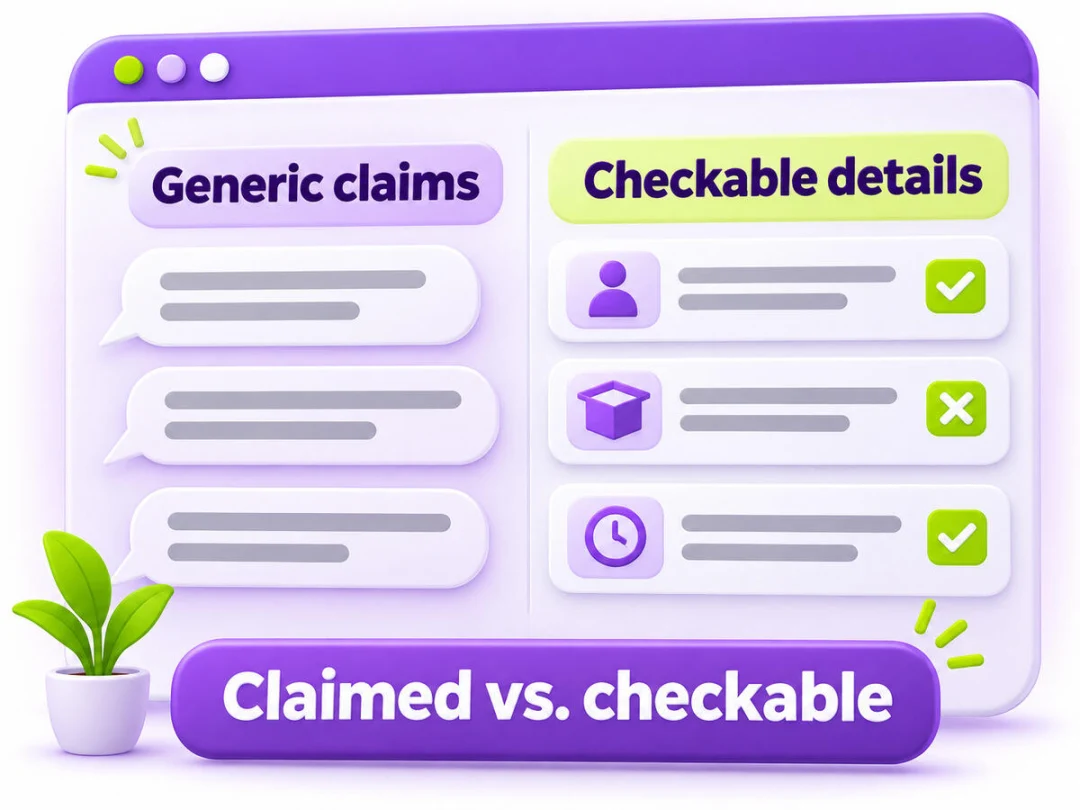
Claimed vs. checkable
Make expertise and authorship honest
A reader who is about to book work or follow a technical explanation should be able to see who is responsible for the page. That does not mean a biography on every short notice. It means a real person where a person is needed.
A real person is better than a stock profile
Use a name, a role, and a fact you can stand behind. "Maya Chen, lead photographer, focuses on family sessions and small weddings in the county" is enough if Maya is a real person at that fictional studio and the claim is true in the teaching scenario. "Our award-winning experts" with a stock portrait and no name is not. Do not invent job titles, degrees, licenses, or years in business. Do not generate a face and present it as a staff photo, and do not borrow someone else's diploma or testimonial.
If more than one person does the work, say who the customer will meet and who reviews the work. A short "written by the shop team, reviewed by [name], service manager" is clearer than a fake sole author.
Who, how, and why — in language a customer understands
On pages that teach or sell a service, answer three plain questions: who is responsible, how the page was prepared (first-hand work, a documented process, or a general summary), and why the page exists. Write those answers the way you would say them at the counter. "I am a staff photographer here and I shoot the family sessions I write about" is clearer than a list of adjectives.
If software helped you draft the text, do not present the result as sole expertise you do not have. Automation can clean up wording. It cannot invent a process you have never run or a credential you do not hold. A generated author with a polished biography is a warning sign, not a shortcut to trust. Keep the language modest. "I have been repairing European cars in this shop since 2018" is a checkable claim if it is true; "the region's most trusted specialist" is usually not.
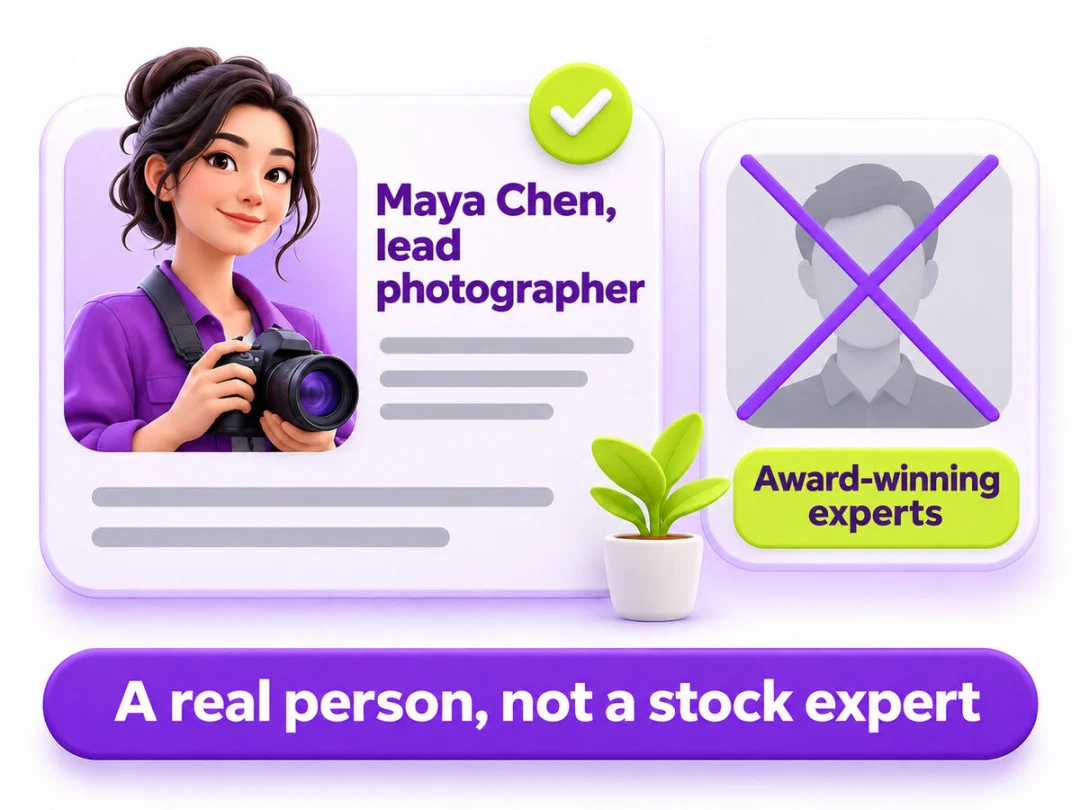
A real person, not a stock expert
Build trust with checkable facts, not slogans
Trust is built from facts a stranger can verify, repeated consistently, and kept up to date. Slogans fail because they cannot be checked, not because they are short.
Contact, policies, and consistent business facts
A small service site should make it easy to find how to reach you, where you work if you have a public location, and the rules that affect a booking or a repair. Hours, a phone number that is answered, a form that actually arrives, and the area you serve are more useful than a paragraph about "putting customers first."
Those facts should match across the site. If the footer, the contact page, and a service page disagree about the address or the phone number, the reader has a reason to doubt the rest. Keep the name, address, and phone consistent, and keep business facts consistent in the places a customer already checks. That is a consistency task, not a lesson in local search or a guide to managing a Google profile.
Policies belong in ordinary language. "We send a written estimate before we order parts, and we call if the findings change the price" is a rule a customer can use; "fair pricing and honest work" is not. If you collect a deposit, say when it is due and what happens if a session is postponed. If a diagnosis is billed separately from the repair, say so before the visit.
Reviews are one signal, not a substitute for clear pages
Reviews can support trust when they are real and describe work you actually do. They do not replace a clear service page, a named person, or a policy a customer can read before they book. A site that is vague about process and then points to a wall of praise still leaves the important questions unanswered.
This is not a guide to automating replies or managing a profile. Replies, when you choose to write them, are a separate skill; replies to reviews are a separate skill from writing the pages themselves. Do not invent testimonials or ask people to ignore a problem on the page because a review looks favorable.
If a review mentions a detail that is already on your service page—a typical timeline, a limit, or a named technician—that is useful confirmation. If reviews are the only place a customer can learn how you work, move that information onto the page you control.
What not to fake, and when extra care is needed
The fastest way to weaken trust is to invent the proof you wish you had. A small site needs claims that survive a careful reading, not borrowed authority.
Invented credentials and recycled content
Do not invent licenses, awards, partnership badges, years in business, or a roster of clients, and do not imply a certification you used to hold or one that applies to a different service. If a claim cannot be checked, take it off the page or rewrite it as something you can defend.
Be just as careful with text you did not earn. A page that restates a brochure or another shop's process—without first-hand limits or your own steps—does not show experience. Copying a competitor's "about" page, even with the names changed, is not authorship. Stock photos of other people's work, generated portraits, and "as seen in" logos you were not featured in belong in the same category.
Topics that can affect health, money, or safety
Not every small business page is automatically a high-risk topic. A menu of portrait packages or a shop's oil-change process is ordinary commercial information. But if a page could substantially affect a person's health, money, or safety, the standard of accuracy is stricter. That includes medical, legal, or financial advice you are not qualified to give, and safety topics you might touch in passing, such as brake performance or electrical work.
Do not offer a diagnosis, a legal conclusion, or an investment recommendation under the cover of a helpful article. Stay inside what you are competent to say, name the person who is responsible, and send the reader to a qualified professional when the decision is not yours to make. Do not treat quality-rater documents as a ranking recipe or cite their section numbers as instructions for climbing in search. Those reviews are not how pages are ordered in results.
A simple review you can repeat
You do not need a score out of 100. You need a short review you can repeat when a page changes or a policy is updated. Walk through the claims a customer would rely on and write down what supports each one. If the support is missing, add a checkable fact or remove the claim.
The table below is a working log for the same fictional studio used earlier. The rows are teaching examples, not a real audit and not a measurement from Google.
| Claim on the page | How it is supported | What to fix |
|---|---|---|
| "A professional team with years of experience" | No names, dates, or roles | Replace with a named photographer and a true, limited description of their work |
| "Sessions include a full gallery in 48 hours" | The studio usually needs two to three weeks | Rewrite as a typical range and a condition, or remove the promise |
| "Award-winning family photographer" | No award is named or dated | Remove the award, or name a real one the person actually received |
| Staff photo of "lead editor Jordan Lee" | A stock image; no editor by that name works there | Remove the invented person and the stock face |
Repeat the same log for contact details, prices you publish, and any license you mention. Date the review. If a fact has changed, update every page that still shows the old version.
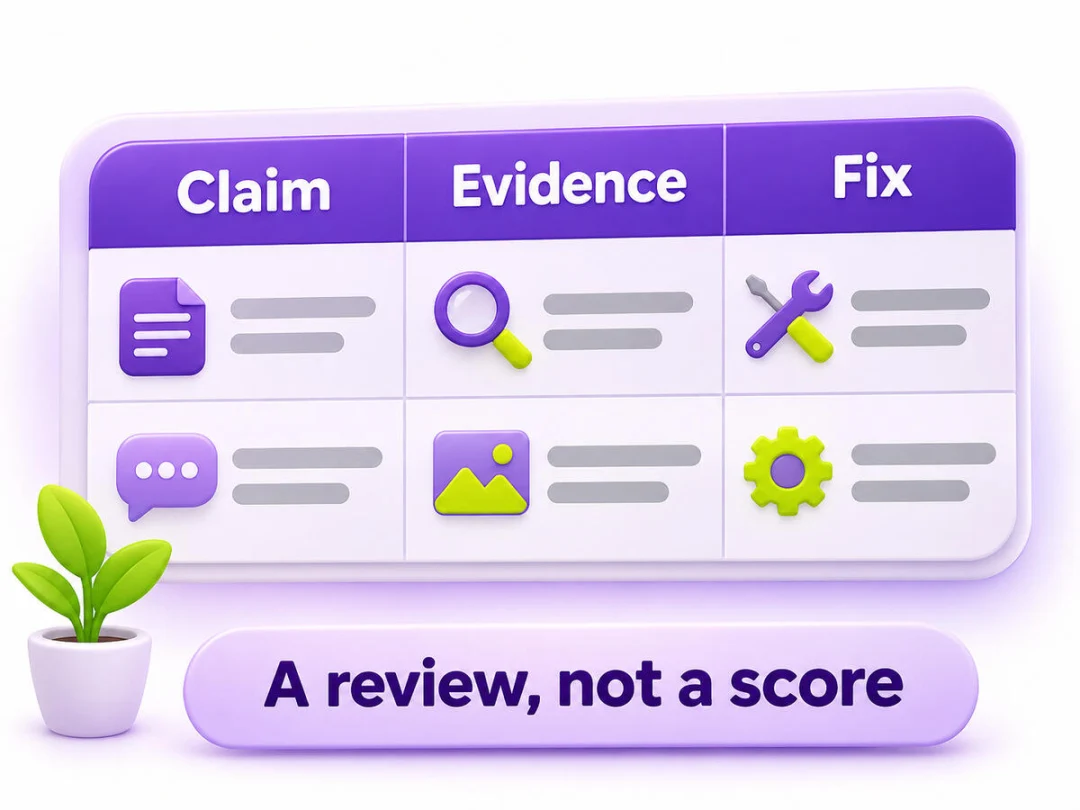
A review, not a score
FAQ
What is EEAT in SEO?
E-E-A-T stands for Experience, Expertise, Authoritativeness, and Trust. In SEO, it is a way to describe whether content looks useful and reliable, not a score or a label in a Google account. The practical work is to make those qualities visible on your pages.
Is E-E-A-T a Google ranking factor?
By itself, no. Public descriptions of the idea say E-E-A-T is not a specific ranking factor. Search systems do look at many signs of helpful, trustworthy content, and trust is treated as the most important of the four parts. That is not a promise that a biography or a badge will raise a position.
How can a small business show experience without national awards?
Show the process, the limits of the service, and work that is actually yours, used with permission. Name the person who does the job. A clear service page with checkable details is more useful than a badge you do not have.
Do I need an author bio on every page?
No. Add a real person where a reader would reasonably want to know who is responsible—on a service explanation, a technical article, or advice a customer might follow. Do not stamp an empty biography, a stock portrait, or a generated author onto every short page.
Can AI-written pages have strong E-E-A-T?
Automation can help you draft or edit, but it does not replace first-hand experience or a person who will stand behind the page. A fabricated author, invented credentials, or a process you have never run are signs of weak reliability. There is no guaranteed pass or penalty attached to the tool itself.
Does answering reviews improve E-E-A-T?
Reviews can support trust when they are genuine, but they do not replace clear pages, consistent facts, or a named person where one is needed. Answering reviews is a separate skill from writing those pages, and it is not a reason to automate replies or treat a profile as a substitute for your site.
Visible proof beats borrowed authority
The useful version of EEAT SEO for a small service business is visible proof: a real process, a real person, and facts a customer can check. You do not need to invent awards, faces, or a score. You need pages that still make sense when someone tries to verify them, and a short review you can repeat when those pages change.