
Basic SEO for $10 a Month: What Happens When Content Is Paid for in Tokens
Content used to have a simple price. A writer charged per article or per word, you paid the invoice, the article went live. That model is quietly being replaced. When a team of AI agents writes the content, nobody invoices you per article. A meter runs instead, and the meter counts tokens.
We know, because we measured ours. Here is what AI tokens cost in practice. The short version: five finished articles took 64.7 million tokens, one article works out to about $0.35, and a month of daily articles would cost about $10 of a subscription. Here is the full breakdown.
Five articles, one meter
An agent team produced five full articles for an auto service website. These are not stubs or spun text. One of them is a complete guide to a single engine fault code, P0325, the knock sensor circuit: what the code means, how it differs from the neighbouring codes, typical causes, symptoms, the diagnostic procedure a shop follows, and an FAQ. About 1,900 words, with images, a comparison table and internal links.
The team's work is recorded in the usage statistics of the Grok subscription that powers it. The five articles ran in one evening session, and the meter reading for that session is exact: 64,700,424 tokens.
One article, on average, took about 13 million tokens.
Where the tokens actually go
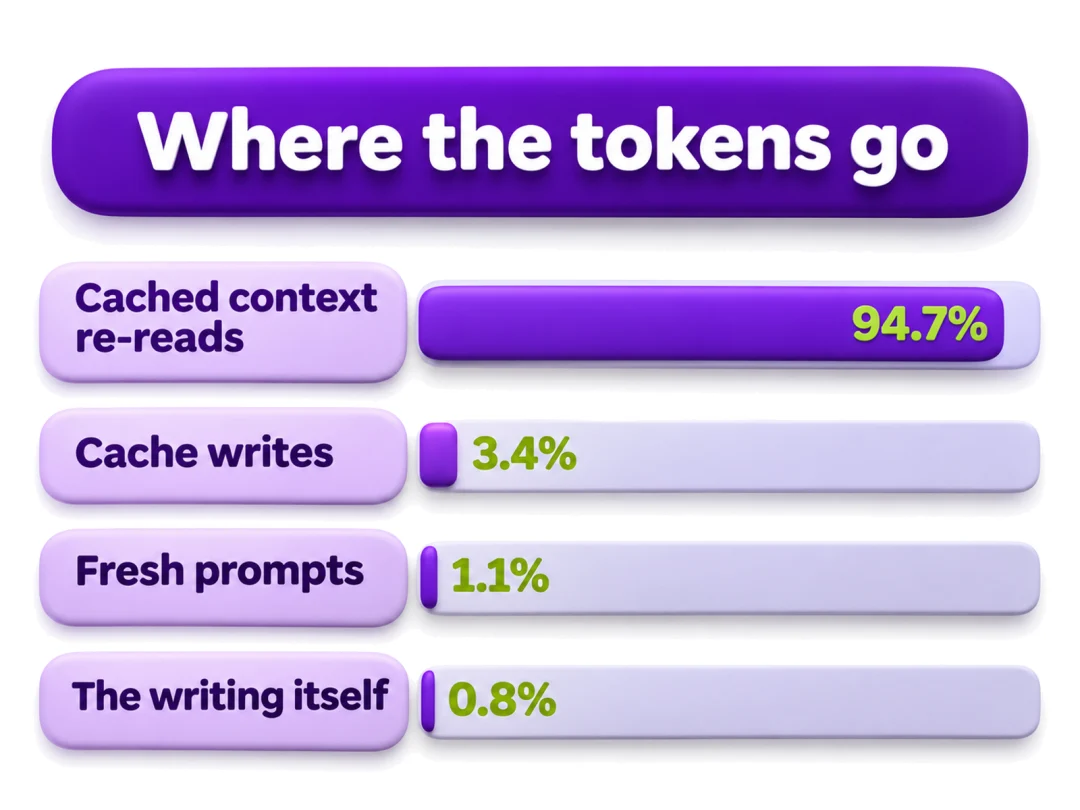
The finished text of an article is roughly 2,500 tokens. So where did the other 13 million go? The breakdown is the interesting part:
- 94.7%: cached context re-reads. Every pass re-reads the research, the brief and the previous drafts.
- 3.4%: writing new material into the cache.
- 1.1%: fresh prompts.
- 0.8%: the generated text itself, every draft and rewrite included.
The writing is under one percent of the bill. The rest is the editorial office thinking: research reading sources, a writer drafting, a critic sending the draft back, the writer rewriting. A human newsroom burns time on the same loops. An agent newsroom burns tokens, and unlike time, tokens are counted to the last unit.
The money
The subscription costs $100 a month. The five articles used about 7% of its weekly included allowance, and the full weekly allowance works out to roughly 916 million tokens. At that rate:
- 1 million tokens costs about $0.027, under three cents.
- One finished article costs about $0.35.
- A month of publishing, one article a day, uses about 388 million tokens, roughly $10 of the subscription.
Read that last line again. Basic SEO content for a small website, an article a day for a month, now costs about $10 a month. Not $10 per article. Ten dollars for the month, paid in tokens.
The same work bought through the API is a different story. At the official Grok 4.7 rates, and with this exact token mix, one article lands between $8 and $16, because long agent prompts fall into the doubled long-context tier. The subscription is cheaper by roughly thirty times, as long as the work stays inside its limits. That is the trade: a flat, capped allowance instead of an open meter.
All prices checked in November 2026.

What the $100 actually buys
xAI does not publish the subscription allowance as a token number. The dashboard shows it only as a percentage, and this week the percentage can be decoded: 229 million tokens of total usage came to exactly 25% of the included weekly volume. So the full week is about 916 million tokens, and a month of weekly resets adds up to roughly 3.7 to 4 billion tokens for the $100. The dashboard rounds the percentage, so read the figure as approximate: somewhere between 900 and 935 million tokens a week.
The allowance is a cap, not a wall. Past it, the account does not stop working; it switches to paid credits, billed as additional usage. On this account that block still reads $0.00, with auto top-up off. Everything in this article ran inside the included volume, and the month's content bill is the flat $100, of which the daily articles used about a tenth.
What changes for a small business
First, content stops being a project and becomes a utility. You do not commission articles one by one; you keep a meter running and a team working, the way you keep the lights on.
Second, the scarce skill moves. When generation costs cents, writing is not the bottleneck. Judgment is: which topics deserve an article, which loops are worth their tokens, and where a human still checks the facts. In our runs the expensive mistakes were not bad sentences. They were confident, well-written wrong details, and they were caught by sampling and by reading the rejection log, not by reading every word.
Third, the budget question changes shape. The question is no longer "what does an article cost?" It is "what does a month of the meter cost, and how many good articles came out of it?" Cost per published article, not cost per generation, is the number to watch, because drafts that never ship still burn tokens.
How useful content brings in an audience
None of this matters if nobody reads the articles. Content works as marketing for a simple reason: people arrive at websites with questions. A driver with a warning light searches the fault code. A shop owner searches what a CRM costs. The page that answers that exact question, clearly and completely, is the page search engines show and the page the visitor stays on.
Useful content also compounds. One good guide keeps bringing visitors for months. It gets bookmarked, shared and linked to, and every new article covers another question customers actually ask. That is the part the token economics changes: when an article costs $0.35 instead of a writer's fee, a small business can afford to answer dozens of specific questions instead of a handful of broad ones, and every answer is another door into the site.
The honest limits
Tokens are cheap inside a subscription allowance and noticeably less cheap outside it. Heavy users hit weekly limits, and API pricing for the same work is tens of times higher. The meter also rewards discipline: a sloppy loop that re-reads a huge context fifty times costs real money even at three cents per million, and produces a worse article, not a better one.
But the direction is set. Content has a new unit price, and it is not the word and not the article. It is the token. The businesses that learn to read that meter early will publish more, spend less, and spend their human hours where humans still win: on judgment.