
Landing Page vs Website: How to Choose for a Small Business
A shop owner wants to announce a seasonal offer and is trying to choose between a single focused page and a fuller site. A friend says a landing page will “sell better.” Another friend says a real business needs a website with several pages. This is a fictional example, not a measured case. The useful first step is not to pick a format by habit. It is to define the job the pages must do.
A landing page vs website decision is a choice about role, audience, and how much information a visitor needs—not a promise of a higher conversion result. This guide gives criteria, a simple matrix, and three educational scenarios so you can choose the smallest structure that answers real questions.
A landing page is a role, not a page count
If you are asking what is a landing page, start with the job it is meant to do, not with the number of pages. In marketing, people often use the term for a page built around one offer and one main action. That page can stand on its own, or it can live inside a larger site.
A one-page website can present the whole business: who you are, what you offer, proof, and a way to get in touch. A campaign landing page can sit beside that site and support one promotion, one audience, or one season. The two are not opposites, and neither is automatically “more modern.”
Campaign page, homepage, and one-page website
A campaign page usually has a narrow job: explain one offer and help a person take one next step, such as a booking request or a form. A homepage has a different job. The difference in a landing page vs homepage comparison is role, not length. A homepage orients a visitor, shows more than one path, and helps someone choose where to go next. A one-page website can look like a long homepage: it represents the business as a whole, even if everything sits on a single URL.
These roles can overlap. A homepage can also be the first page a campaign visitor sees. A campaign page can include a short path back to the rest of the site when that context is necessary. What matters is whether the page’s job is clear, not whether the menu is empty.
Why analytics uses the word differently
Analytics tools often use the same words in a broader way. In GA4, a landing page is the first page of a session. That first page might be a campaign offer, a homepage, a service page, or an article. It is not, by definition, a page without navigation.
When you look at reports, do not treat every “landing page” row as a campaign page you designed for one offer. The report is telling you where sessions began, not which pages were built as campaign destinations. Keep the marketing meaning and the analytics meaning separate so you do not judge the wrong page by the wrong job.
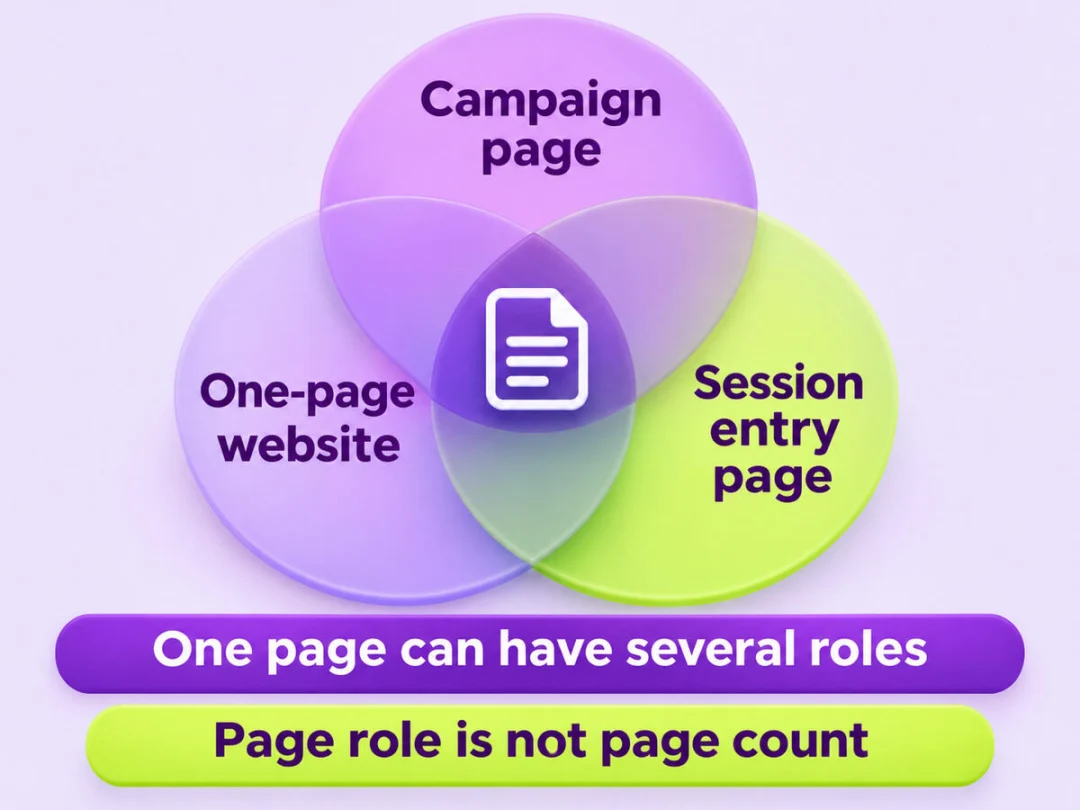
Page role is not page count
Compare the jobs each structure can do
The useful question in a landing page vs website comparison is not “which format is better.” It is “what job does this visitor need the page to do.” A focused page and a small website can both work. They fail in different ways when the job and the structure do not match.
There is no rule that a focused page is only for ads, that a website must have a minimum number of pages, that either format can be launched on a fixed timetable, or that a focused page can never appear in search. Those shortcuts skip the work of matching structure to questions.
One audience and offer
If one audience is arriving for one offer, a focused page can be enough. The visitor already has a reason to be there: a seasonal session, a limited call for work, or a single service with a clear next step. The page should explain that offer, show the proof that belongs to it, and make the next step usable. Extra paths can wait if they would only dilute the question the visitor came to answer.
This still requires honest content. A short page with a vague promise is not more effective simply because it is short.
Several services and research paths
If visitors arrive with different jobs in mind, or need to compare more than one path, a small set of connected pages usually helps more than one long scroll. A shop that handles inspections, scheduled repairs, and longer diagnostics may need a homepage that routes people, plus enough detail for each kind of work. An artist who shows finished pieces and also explains commission terms may need more than one block if those questions keep getting mixed together.
The table below is a comparison sheet, not a ranking of formats and not a build estimate.
| Question | Focused campaign page | One-page business site | Small multi-page site | Site plus a campaign page |
|---|---|---|---|---|
| Main goal | One offer, one action | Represent the whole business | Help visitors choose among paths | Keep the site and support one campaign |
| Content complexity | Narrow scope | Several topics on one URL | Separate pages where questions differ | Shared facts on the site, campaign facts on the extra page |
| Proof needed | Proof for that offer | Proof for the practice as a whole | Proof next to the relevant path | General proof on the site, offer-specific proof on the campaign page |
| Incoming traffic | One campaign, audience, or season | Mixed visits to the business | Mixed visits and different queries | Campaign traffic to the focused page, other visits to the site |
| Navigation | Limited; keep necessary contacts and policies | In-page sections can be enough | Clear paths between related pages | Campaign page stays focused; the site keeps the wider menu |
| Maintenance | Update one offer without rewriting the site | One page to update, but changes can get crowded | Update the affected page; watch conflicting facts | Change or retire the campaign page when the offer shifts |
| What to measure | That one action, from that source, in a defined period | Inquiries or bookings, with a clear denominator | Useful actions by path, not only total visits | Campaign results and site results kept separate |
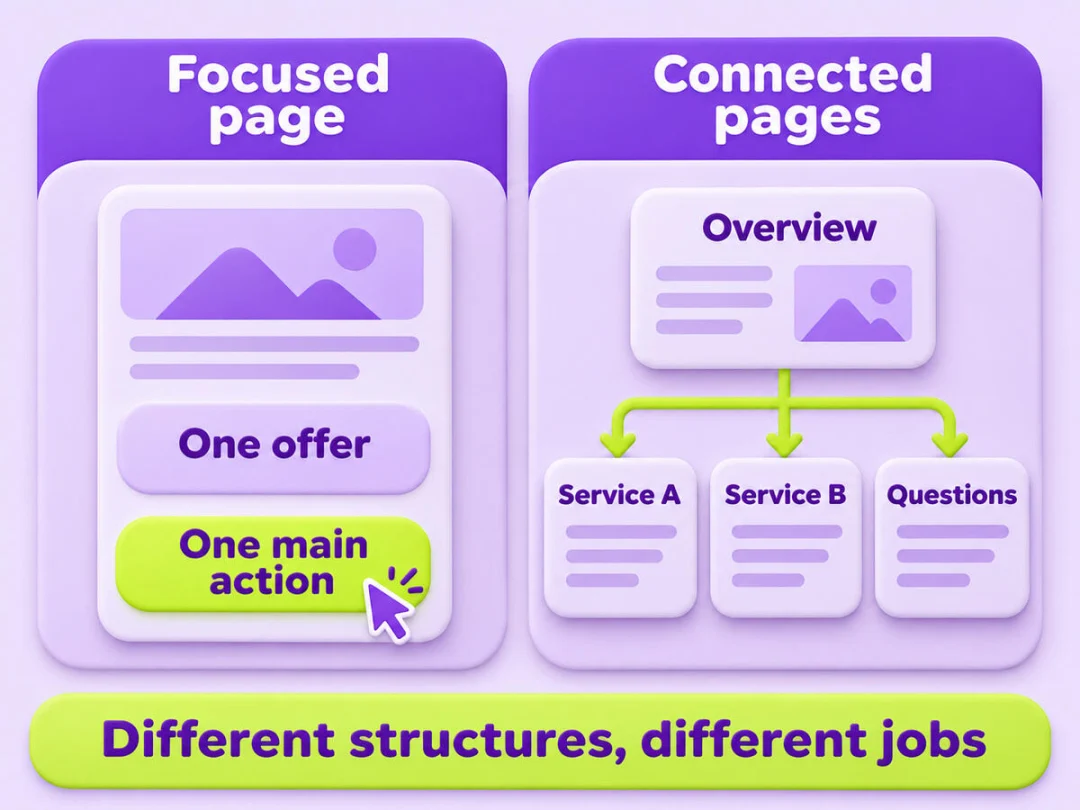
Different structures, different jobs
Use a decision matrix, not a design trend
Choose from the visitor’s questions and from what you can maintain, not from a layout trend. A format that looks “clean” is not useful if the customer still cannot tell what is included, where you work, or how to start.
If you still need to check whether customers ask different questions, pause and gather those questions before you add pages. If the audience, offer, or maintenance owner is still unclear, choose “need more facts” and resolve those questions before choosing a structure. A blog is not required for every business, and a new page is not required for every wording of a query.
When a focused page is enough
A focused page is often enough when the audience is coming for one offer, the scope can be explained on that page, the proof belongs to that offer, and one person can keep the facts current. It also helps when you want to test a seasonal or limited offer without rebuilding the whole site.
Consider separate pages when visitors need distinct paths for different services, locations, or conditions that would become confusing on one page. A landing page can extend across several screens. Do not remove privacy information, policies, or needed context just to leave a single button.
When visitors need several connected pages
Several connected pages help when the questions differ by service, by location, or by stage of the decision. They also help when one long page would mix unlike jobs—such as a repair type that needs its own process and proof—or when different people on the team update different offers. In that case, a homepage or a simple list can point the way, and each page can stay specific.
Connected pages only work if someone keeps them consistent. Two pages that disagree on hours, area, or price method are worse than one shorter page with a true answer.
When both work together
Sometimes the right answer is both. Keep a small website for the business as a whole, and add a campaign page for a season, a limited offer, or a specific audience. The campaign page should not silently contradict the site. When the offer ends, update or retire that page instead of leaving an expired promise online.
This is also where maintenance matters. If no one can update two places, do not invent a second page you cannot keep accurate.
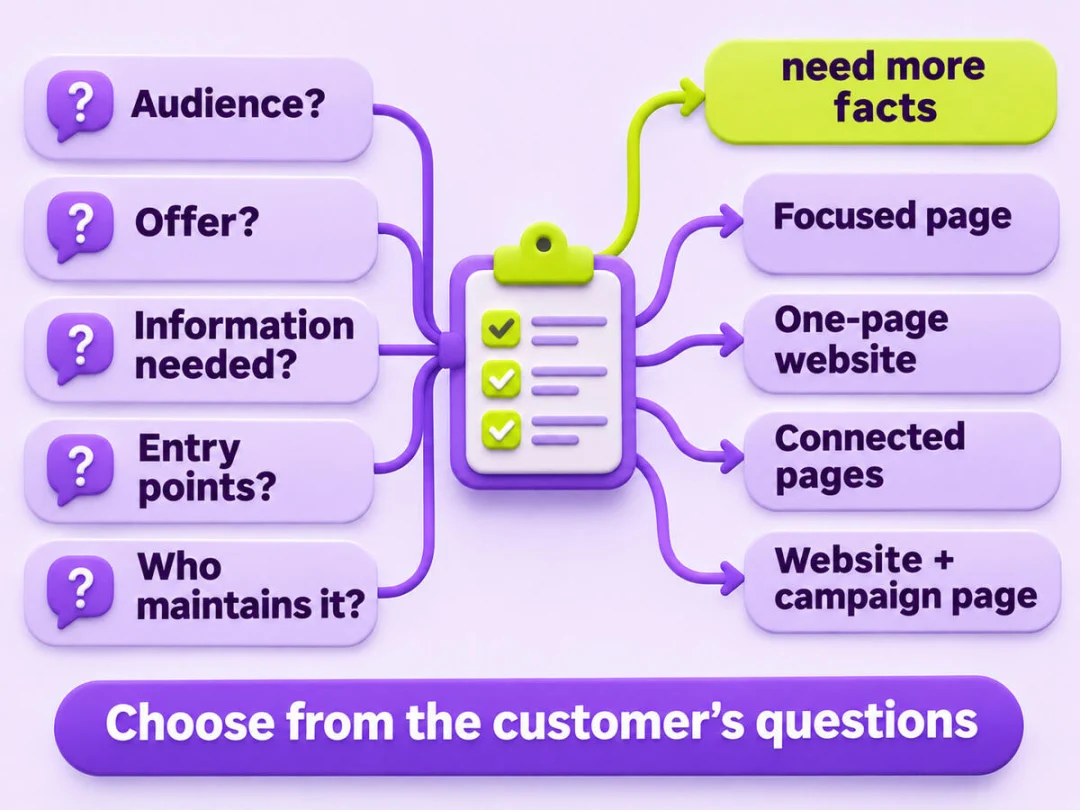
Choose from the customer’s questions
Three small-business scenarios
The landing page examples below are fictional scenarios, not real clients and not proof that one structure “wins.” Each starts with a condition, a reasonable structure, and a reason to reconsider. Fill in only the facts of your own business.
A photographer testing seasonal sessions
Starting condition: the photographer already has a simple site and wants to test a short run of holiday mini-sessions for a defined period. The offer has its own dates, a limited number of sittings, and a specific next step.
A reasonable first choice is a focused campaign page that sits beside the existing site. The page can explain the seasonal offer and point back to the main site for broader portrait work. Reconsider if visitors keep asking about year-round packages, travel, or usage terms that do not belong on the seasonal page, or if the mini-session becomes a regular service that needs a lasting place on the site.
An auto shop with different repair needs
Starting condition: people contact the shop with different jobs in mind. One visitor wants a scheduled inspection. Another needs a defined repair. A third has a problem that requires a longer diagnosis before any repair is approved.
A reasonable first choice is a small multi-page site: a homepage that routes the visitor, plus enough separate detail for those different jobs. Reconsider if the shop later runs one seasonal campaign, such as a winter-prep offer, and needs a focused page for that campaign only. Also reconsider if two “services” are in fact the same process with the same limits and can share one page.
An artist accepting commissions
Starting condition: the artist takes commissions and also needs a simple public place to explain the practice, show a few finished pieces, and describe how a commission starts.
A reasonable first choice is a one-page website that presents the practice, the commission path, and a contact method. Reconsider if visitors need a separate gallery, if different kinds of commissions have different terms, or if the artist later announces a limited call for work that deserves its own campaign page. The structure should change when the questions change, not when a new layout becomes fashionable.
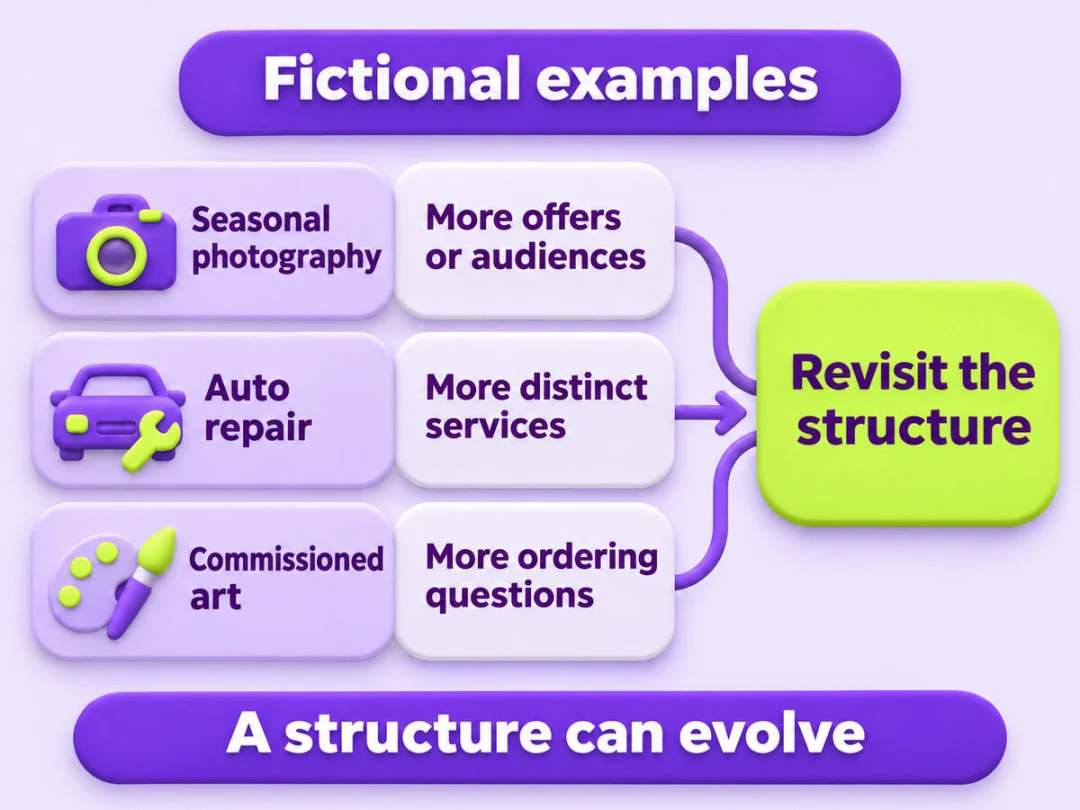
A structure can evolve
What neither option fixes by itself
Neither a focused page nor a larger site will repair unclear scope, invented proof, a broken form, or hours and availability that are not true. A visitor who cannot tell what is included will not be helped by an extra menu item. A visitor who cannot submit a request will not be helped by a shorter scroll.
The number of pages does not prove trust and does not guarantee search visibility. A one-page site can be found if it is useful and accessible. A larger site does not earn traffic merely by having more URLs. Removing privacy information, policies, or accessibility aids to leave “just one button” does not make the page more honest, and it can remove information a person needs before contacting you.
Minimum landing page best practices, in this article, are checks rather than decoration: the offer is true, the next step works, the important conditions are visible, and the page can be used on a phone. The same checks apply to a homepage and to a service page. This is not a technical audit of the whole site.
Measure useful outcomes and expand when needed
Measure the outcome that matches the job. Count bookings or inquiries separately from visits. Count qualified requests separately from total form submissions. A thank-you page is not proof of a qualified lead. Keep the same denominator, period, and source definition when you compare one period with another.
A landing page conversion rate is only meaningful when you know which action you counted, which visits you included, and which source those visits came from. You cannot treat conversion from different sources as proof that one structure is better than another. There is no confirmed average “good” rate that this article can apply to a small site, and this is not a tutorial in analytics software.
Add a page when you have a confirmed, separate need: a different set of questions, a different offer, or a campaign that would clutter the main site. Do not add a page for every keyword variation, and do not build a set of nearly identical city pages that repeat the same thin content. When you do add connected pages, help readers move between related pages so the path stays understandable. Choose the job first, then the smallest structure that can do that job honestly.
FAQ
Can a landing page replace a website?
Sometimes, if the business has a narrow job, a clear offer, and visitors who do not need several different paths. It depends on the information they need and how they arrive. A single page is not automatically enough for a business with unlike services or unlike audiences.
Is a one-page website the same as a landing page?
No. A one-page website can represent the whole business. A landing page, in the marketing sense, is often built around one offer and one action. The difference is purpose and role, not the number of pages.
What is the difference between a landing page and a homepage?
A campaign page is usually built for one action. A homepage helps a visitor get oriented and choose a path. The two can overlap—the homepage may also be the first page of a session—but the jobs are not identical.
Can a landing page appear in organic search?
Yes, if the page is accessible, can be indexed, and is useful for the query. That is not a guarantee of ranking, and the label “landing page” neither helps nor blocks a page by itself.
Do landing pages need to remove every navigation link?
No. That is not a universal rule. Necessary contact details, policies, and context should not be sacrificed only to leave one button. Limited navigation can help a focused offer, but useful links are not automatically a defect.
Does a landing page always convert better?
No. A higher result on one page is not proof that the format is superior unless the traffic, the audience, and the event being counted are comparable, and the comparison is designed for that question. Structure alone does not guarantee a better rate.
Choose the smallest structure that answers the real questions
The sound landing page vs website choice is the smallest structure that answers the questions a real visitor has, and that you can keep accurate. Start with the job, the audience, and the facts you can maintain. Then expand only when a separate need is clear.