
Lead Follow-Up for Small Business: From Inquiry to Next Step
A family emails a photographer about a Saturday session for a birthday. The note lands in a shared inbox, and nobody answers that day. By Monday the family has booked someone else. This is a fictional example, not a measured case—but the problem is ordinary: the inquiry arrived, and there was no clear next step.
Lead follow-up is the work after that first message: confirm it arrived, answer the actual question, record who owns the conversation, and either move it forward or close it without pressure. You can run this in a shared table, in email, or in any record you use. This guide is a manual workflow, not a reason to buy software.
What lead follow-up includes
This work starts after an inbound inquiry exists. It is not the same as finding new people to contact. A useful process covers four jobs: confirm the message was received, answer the question that was asked, keep one owner and a dated next step, and stop when the person has replied, declined, booked, or asked not to be contacted again.
When the person replies, stop the reminder sequence and respond to their message; do not stop the conversation itself.
In a small service business, that is also what people often mean by sales follow up: a relevant next message after a real conversation has begun, not a drip of leftover pitches.
Acknowledgement vs a useful answer
An automatic “we got your message” is not the same as a human answer. An acknowledgement only tells the person the note arrived. A useful answer confirms the request, adds a specific detail you can stand behind, asks one question you need, and names the next step.
If you send an auto-reply, treat it as a receipt, not as the reply. The clock that matters is the time until someone answers the substance of the request. A receipt does not tell a family whether Saturday is still open, or a shop whether a diagnostic visit can be booked.
Inbound inquiry vs cold outreach
An inbound inquiry is a person who already reached out—about a date, a repair, a session, or a commissioned piece. They asked a question. Your job is to answer it and keep the thread tidy.
Cold outreach is different: you started the contact. The tone, purpose, and legal limits are not the same. A request for a quote does not, by itself, give you open-ended permission to add that person to a marketing list, send promotional texts, or keep writing after they have said no. Message type, channel, and jurisdiction all matter; check the rules that apply to you. This article does not offer legal clearance for a template.
Give every inquiry an owner and a next step
An inquiry can go unanswered when two people each assume the other will reply, or when nobody records the next step. Assign an owner and a dated next action before polishing the wording.
A simple lead follow up system, in this article, is not a product. It is a shared record with an owner, a date, and a status that anyone on the team can read.
A minimum lead record
You do not need a long profile. You need enough lead tracking to prevent a message from sitting unanswered or being handled twice. Keep only what you need to serve the request. Do not store passwords, extra personal details, or notes that have no operational purpose.
A shared spreadsheet or notebook is enough. Record the source, the date received, the need in plain words, one owner, the last action, the next step with a date, the allowed channel, and a short status. Reply in the same channel unless the person asked otherwise. These fields are a starting point, not a software schema.
Here is a fictional row for a photography inquiry, with placeholder details only:
| Source | Date received | Need | Owner | Last action | Next step and date | Allowed channel | Status |
|---|---|---|---|---|---|---|---|
| Website form | 2026-11-10, 09:40 | Saturday family session, about two hours, outdoor park | Maya | Asked about preferred start time (2026-11-10, 11:15) | Send availability and a session outline by 2026-11-11 | Waiting for clarification |
Use the same short status list as a team. A practical sequence is: received → replied → waiting for clarification or a decision → agreed or closed. Change the wording if you must, but do not invent a long pipeline that nobody updates.
If you need context on where local inquiries can come from, that is a separate question from handling a request already in your inbox.
Handover without duplicate replies
When the owner changes—someone is out, a specialist takes over, or a quote needs review—write the handover in the record before anyone else sends a message. The new owner should see the original request, the last action, and the promised next step.
Only the current owner should send the next message, unless they have clearly asked someone to step in. If two people start a reply, one of them should stop and note that in the record. Duplicate answers confuse the customer and make your dates unreliable.
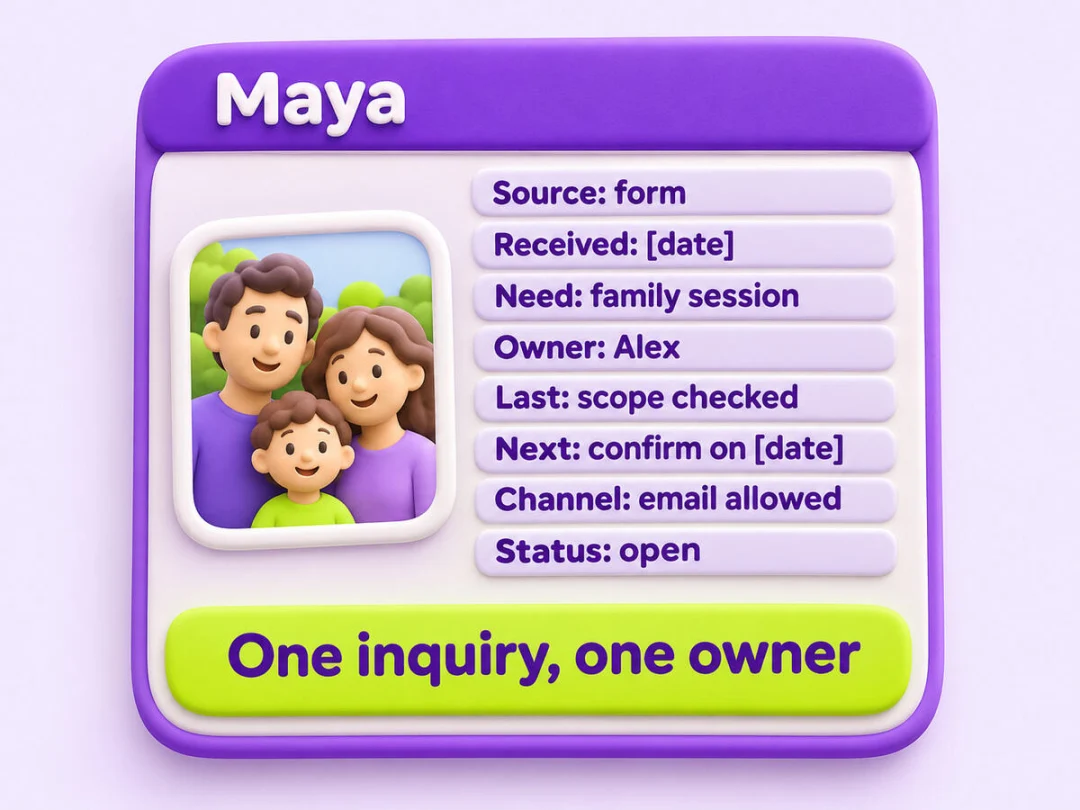
One inquiry, one owner
Reply to the actual question first
The first useful reply should address what the person asked, not everything you might later sell. If they asked whether Saturday is open, start with Saturday. If they asked whether a diagnostic visit can be booked this week, start there. A broad introduction to every service can wait until the immediate question is clear.
Be specific without inventing a quote
You can be concrete without inventing a price, a completion date, or a promise you have not approved. Confirm the scope as you understand it. Name the part you can already stand behind—such as “I can hold a two-hour outdoor session if Saturday late afternoon is still free.” Then ask one question that would change the next step, such as a preferred start time, the vehicle model, or the size of the artwork.
Do not fill the gaps with a made-up number “just to keep things moving.” If a colleague has to approve a price or a schedule, say that a person will confirm it. “I will check and reply by Thursday afternoon” is more useful than a fast figure you later withdraw.
Set expectations you can meet
Promise only a response window you can keep on a normal day, not an impressive target you miss when the shop is busy. If you cannot answer the full question immediately, say what you can confirm now and when the rest will come, then put that date in the record.
There is no universal standard for how quickly every small business must answer. A same-day reply is often kind; it is not a certified rule. What matters is that the person knows what happens next, and that you meet the time you named.
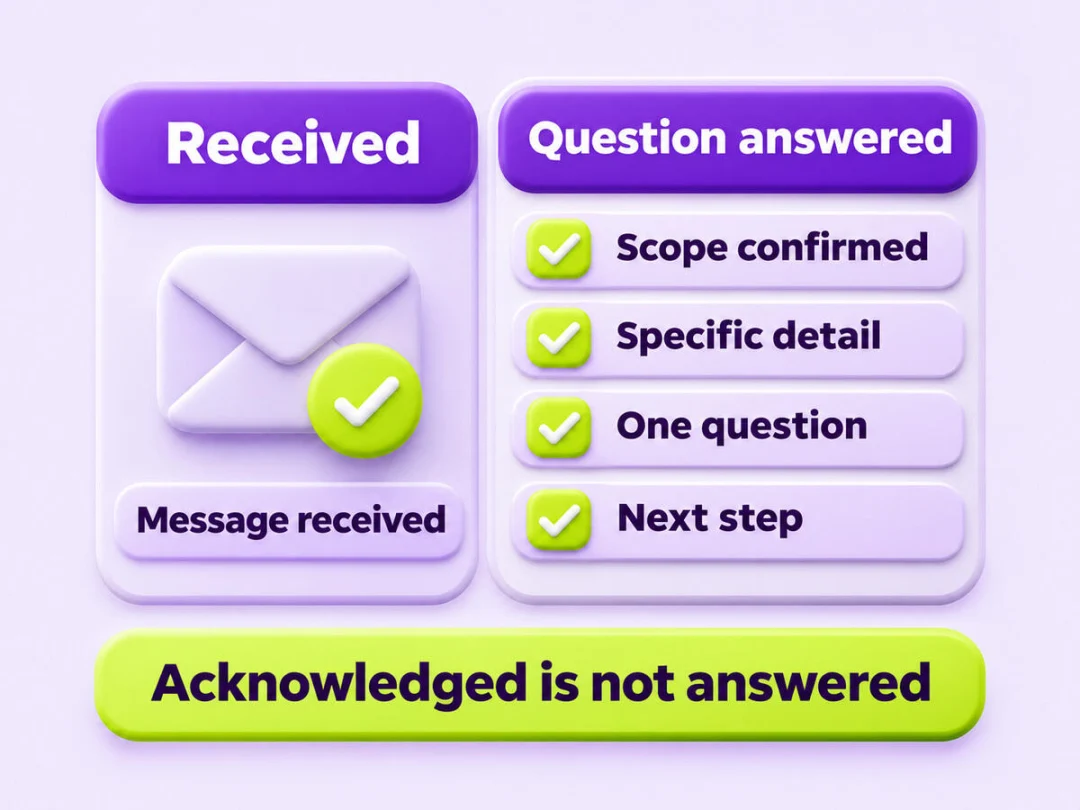
Acknowledged is not answered
Write follow-ups that add something useful
A later message should earn its place. Repeat “just checking in” only if you also add a useful detail, a clearer next step, or a clean way to close the conversation. The three notes below are educational templates. Adapt the facts, replace every placeholder, and do not send them as-is. They are not a claim of legal compliance.
There is no required number of touches and no official interval. Write again only when you have a reason, and stop when the conversation has changed.
After the first inquiry
Use this when you have received the request and can confirm part of it, but still need one fact before you go further.
Subject: Your [Saturday family session] request
Body:
Hello [Name],
Thank you for writing about a [Saturday family session] in [the park near your neighborhood]. I have your note and can look at a window of about [two hours] if that date is still available.
I only need one detail to plan the next step: [do you prefer a late-afternoon start, or is earlier better]? After I hear from you, I will [check the date and send a simple session outline]. If your plans have changed, a short reply is enough and I will close the request.
[Your name]
[Business name]
This is a short sales follow up email after a real inbound request, not a cold pitch. It confirms the subject, adds a next step, and leaves an easy way to stop.
After a quote
A follow up email after quote should point back to the estimate you already sent, not restart the sale from zero. Name the agreed subject in words. Do not invent a deadline or a disappearing discount.
Subject: Following up on the estimate for [Saturday family session]
Body:
Hello [Name],
I wanted to follow up on the estimate I sent on [November 10] for a [two-hour outdoor family session]. It included [the session time, a set of edited images, and the travel area we discussed].
If you have a question about [the number of edited images or the backup weather date], I am happy to clarify it. If you would like to book, tell me a start time and I will confirm availability. If you have chosen another option, you can say so and I will close the file.
[Your name]
[Business name]
One open question is enough. The person should be able to say yes, ask about one item, or decline without pressure.
A polite close-the-loop message
If you still have no decision after a useful reply and a later note, a final message can close the loop without chasing. This follow up email after no response is a courteous ending, not a last push.
Subject: Closing the request for [Saturday family session] unless you want to continue
Body:
Hello [Name],
I am writing once more about your [Saturday family session] request. I will close this inquiry on my side so it does not sit open. If you still want to talk about the session, reply to this email and I will pick it up. If not, no further message is needed, and I wish you a good celebration.
[Your name]
[Business name]
After a close-the-loop note, mark the status closed unless the person replies. Do not switch to a call, a text, or a social message just because email went quiet.
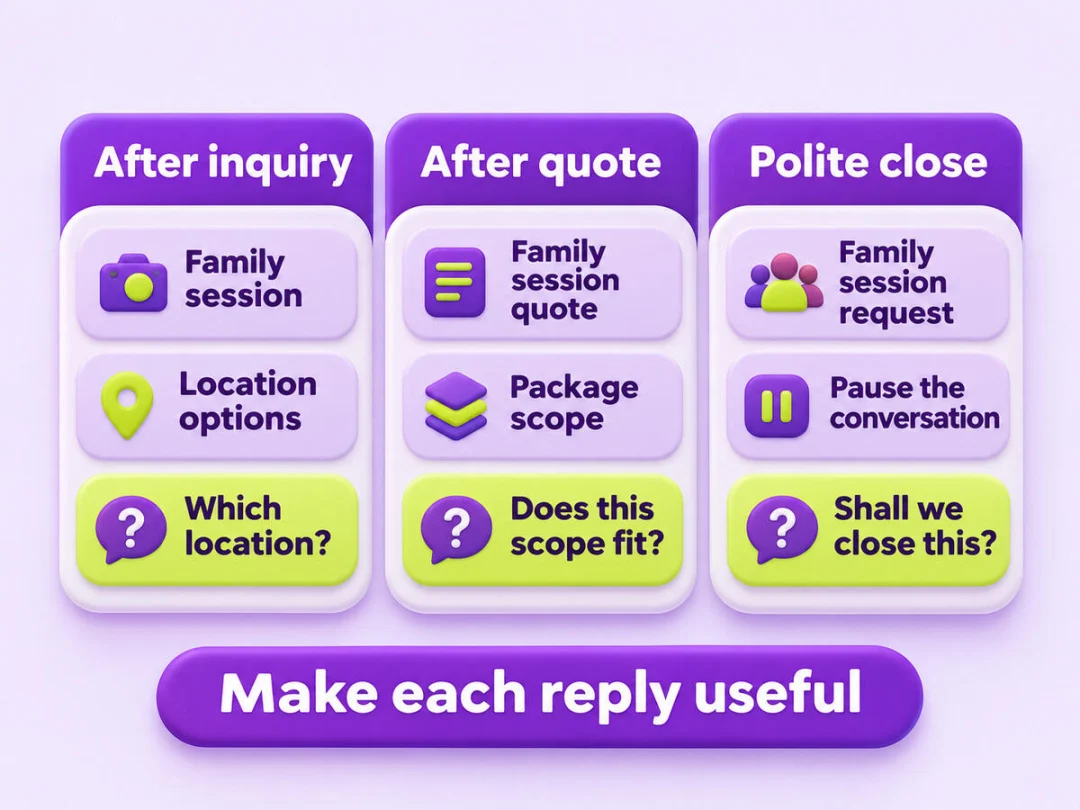
Make each reply useful
Stop, pause, or hand the conversation to a person
Knowing when not to write is part of the process. Before any further message, check the record: has the person replied, booked, declined, or asked you to stop?
Replies, opt-outs, and changed plans
Stop when the person answers, books, declines, or asks not to receive further messages. An opt-out or a clear “please don’t contact me” is a stop, not a cue to try another channel. If they say they want to pause until a later date, record that date and wait; that is a pause, not an invitation to keep checking in.
Plans change: a family may postpone, a shop customer may repair the car elsewhere, a commissioning client may freeze a project. Update the need and the status instead of repeating the old offer.
Automation needs stop rules
If you use any automatic reminder, it still needs a human-readable stop condition. It should not go out after a reply, a booking, a decline, or an opt-out, send a second copy through another channel, or keep running because nobody updated the status.
Some conversations should never stay in a sequence. A complaint, a billing dispute, an unclear or unsafe scope, or a request that needs a judgment call should go to a person. This article does not give instructions for automatic advertising texts or robocalls. Those channels have their own rules, and a form submission is not blanket permission.
Email requirements depend on the type of message and the channel you use. Business-to-business contact is not an automatic exception. Do not treat any template here as proof that a message meets every applicable rule. If you need a legal reading, have it checked separately against the current primary rules that apply to you.
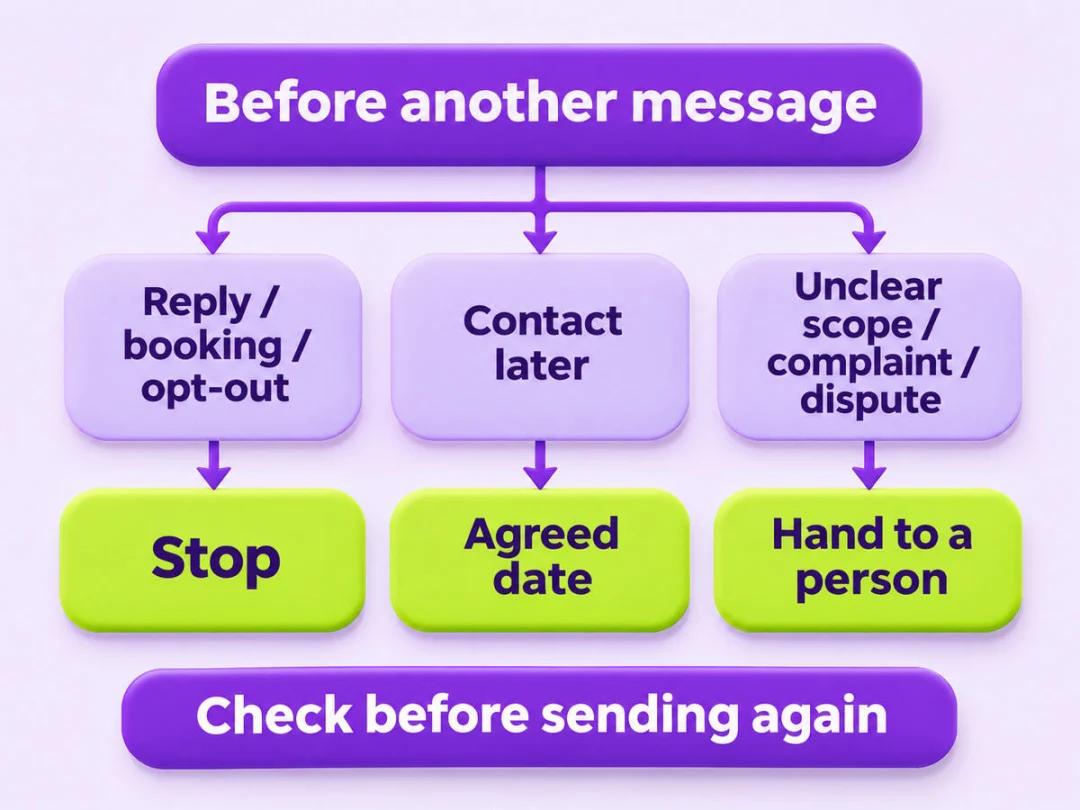
Check before sending again
Review what happened, not just how many messages went out
Counting sent reminders tells you almost nothing. Review the conversation’s result. For a period you define in advance—such as one month—look at a clearly named set of inquiries and keep that same set as the denominator.
Useful checks include:
- Time to the first substantive answer, counted separately from any automatic acknowledgement. That is your lead response time for the period, not a universal benchmark.
- The share of inquiries that received a substantive answer, ended in a booking or agreement, or ended in a clear decline or a requested stop.
Not every inquiry is a sale. A closed file can still be a good outcome if the person got a clear answer and you stopped on time. Do not attribute every increase in bookings to follow-up alone. Season, capacity, price, and how easy it is to inquire also change.
If your site is still young, keep search progress and inquiry handling on separate calendars. It helps to separate search progress from lead handling so you do not judge this week’s replies by a longer ranking cycle.
FAQ
How do you follow up with leads without being pushy?
Give each message a reason: a confirmed detail, a missing fact, or a clean way to close the file. Stay with the request they already made, and leave an easy way to end the conversation. In practice, how to follow up with leads is useful context, one clear question, and a stop when they ask for one.
How many follow-ups should a small business send?
There is no universal number. Write again when you have something useful to add or need to close the loop, and stop when the person replies, declines, books, or asks you to stop. A fixed count of “touches” is not a certified standard.
What should a follow-up email after a quote say?
Point back to the estimate you already sent, name the subject in plain words, and ask one open question about a real detail. Do not invent urgency or a disappearing price. Invite a booking, a clarification, or a polite close.
Is an automatic acknowledgement enough?
No. An auto-reply can confirm that the message arrived. It does not answer the actual need—whether a date is possible, what a diagnostic visit includes, or how a commission would start. Someone still has to answer the substance of the request.
Can I track leads without a CRM?
Yes. A shared journal or table can be enough if the team can all open it, one person owns each inquiry, and the next step has a date. The habit of updating the record before the next message matters more than the tool.
When should I stop following up?
Stop after a decline, an opt-out, a clear answer, a booking, or a change that closes the original request. If you agreed to pause until a later date, wait for that date. After a close-the-loop message, do not restart the same request on another channel.
A workable routine beats persistent chasing
The useful habit is small: one owner, one dated next step, a reply that answers the real question, and a clear stop. A calm lead follow-up routine protects the customer and your time. You do not need a long sequence of reminders. You need a record you trust and messages that still help after the first reply.