
Customer Retention for Small Business: How to Keep Repeat Work
A fictional photo studio delivers a family gallery on time. The pictures are good. Then the thread goes quiet. The client does not know whether to write again next year, whom to write, or how to ask for another session. The same gap shows up in an auto shop that finishes a brake job well and hands the keys back without saying what was done, what was left out, or when it would make sense to return.
Customer retention, in this guide, is the work of finishing a job in a way a person can trust, making the next visit easy to request, and inviting that visit without pressure. It does not require a new platform, and it is not a promise of a higher percentage of repeat work.
What customer retention means for a small shop
In a small shop or studio, this work is the habit of keeping a completed job from becoming a dead end. After the work is done, the person should know what happened, how to reach you, and whether a later visit would make sense. Client retention, in this setting, is the same idea under a more personal name: the person you already served should be able to come back without starting from zero.
This is not a loyalty product, a points program, or a formula. It is ordinary follow-through after a job you have already finished.
It starts after a completed job
The work in this article begins when the job is done, not when a stranger first inquires. A clear handover is part of the service. The person should leave with a short record of what you did, what you did not do, and what is worth watching later. If that record never exists, even a satisfied client may not know how to ask for the next visit.
A finished job that nobody can reconstruct a month later is harder to return to. The client may remember that the work felt fine and still be unsure what to request, or whether the same person is still the right contact. Writing the ending down is not a marketing flourish. It is how the job actually ends.
It is not the same as chasing a new inquiry
A new request has not yet become a job. The person may still be deciding whether to hire you, and the next step is to answer and either book the work or close the thread with care. That is a different task: handling a new inquiry is a different job. The neighboring article covers the incoming request before the first visit. This article starts after you have already done the work.
The two tasks can sit next to each other in the same notebook. They should not be treated as the same habit. A prompt reply to a stranger does not, by itself, tell last month’s client when to come back. A kind note to a past client does not, by itself, rescue a new inquiry you never answered.
Finish the job in a way a person can trust
The most useful step toward later work is often the last page of the current job. If the handover is vague, the client has to guess what was included and what might need attention later. Guessing is a poor basis for a return visit.
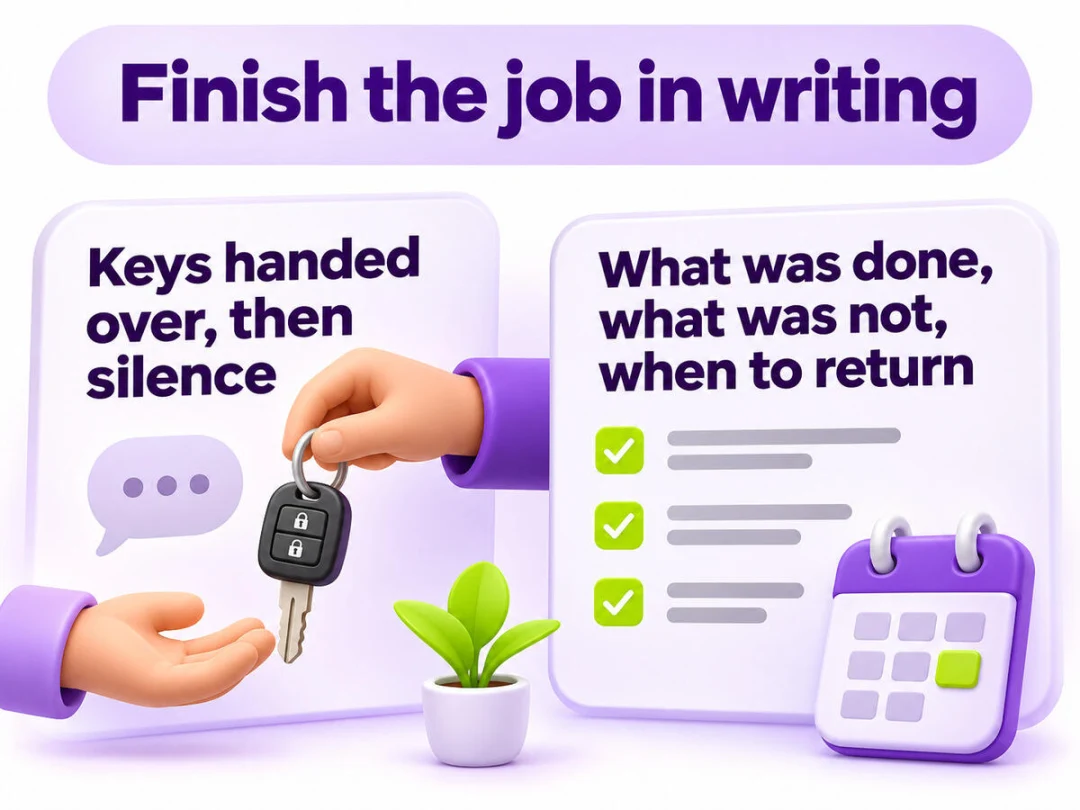
You do not need a long report. You need a short, plain record the person can keep: what you did, what was outside the job, and what is worth watching. Write it in the same language you used when the work was booked, and give it to the person when the work is handed over: in person, in a message, or both.
Do not invent a lifetime promise in order to sound confident. If a part may need another look after a season of driving, say that. If a gallery is complete and a later session would only make sense when the children have grown, say that. A honest limit is easier to trust than a claim that the work will “last forever.”
Say what was done, what was not, and what to watch
A useful handover answers three questions. What did you actually do? What did the client ask about that was not part of this visit? What should the person watch, and on what kind of horizon?
In the fictional shop, that might be: pads replaced, rotors measured and left in place, a note that the rotors should be checked again after a stated interval of driving, and a reminder that a full alignment was not part of this ticket. In the fictional studio, it might be: the agreed gallery delivered, a note that extra prints were not included, and a suggestion that a new session would make sense around a birthday or a school year, not “sometime soon.”
The point is not to upsell at the door. The point is to leave a record the client can use without calling you to reconstruct the visit. If something went wrong and you already made it right, say what you changed so the ending is as clear as the rest of the job.
Finish the job in writing
Make the next visit easy to book
Repeat customers still have to find a way back in. If hours are hard to discover, if the only contact is a generic inbox nobody owns, or if the person does not know what to ask for, a willing client can stall. Making the return visit easy is part of retention, not a separate software project.
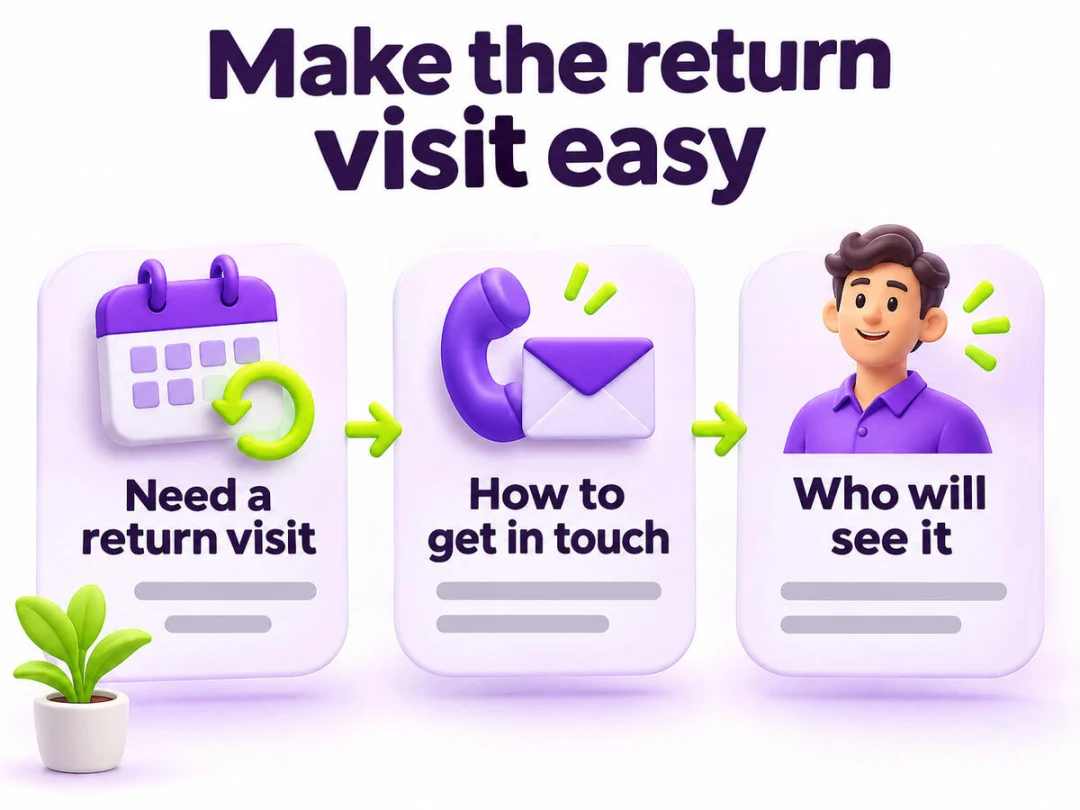
A clear path is enough: when you are available, whom to contact, and how to make a specific request. That path can live on the same service page the person used the first time, in the handover note, or in both. You can keep the details in a notebook, send them in a short message, or say them at pickup. Those are ordinary scenarios, not a reason to buy a new booking tool.
If the public page is vague, a past client has the same problem a new client has. A useful companion to this habit is what to write on a service page: a page that names the work and how to request it helps a returning person as well as a first-time reader. This article does not repeat that writing lesson.
Hours, a named person, and a clear request
Three details remove a lot of the friction. Post or send the hours you actually keep. Name a person or a mailbox that will see the request. Invite a specific request , “brake check after the interval we noted,” “a family session this fall”, rather than “get in touch if you ever need anything.”
If you will be closed for a week, say so before the client writes into silence. If only one person handles scheduling, say who that is. If a request needs a photo, a plate number, or a preferred date, say that once, clearly. The client should not have to invent the process.
A named person matters more than a polished form. A form that nobody reads is not easier than a phone number that goes to the right desk. Choose the channel you will actually answer, and keep it consistent with the page and the handover note.
Make the return visit easy
Invite the next visit without pressure
Once the job is finished and the path back is clear, you can invite the next visit when there is a real reason. Customer retention strategies in a small shop are mostly this: finish clearly, stay reachable, and write when you have something useful to say. That is also how to retain customers you have already served, without a points program and without a series of empty check-ins.
A reminder should help the person decide. It can point back to the note you left at handover: a service interval, a seasonal check, a later session that now makes sense. It should be easy to decline or ignore. If the person asks you to stop, stop. This article is not legal advice; treating a clear request to be left alone as the end of the thread is also basic courtesy.
Do not promise that a set number of messages will bring work back. A quiet month after a finished job is not, by itself, a failure of this habit.
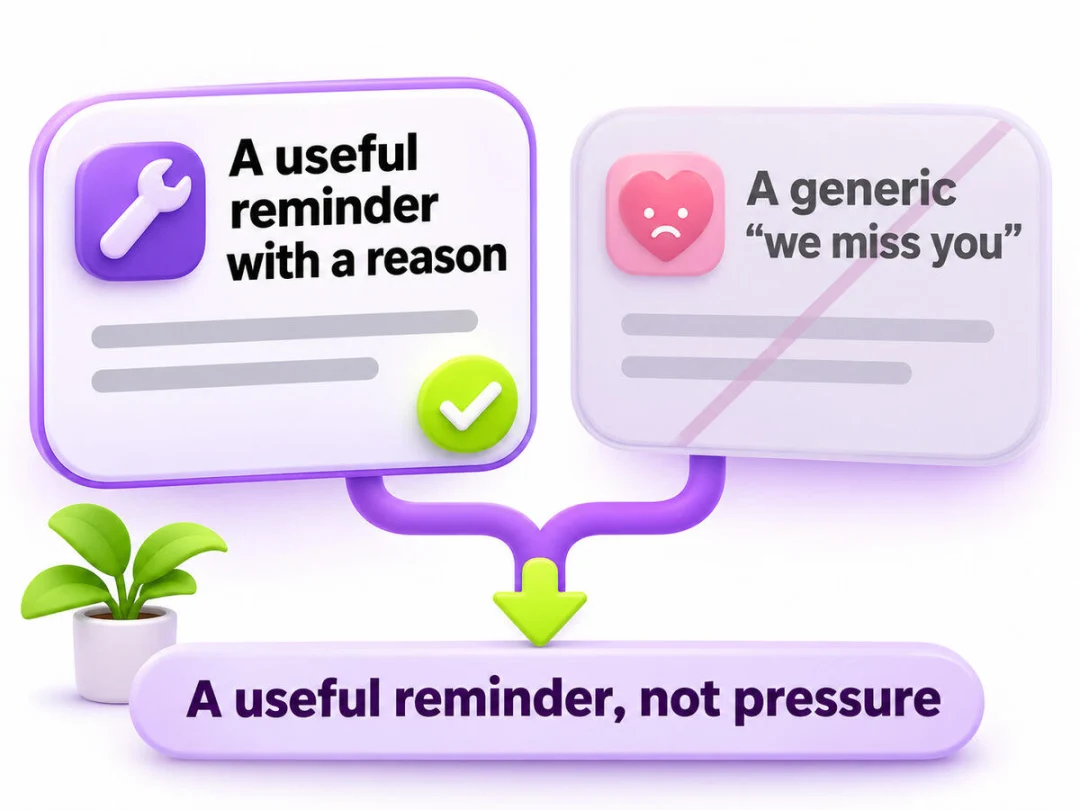
A useful reminder beats a generic “we miss you”
“We miss you” tells the client nothing they can act on. A useful reminder names the work, the reason, and the way to request a visit. “Last October we noted that the rotors should be checked after this kind of driving interval. If you want that look, here is how to request it, and here is who will see the message.” That is a reminder. “It’s been a while: book today!” is pressure without a reason.
The same rule holds for a studio. If you said a later session would make sense when the children had grown, write when that horizon is near, and include how to ask for a date. If you have no such horizon, you may not have a reason to write yet. It is better to wait than to invent a promotion so the calendar is not empty.
Keep the note short. Repeat the useful facts from the handover; do not rewrite the whole job. One clear invitation is enough to start with. If there is no reply, you do not need a longer chain of the same message.
A useful reminder, not pressure
Reviews can support trust, they do not replace follow-through
A public review can help a future client decide, and a thoughtful reply can show that you read what people write. Reviews can also give you a signal when something in the job or the handover was unclear. None of that replaces a finished job, a way to book again, or a useful invitation.
Do not treat a five-star request as the close of the visit, and do not treat a review program as a retention plan. If a past client leaves a comment, read it. If a repair is needed, make the repair. If you reply in public, replies to reviews are a separate skill and are covered in that neighboring article. This guide does not teach you how to collect reviews, how to automate replies, or how to manage a profile.
A review does not, by itself, cause a person to return. It may support trust. The return still depends on whether the last job was clear and whether the next visit is easy to request.
A log, not a loyalty score
A short log of who should hear from you
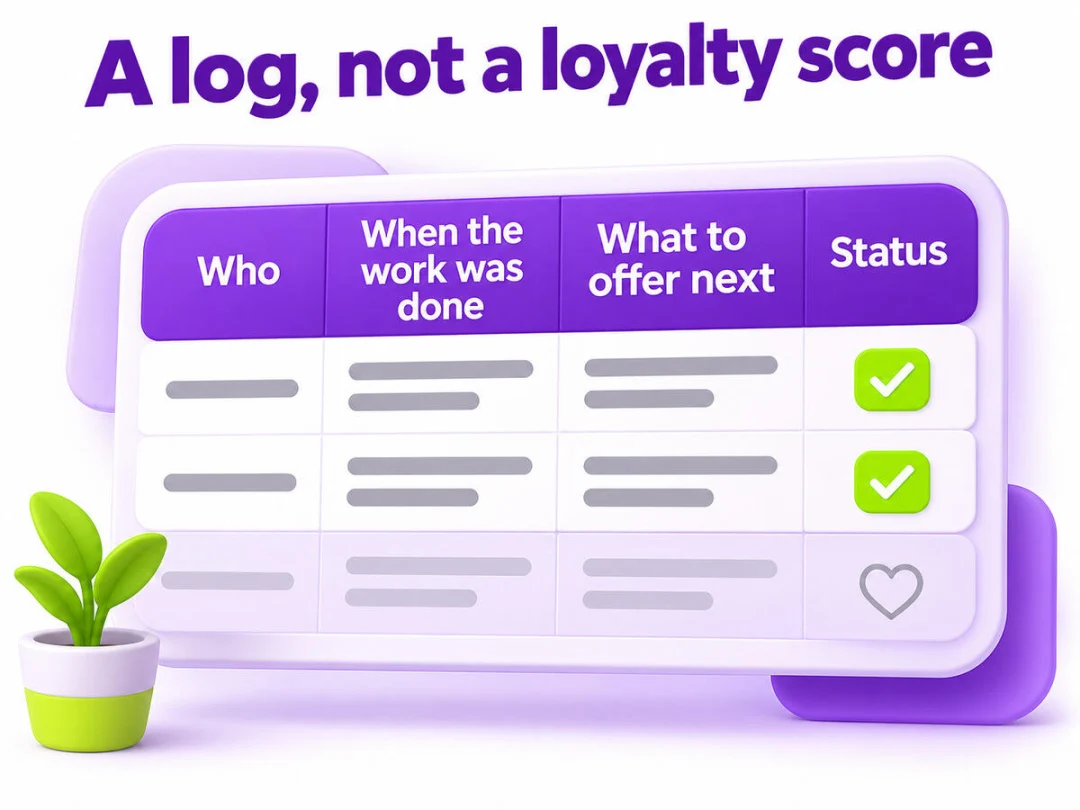
A small shop does not need a dashboard of scores. It needs a short log you will actually keep: who the person is, when the work was done, what later visit might make sense, and whether you have already written. Before you send a reminder, check the log. If there is no real next reason, do not invent one.
The table below is a teaching log for the same fictional studio and shop. The rows are made up. This is not a live roster, not a loyalty score, and not a retention-rate formula.
| Who | When the work was done | What to offer next | Status |
|---|---|---|---|
| Maya, family session | Gallery delivered in October | A later session when the children are a year older | Not contacted yet |
| Jordan, brake job | Pads replaced; rotors measured | A check at the interval noted at pickup | Reminder drafted, not sent |
| “Past client,” no date | Not recorded | A generic “we miss you” | Do not send; there is no reason yet |
The third row is the warning. A name without a date and without a next reason is not a reason to write. The log is there to stop that message, not to fill a quota of contacts.
FAQ
What is customer retention for a small service business?
It means the person you already served can see what was done, know how to return, and, when there is a reason, receive a useful invitation. It is not a second sales pitch, a loyalty program, or a promise that a percentage of clients will come back.
How can I get better at this without starting a loyalty program?
Finish the job in writing, make the next contact easy, and write later only when you have a real reason: a service interval, a gallery that is ready, a seasonal visit that now makes sense. That is how to improve customer retention in a small service shop without adding a points scheme or a new platform.
Is handling a new inquiry the same as keeping past work coming back?
No. Handling a new inquiry is the work of answering someone who has not yet hired you. Retention, as this article uses the word, starts after a completed job. You can keep both in the same notebook; they are still different jobs, and they need different next steps.
How often should I write to people I have already served?
There is no honest universal rhythm. Write when there is a reason that belongs to that person, and stop if they ask you to stop. A useful note tied to the handover is better than a fixed calendar of empty messages. This article does not invent a weekly or quarterly quota.
Do public reviews, by themselves, keep people coming back?
They can support trust and they can show you where a job or a handover was unclear. They do not replace a clear ending to the work or a simple way to request the next visit. Collecting reviews is not the method in this guide, and replies to reviews are a separate skill.
Do I need CRM software to keep past clients coming back?
No, not as a requirement. You need a short list and a next step you will actually keep. A notebook or a simple message log can be enough. This article is not a review of CRM tools and does not point you to a software product.
Repeat work comes from a finished job
For a small shop, this habit is mostly follow-through: end the job clearly, make the return visit easy, and invite it only when you have something useful to say. A quiet inbox after a vague handover will not be fixed by a new tool. Write the ending of the job, keep a short log, and let the next visit be easy to ask for.